Fermilab editor’s note: This article, originally published by MeriTalk, covers a U.S. Department of Energy Genesis Mission event at SC26 in Chicago, where Fermi National Accelerator Laboratory Director Norbert Holtkamp joined DOE Under Secretary for Science Darío Gil for an on-stage discussion. The article highlights Fermilab’s role in the DOE national laboratory initiative to combine super intelligence, high-performance computing and quantum computing to accelerate scientific discovery and advance U.S. leadership in research and innovation.
Washington has assembled its Science Avengers on the Department of Energy Genesis program. This time, the mission isn’t saving the universe. It’s accelerating American scientific discovery – which may well be precisely about saving the universe.
At the center of the action is Energy Department Under Secretary Darío Gil, our own Tony Stark — a technology visionary with an ambitious plan to bring America’s scientific superpowers together around a common mission. Like Stark, Gil sees the intersection of technology, imagination, and engineering as an opportunity to accomplish things that once seemed impossible – he’s even got the cool glasses.
So, the script was set for the MeriTalk-Argonne Labs-Puls AIQ Chicago gathering at SuperComputing 26, An Evening with Darío Gil: The Genesis Mission — What’s New and What’s Next? Gil laid out an extraordinary proposition.
“We spend $1 trillion a year in R&D,” Gil told the audience. “The ultimate goal that we have with the Genesis Mission is to double the productivity and impact of that trillion dollars within a decade.”
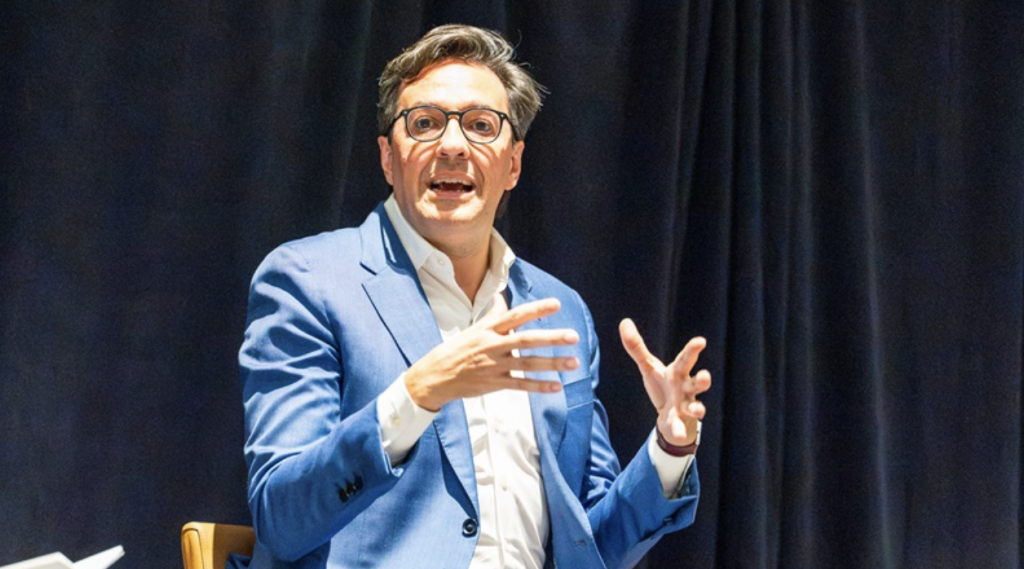
The assembled, standing-room-only crowd of 200+ national lab, industry, and international science execs responded to Gil with applause and hoots of support.
That’s not just an ambitious technology objective. It’s a fundamental rethink of how America approaches scientific research – and humanity’s trajectory. Genesis is a new kind of public-private super science innovation incubator. National labs, universities, and industry create team applications for Energy funding. Teams typically retain ownership of inventions, while the government gets use rights.
Three superpowers, one mission
The Genesis playbook brings together three capabilities: high-performance computing, artificial intelligence, and quantum computing. “These are the three legs that we seek to both unify and make available at an unprecedented scale to all scientists and engineers across the United States and with our collaborators around the world to be able to accelerate progress,” Gil said.
He spotlighted Genesis year-one traction. “We received more than 5,000 proposals and initiated a portfolio of 297 projects spanning energy, physical sciences, national security, space, health, and biology in all 50 states,” he explained. “These projects brought together more than 70 institutions and secured $2.5 billion in partner computing resources and technology contributions.”
National labs, universities, and industry
Fermilab Director Norbert Holtkamp and Argonne National Laboratory Director Paul Kearns joined Gil and MeriTalk’s Steve O’Keeffe on stage for an executive panel conversation. The program also featured representatives from Dell Technologies, HPE, Google, and IQM.
The eclectic speaking program reflects the different strengths of the Energy-Labs-Industry-University-International team. National laboratories contribute research facilities and scientific expertise; industry brings computing platforms, models, tools, and engineering capacity; universities train researchers and develop new talent.
Holtkamp said the laboratories have long worked together to build major scientific facilities. “Genesis can extend that collaboration by giving researchers incentives and resources to work across institutional lines,” Holtkamp explained. “The only way forward for us to do more with less is to use common resources more efficiently … we have to use these tools.”
In a quick-fire exchange, Holtkamp named one cross-laboratory ambition in four words: “Make quantum computing work.”
Argonne Labs’ Kearns, a biologist by training, pointed to the potential of using computing to understand molecules and develop new materials. “My ask to industry is bring us the toughest problems you’ve got, and we’d love to work with you to find a solution,” Kearns observed.
Defining success
Gil and the national lab directors resisted temptation to define Genesis success against a single moonshot outcome. “The mission’s challenge portfolio includes work in fusion energy, advanced nuclear power, materials science, national security, space, biology, and pediatric cancer,” Gil said. “Genesis shared capabilities should help researchers pursue discoveries across fields, with some moving faster than others.”
“Our objective is to give enough compute to the whole community that scientists are not limited by that,” said Gil. “They should only be limited by their imagination and their capability to carry their work — we don’t want compute scarcity to inhibit progress.”
“The mission’s long-term success will depend on continued execution and bipartisan work with Congress, which is an indispensable partner in making Genesis endure,” Gil said. “We want institutions to see themselves as active participants in shaping the work. My biggest desire would be that … each institution feels I’m part of this. It’s not happening to me. I have agency.”
“It’s about creating shared scientific infrastructure that allows America’s best minds to work together, access unprecedented computing resources, and move discoveries from the laboratory into the real world faster,” said Gil in closing.
Genesis is, by definition, about creation. Iron Man himself would respect Gil’s ambition.
Industry innovators
Industry partners stepped to the microphone to applaud the Genesis vision and pledge support.
“At Dell, we see data as essential to discovery — we’re partnering with Nvidia on infrastructure for AI, simulation, and modeling,” said Carroll. “We believe data is the fuel that is going to power discovery.”
Dan Carroll, Dell Technologies federal chief technology officer
“We work closely with the Department of Energy and national laboratories, including work in exascale computing,” said Wisnieski. “Progress should remain the measure of success. I’m passionate about driving science and engineering.”
Bob Wisniewski, chief architect and fellow, HPC and AI, HPE
“We’re working with Energy and the Labs to provide support across our full portfolio, from compute to tools such as AlphaFold, AlphaGenome, and AlphaEvolve,” Sell said. Addressing gathered national lab scientists, he noted. “If you have questions or you want to get up on the board and run it, please feel free to reach out. We’re here to help.”
Dustin Sell, principal architect, Google
Goetz brought an international perspective to the discussion. “Science and advanced computing depend on global collaboration and supply chains,” said Goetz. “Science doesn’t know any borders. The laws of physics are the same around the globe.” He observed IQM is working with U.S. national laboratories and universities and pointed to initiatives in workforce development, including a hackathon supported by Argonne and Northwestern University.
Dr. Jan Goetz, CEO and co-founder, IQM