Each year at Fermi National Accelerator Laboratory, the guest artist and composer program, funded by Fermi Forward Discovery Group, facilitates creative collaborations with scientists and engineers to make Fermilab’s scientific exploration more accessible.
“I want to gather the data, see what’s interpreted from it and transfer that to a visual plane.”
Visual artist Eleftheria Lialios
When studying the universe at its smallest scales, researchers at Fermilab rely on massive detectors that translate unseeable subatomic particles into data that researchers can interpret. They use graphs, tables and charts to represent the signals from the detectors, but artists’ creative perspectives can present this science in imaginative and unexpected ways that resonate with the public.
“Music is the most abstract of the art forms; it takes place in time.”
Composer Isaac Smith
In 2026, guest artist Eleftheria Lialios and guest composer Isaac Smith will bring their distinctly creative viewpoints to translate complex scientific concepts into immersive multisensory experiences.
A selection committee composed of Fermilab scientific staff and public engagement staff evaluates applicants to the program based on their creative and academic backgrounds and their enthusiasm for immersing themselves in Fermilab’s scientific work.
“Our artists and guest composers create works rooted in science that inspire and provoke thought,” said Georgia Schwender, Fermilab visual arts coordinator.
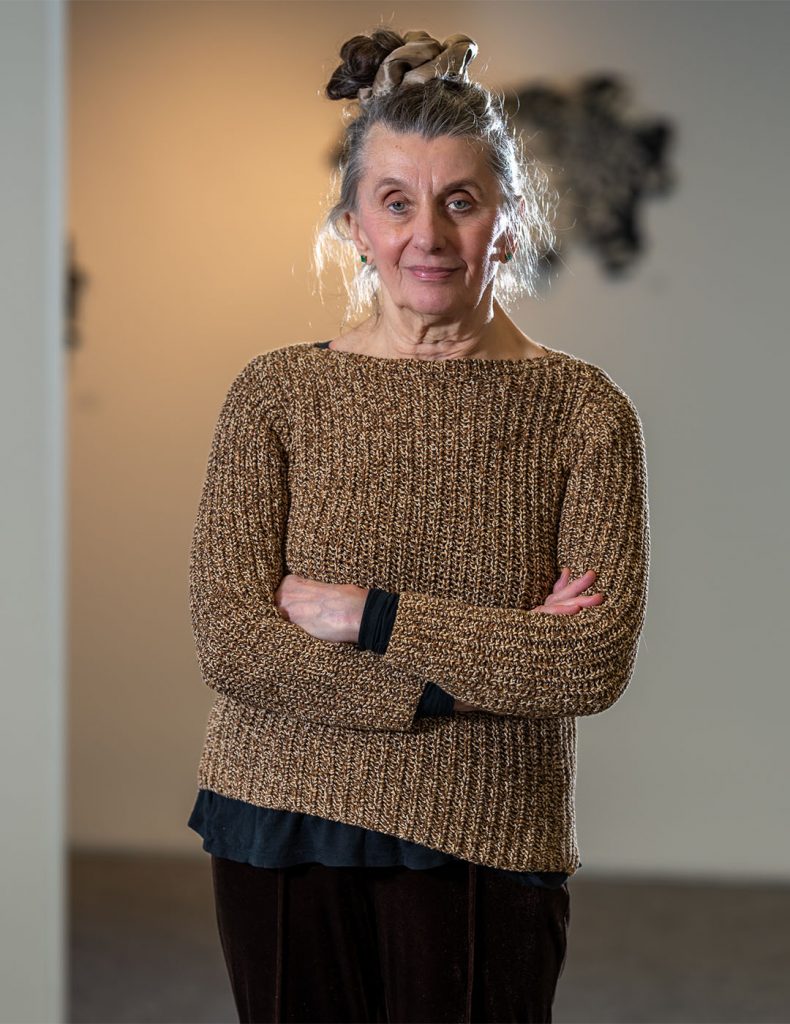
Eleftheria Lialios — Guest Artist
Visual artist Eleftheria Lialios brings a deeply personal and historical approach to her work, with roots in psychology, anthropology and photography. At Fermilab, she is interested in how scientific data, particularly from cosmic ray telescopes and particle accelerators, can be transformed into engaging visual experiences.
“Everyone interprets art based on who they are; that’s the individuation of art,” Lialios said. “I want to gather the data, see what’s interpreted from it and transfer that to a visual plane.”
Her process is immersive and tactile. She has created large-scale transparencies, installations and even sculptural works based on photographic imagery. At Fermilab, she hopes to leverage Fermilab’s scientific tools and resources to create new visual narratives that blend scientific observation with artistic intuition.
Isaac Smith — Guest Composer
Isaac Smith, with a background in both mathematics and music, sees a natural harmony between scientific abstraction and musical expression.
“Music is the most abstract of the art forms; it takes place in time,” he said. “When you relate to what’s going on in STEM, no human has seen a neutrino or a proton. We detect the remnants or traces of these things. Music lets you dig into the emotional or spiritual content of that abstraction.”
Smith, who holds a doctorate in music composition and works in the Musicology and Music Theory Office at Indiana University, has long been fascinated by the elusive nature of neutrinos. His upcoming work at Fermilab will focus on data sonification — transforming scientific data into sound.
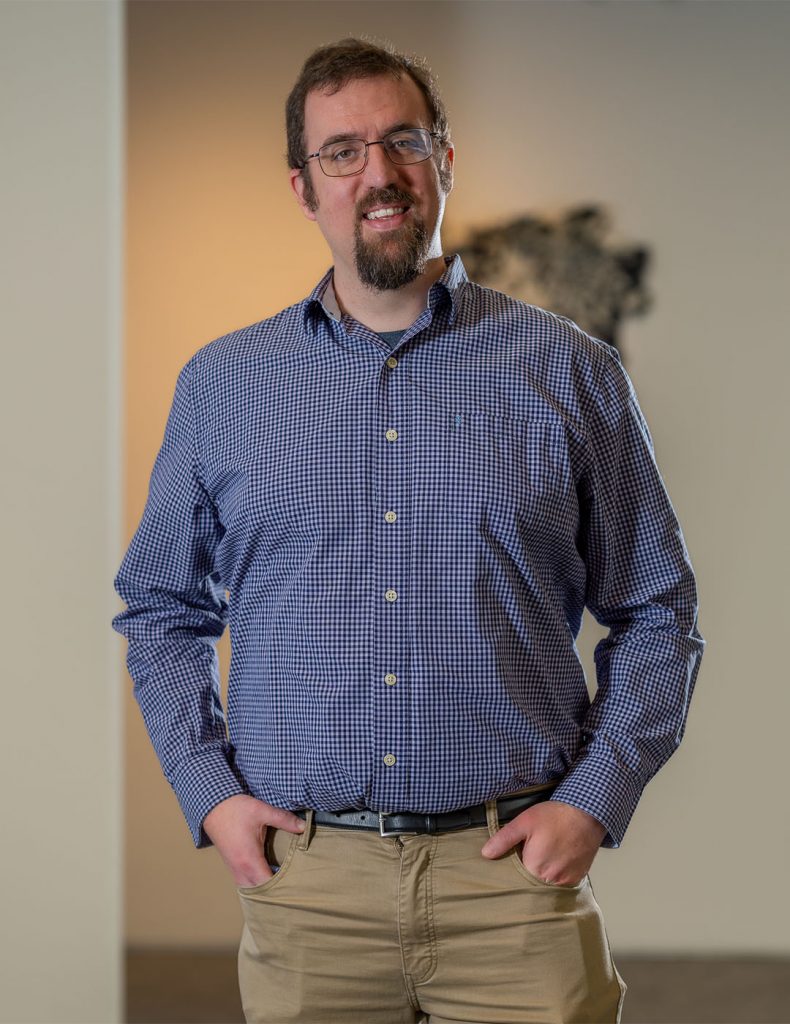
Smith said he is particularly interested in how music can embody the joy, curiosity and wonder that scientists feel when exploring the unknown.
“The big thing I’m going to try to do initially is connect with the scientists,” Smith explained. “I aim to understand what they’re doing and what they’re excited about. I want to form a relationship with them and get my feet under me in terms of connecting with the scientific data.”
Lialios and Smith will work throughout the year, and in the latter half of 2026, the public will be able to experience their creations firsthand in Fermilab’s Wilson Hall.
Fermi National Accelerator Laboratory is America’s premier national laboratory for particle physics and accelerator research. Fermi Forward Discovery Group manages Fermilab for the U.S. Department of Energy Office of Science. Visit Fermilab’s website at fnal.gov and follow us on social media
Recommended reading
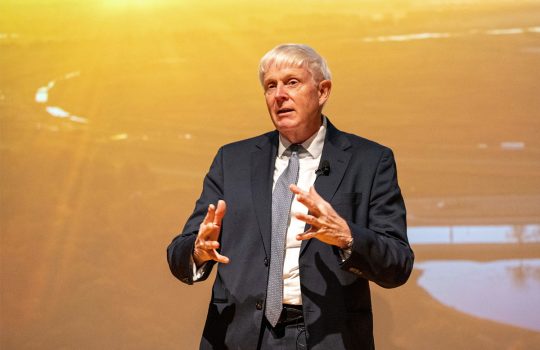
Norbert Holtkamp appointed director of Fermi National Accelerator Laboratory
Norbert Holtkamp brings deep scientific and operational expertise to Fermilab, having managed large scientific projects throughout his career.
Amy Nam named 2025 Fermi Forward Discovery Group Guest Composer
Amy Nam, the 2025 Fermi Forward Discovery Group Guest Composer, will use her musical talents to transform complex physics concepts from research at Fermilab into accessible auditory experiences for the public. Through her project, “The Harp Inside Schrödinger’s Box,” Nam aims to blend original harp music and spoken word to both educate and engage new audiences with quantum physics research.
Jelena Berenc named 2025 Fermi Forward Discovery Group Guest Artist
Jelena Berenc is the Fermi Forward Discovery Group 2025 Guest Artist at Fermilab, where she will collaborate with scientists to create artwork inspired by their research. Her innovative approach, called information realism, allows her to explore complex scientific concepts through visual language, offering the public a unique perspective into the work at Fermilab.