Daniel Bafia will develop a new measurement approach that uses magnetic vortices to investigate defects and interfaces that can limit the performance of superconducting quantum devices. The project could provide researchers with a new way to understand and ultimately reduce sources of energy loss in quantum materials.
Daniel Bafia, an associate scientist at the U.S. Department of Energy’s Fermi National Accelerator Laboratory, has received a DOE Early Career Award to investigate the microscopic defects that can limit the performance of superconducting quantum devices. His project aims to harness magnetic vortices – a characteristic feature of certain superconductors and a common source of energy loss – as a tool to probe otherwise hidden defects in superconducting materials.
Superconducting materials are essential to many quantum technologies because they can preserve quantum information with exceptionally low energy loss. But even in high-performing devices, microscopic features within the materials and at their interfaces can contribute to microwave dissipation and impact device performance.
Researchers can measure microwave loss in a superconducting device, but directly determining which defects cause that loss remains difficult. Bafia’s project proposes a unique approach: investigating whether magnetic vortices can be used to probe what he calls the “hidden defect landscape” within superconducting materials.
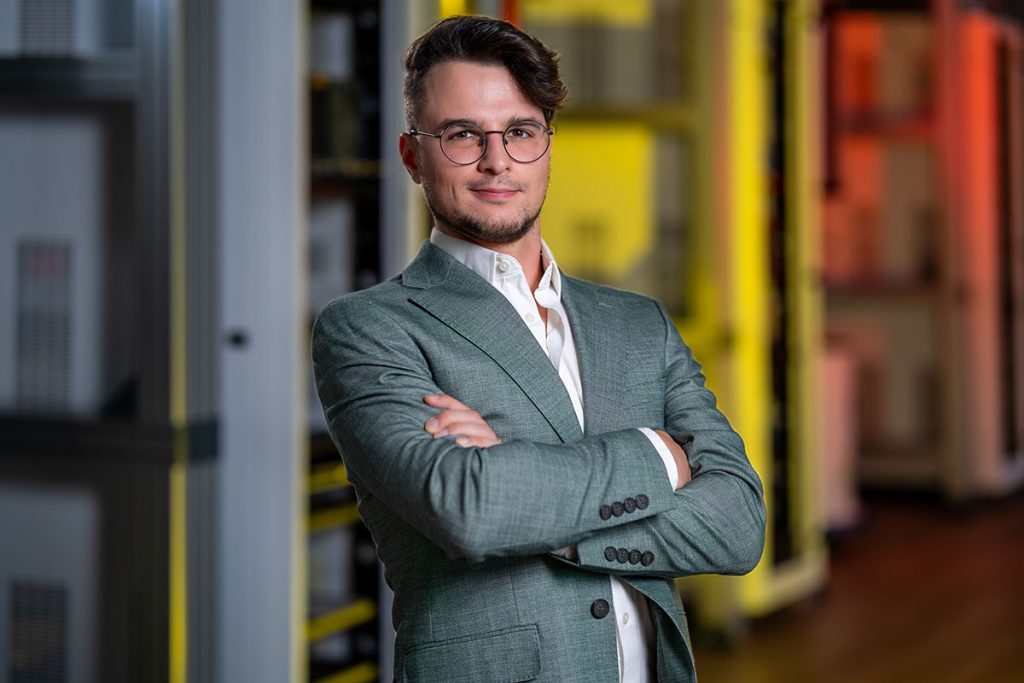
Daniel Bafia is an associate scientist at Fermilab. Credit: JJ Starr, Fermilab
“I want to identify what is presently limiting the performance of our qubits,” Bafia said. “What I’m doing is developing a new measurement framework to understand where these sources of energy loss are coming from.”
Magnetic vortices can form in type II superconductors, including materials such as niobium and tantalum, when magnetic flux penetrates the material in its superconducting state. Each vortex carries a tiny amount of magnetic flux through the superconductor. At its center, superconductivity is suppressed and the material behaves more like a normal conductor, while superconducting currents circulate around the core.
Those vortices interact with defects in the surrounding material, which can pin them in place. By measuring how trapped vortices contribute to radio-frequency dissipation, Bafia wants to determine whether different defect environments produce distinguishable signatures.
“Rather than treating vortices as another source of unwanted loss, my goal is to explore whether their interactions with defects and interfaces can become a new tool for characterizing superconducting materials.”
Daniel Bafia
“My job is to figure out what the connection is between the defects and the vortices,” said Bafia. “Rather than treating vortices as another source of unwanted loss, my goal is to explore whether their interactions with defects and interfaces can become a new tool for characterizing superconducting materials.”
The work builds on more than a decade of Fermilab research into trapped magnetic flux in niobium superconducting radio-frequency (SRF) cavities for particle accelerators, along with extensive experience in materials and magnetic characterization. Those capabilities provide a foundation for extending techniques developed through accelerator-focused SRF research to investigate materials challenges in superconducting quantum devices.
The project also connects directly to the goals of the Superconducting Quantum Materials and Systems Center, one of five DOE National Quantum Information Science Research Centers. If Bafia can establish a relationship between vortex behavior, the underlying defect landscape, and qubit performance, the framework could provide a new way to characterize sources of dissipation that researchers have not been able to isolate directly.
“If we can link vortex pinning to energy loss, it could provide a new way to understand the defects that limit materials for superconducting quantum computers,” Bafia said.
Fermi National Accelerator Laboratory is America’s national laboratory for particle physics and accelerator research. Fermi Forward Discovery Group manages Fermilab for the U.S. Department of Energy Office of Science. Visit Fermilab’s website at www.fnal.gov and follow us on social media.
The Superconducting Quantum Materials and Systems Center at Fermilab is supported by theDOE Office of Science.
The Superconducting Quantum Materials and Systems Center is one of the five U.S. Department of Energy National Quantum Information Science Research Centers. Led by Fermi National Accelerator Laboratory, SQMS is a collaboration of more than 30 partner institutions — national labs, academia and industry — working together to bring transformational advances in the field of quantum information science. The center leverages Fermilab’s expertise in building complex particle accelerators to engineer multiqubit quantum processor platforms based on state-of-the-art qubits and superconducting technologies. Working hand in hand with embedded industry partners, SQMS will build a quantum computer and new quantum sensors at Fermilab, which will open unprecedented computational opportunities. For more information, please visitsqmscenter.fnal.gov.
Building on her earlier work with quantum amplifiers for a leading dark matter experiment, Rakshya Khatiwada will use a four-qubit entangled system to test whether it offers a sensing advantage when exposed to a simulated dark matter signal. The project, based at Fermilab, could open the door to detecting dark matter candidates such as axions and dark photons.
Two new awards will expand Fermilab’s critical role in the Genesis Mission by developing custom microelectronics and advancing quantum information science.
A first-of-its-kind blinded materials characterization study spanning 22 superconducting quantum devices, seven characterization techniques and six leading institutions helps build the scientific foundations of scalable quantum computing.