
Knowing the when and where of subatomic particle interactions inside a detector is essential for physicists to understand exactly what happened, what kind of particles were involved, and to tell one signal from another. Future high-energy physics experiments will require detectors that can track an unprecedented number of signals from particles while distinguishing between signals occurring only trillionths of a second apart. This feat will depend on custom-made, innovative electronics and sensors that quickly and precisely determine when and where particles pass.
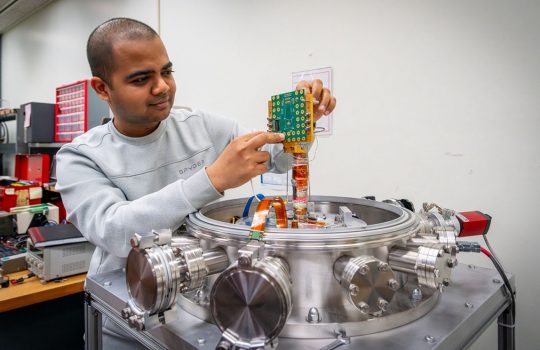
To help meet this challenge, a team at the U.S. Department of Energy’s Fermi National Accelerator Laboratory, led by scientist Artur Apresyan, developed a new, ultrafast readout chip called the Fermilab Constant Fraction Discriminator, or FCFD.
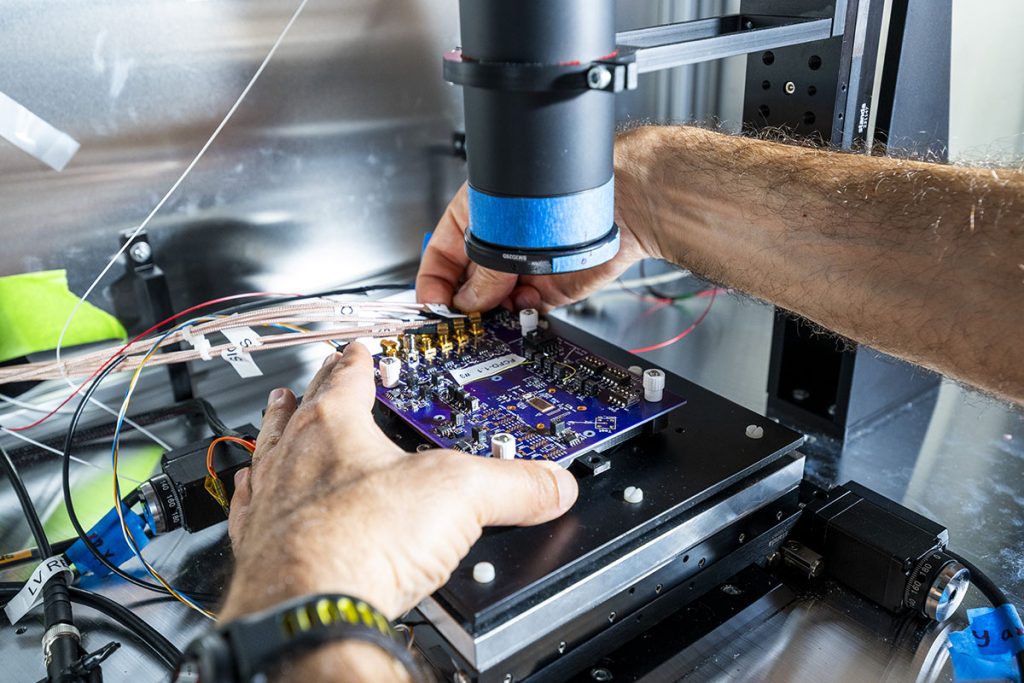
FCFD uses an algorithm called constant fraction discrimination to determine the exact time a signal arrives, independent of its size — basically, a stopwatch for particle detection.
This custom chip translates signals from particles passing through the detector into measurable, analyzable data at levels of timing and position accuracy never achieved before.
As described in a paper recently published in Nuclear Instruments and Methods in Physics Research, researchers from Fermilab, California Institute of Technology and Lawrence Berkeley National Laboratory tested the FCFD chip at particle test beams against stringent performance requirements of the Electron-Proton/Ion Collider detector, or ePIC, the first experiment planned to run at the Electron-Ion Collider at Brookhaven National Laboratory in the mid-2030s.
State-of-the-art detectors like ePIC will need precise timing to determine particle times of flight — how long it takes a particle to travel through the detector. Using the FCFD chip, scientists reached a timing accuracy of about 40 picoseconds (40 trillionths of a second) and narrowed particle position precision to within 15 micrometers — about one-fifth the width of a human hair. This measurement precision allows experimenters to identify the type of particle, whether it is a proton, kaon or pion. Distinguishing between these particles helps scientists understand what they are made of, how they behave and how they transform into the matter we can see.
“Smartphones scanning for facial recognition are doing the same time-of-flight types of measurements as in FCFD. In that case, it measures how long it takes for light to bounce off your nose versus your eyes,” said Apresyan.
Fermilab designed the FCFD to be immune to an effect called time-walk. Signals with higher-amplitude trigger the sensor faster while lower-amplitude signals have a slight delay, hindering timing accuracy and requiring constant calibration and extra work and processing to correct it. The constant fraction discrimination algorithm used by FCFD automatically corrects for this.
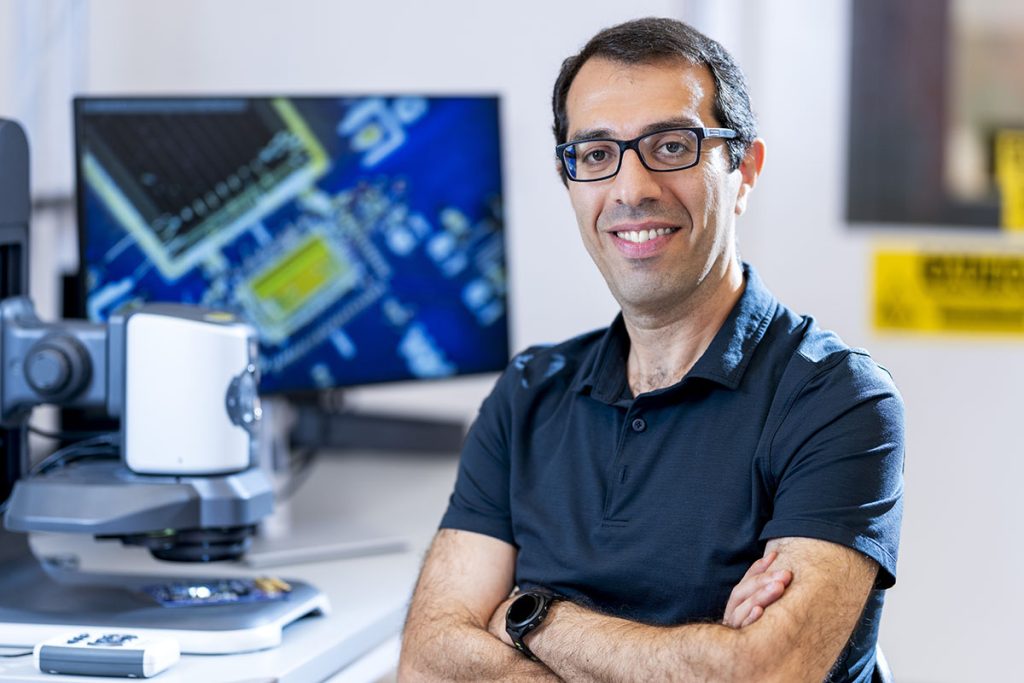
“Constant fraction discrimination compensates for variation in signal amplitude at the electronics level, eliminating time walk effects,” said Si Xie, a scientist at Fermilab who worked on this research. “This means you can get rid of the extra bells and whistles — all the calibration, extra work and processing. It greatly simplifies everything downstream.”
FCFD is optimized to work with special silicon sensors often used in particle physics called AC-coupled low-gain avalanche diodes, or AC-LGADs. These sensors are capable of tracking exactly where and when a particle passes through a detector. When that happens, the sensor creates a tiny electrical signal, amplifies that signal and distributes it to nearby strip sensors.
“Basically, you have this strip sensor with different channels, or antennas,” said Fermilab scientist Shuoxing Wu, who is also part of the research team. “If a particle passes between the first and second strips, you can measure how strong the signal is on each and take a weighted average to determine the position.”
While the initial version of the chip was a proof of concept based on a single channel to perform only time measurement, the latest version was expanded to six channels and also to perform position measurements. As a result of their initial success, scientists at the Electron-Ion Collider approached Fermilab to develop a full, 32-channel FCFD chip for the ePIC detector.
“It was a perfect match because we understand the sensors very well. We developed them. And we understand how to develop the timing chip,” said Apresyan.
“The FCFD chip development is a great example of Fermilab’s mission in action.”
Artur Apresyan, Fermilab scientist
Fermilab has decades of experience designing application-specific integrated circuits as well as developing precision timing detectors, both on the detector and the readout side. In particle physics, this technology can be used to develop quantum sensors, where rapid measurement and readout of quantum states are required, or for beyond-collider physics.
“The FCFD chip development is a great example of Fermilab’s mission in action. We’re helping create world-leading detectors as well as developing innovative technologies for particle physics that can serve society,” said Apresyan.
“Our experience, expertise and infrastructure will allow us to do a lot more in the future. Fast timing development is very synergistic and crosses boundaries,” he added. Now that FCFD is proven to meet the needs of the ePIC experiment, the research team is extending the design to a full-sized chip, expected to be complete in late 2027.
This research is funded by the U.S. Department of Energy Office of Nuclear Physics DOE-NP.
Fermi National Accelerator Laboratory is America’s national laboratory for particle physics and accelerator research. Fermi Forward Discovery Group manages Fermilab for the U.S. Department of Energy Office of Science. Visit Fermilab’s website at www.fnal.gov and follow us on social media.
Recommended reading
Fermilab to lead two new Genesis Mission awards to accelerate development of microelectronics and quantum
Two new awards will expand Fermilab’s critical role in the Genesis Mission by developing custom microelectronics and advancing quantum information science.
Using AI, Fermilab researcher probes how transistors behave in extreme cold
Olivia Seidel’s work draws on Fermilab’s deep expertise in microelectronics and cryogenic devices to support key goals of the Genesis Mission — a sweeping U.S. Department of Energy artificial intelligence initiative.
Fermilab leads multi-lab AI initiative to accelerate design of chips used in extreme environments
Researchers with Department of Energy national laboratories are working together alongside industry collaborators to support Genesis Mission goals by using the power of artificial intelligence to significantly reduce design times of custom computer chips for use in extreme temperature, high-radiation and ultra-fast environments.