
As private industry races to develop fusion energy into a reliable power source, what role can Fermi National Accelerator Laboratory and the other U.S. national laboratories play in harnessing this promising energy technology for the benefit of society? That question was a key topic of discussion on Oct. 13 at Fermilab with national laboratory and industry leaders.
Fusion occurs when light atomic nuclei, typically isotopes of hydrogen, combine to form a heavier nucleus, releasing energy. Researchers are working to harness this process as a potential source of abundant, low-carbon energy. However, significant scientific and engineering challenges remain in sustaining fusion reactions and in developing the technologies needed to convert the energy released by fusion into usable electricity.
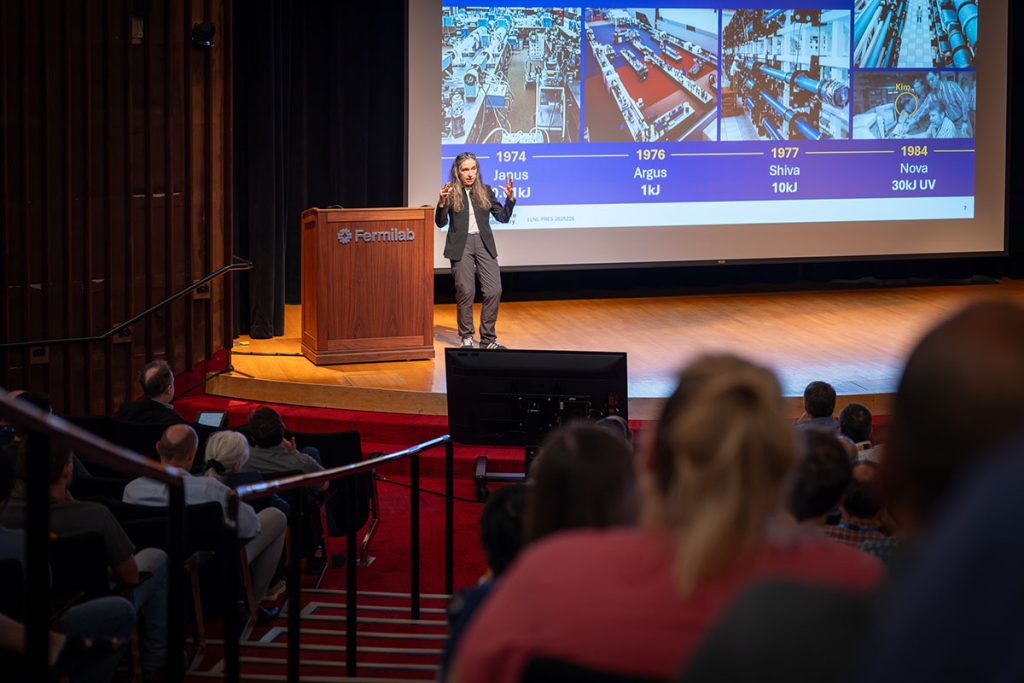
To date, the National Ignition Facility at the U.S. Department of Energy’s Lawrence Livermore National Laboratory in California is the only facility to have achieved fusion ignition in a laboratory setting. NIF uses powerful lasers to compress and heat a small fuel capsule. At NIF, ignition occurs when a fusion experiment produces more energy than the laser energy delivered to its target. During the event, LLNL Director Kim Budil gave a presentation on NIF’s history and the current state of fusion research.
“It’s very different to make power than do a science experiment,” Budil said.
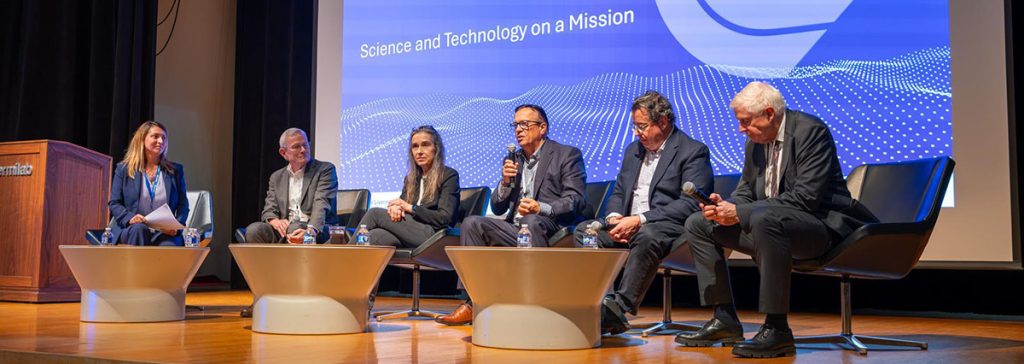
Even so, Budil expressed optimism about the path ahead. She pointed to scientific breakthroughs, advances in technologies such as lasers and superconducting magnets, and growing private-sector investment as signs of progress.
Although companies are pursuing different approaches to fusion, many face common technical challenges, including understanding how materials and components will perform under the extreme conditions inside a fusion system. Joe Hoagland, associate laboratory director for the Fusion and Fission Energy and Science Directorate at Oak Ridge National Laboratory, discussed the need for better information about how materials respond to these environments and how long they can withstand them.
The national labs’ role
National laboratories can help address these challenges by bringing their specialized facilities, scientific expertise and technical capabilities to bear on problems that extend across different approaches to fusion energy development.
The national laboratories “can team collectively and also with industry, to help understand where the challenges are and bring our expertise to solve them,” said Argonne National Laboratory Director Paul Kearns during the panel discussion. “Taxpayers have made a tremendous investment across the national lab complex over the last 80 years,” Kearns said. “So we have a lot of data and a lot of know-how. We also have some unique facilities that could help provide needed information to support fusion energy development.”
What Fermilab could contribute
Director of Fermilab Norbert Holtkamp said during the panel discussion that Fermilab could contribute to addressing the critical challenge of producing fuel for future fusion reactors. Holtkamp described how particle accelerator technology can produce neutrons, which can be used to breed tritium from lithium. Tritium is one of the fuels used in the leading deuterium-tritium fusion approach, and securing a reliable supply will be a key challenge for future fusion power plants.

Currently, Fermilab is building the Proton Improvement Plan-II, a powerful accelerator that will use superconducting radio-frequency technology to provide high-intensity proton beams for the laboratory’s particle physics program. More work is needed to determine how Fermilab’s accelerator expertise and related technologies could support specific fusion applications.
Fermilab could also contribute its expertise in superconducting magnets, a key technology for several approaches to fusion energy. The laboratory has decades of experience developing superconducting magnets for scientific research and is expanding its work on high-temperature superconductors. Fermilab is also developing MAGNES, a facility to test high-current superconducting cables in a high-background magnetic field. This facility will enable researchers and fusion developers to evaluate technologies for future applications.
A long-term goal worth pursuing
Commercial fusion power remains a longer-term goal, with significant scientific, engineering and deployment challenges still to overcome. But panelists said it is fusion’s benefits that make continued research and development worthwhile. Frank Laukien, founder and chair of Gauss Fusion, highlighted the potential safety and nonproliferation advantages of fusion compared with conventional nuclear fission and described it as a promising long-term source of energy.
Budil also pointed to fusion’s prospective national security benefits, including the capability of diversifying energy supplies and reducing dependence on geographically concentrated resources.
“It’s worth doing,” Budil said of fusion energy. “It’s plausible, but it’s going to take a lot of hard work.”
Fermi National Accelerator Laboratory is America’s national laboratory for particle physics and accelerator research. Fermi Forward Discovery Group manages Fermilab for the U.S. Department of Energy Office of Science. Visit Fermilab’s website at www.fnal.gov and follow us on social media.
Recommended reading
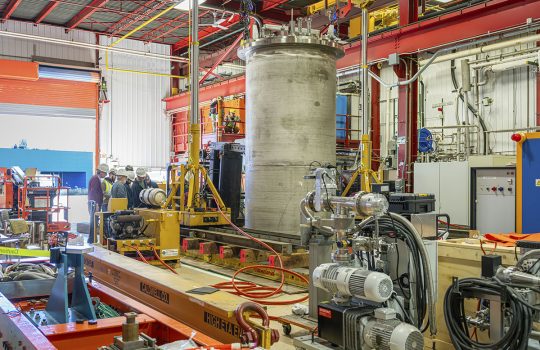
Physics and fusion research advances through Fermilab’s MAGNES
Fermilab’s long legacy of pioneering superconducting magnet technology is entering a new chapter with the launch of the MAGNet Environment Simulator. The test platform will support cutting-edge research aimed at enabling the powerful magnets needed for future fusion energy systems.

National laboratory and industry leaders to discuss the future of fusion at Fermilab
Leaders from U.S. national laboratories and industry will come together at Fermilab on October 13 to participate in a special public evening focused on the future of fusion energy.