Editor’s note: Members of the CDF collaboration will give a scientific presentation with details about their measurement on Friday, April 8, at 4 p.m. CDT. Click here for more information and registration.
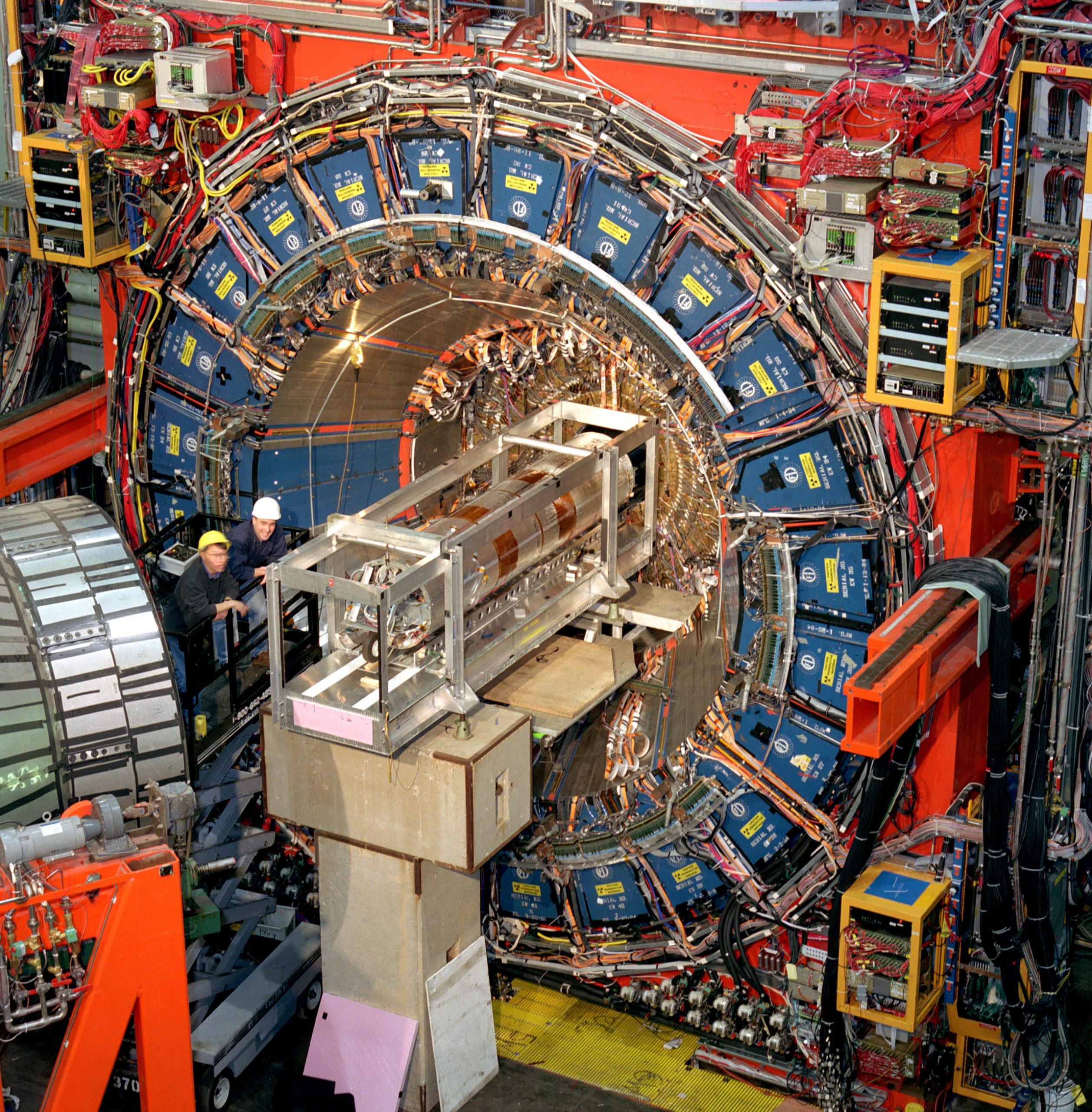
The Collider Detector at Fermilab recorded high-energy particle collisions produced by the Tevatron collider from 1985 to 2011. About 400 scientists at 54 institutions in 23 countries are still working on the wealth of data collected by the experiment. Photo: Fermilab
After 10 years of careful analysis and scrutiny, scientists of the CDF collaboration at the U.S. Department of Energy’s Fermi National Accelerator Laboratory announced today that they have achieved the most precise measurement to date of the mass of the W boson, one of nature’s force-carrying particles. Using data collected by the Collider Detector at Fermilab, or CDF, scientists have now determined the particle’s mass with a precision of 0.01% — twice as precise as the previous best measurement. It corresponds to measuring the weight of an 800-pound gorilla to 1.5 ounces.
The new precision measurement, published in the journal Science, allows scientists to test the Standard Model of particle physics, the theoretical framework that describes nature at its most fundamental level. The result: The new mass value shows tension with the value scientists obtain using experimental and theoretical inputs in the context of the Standard Model.
“The number of improvements and extra checking that went into our result is enormous,” said Ashutosh V. Kotwal of Duke University, who led this analysis and is one of the 400 scientists in the CDF collaboration. “We took into account our improved understanding of our particle detector as well as advances in the theoretical and experimental understanding of the W boson’s interactions with other particles. When we finally unveiled the result, we found that it differed from the Standard Model prediction.”
If confirmed, this measurement suggests the potential need for improvements to the Standard Model calculation or extensions to the model.
Scientists have now determined the mass of the W boson with a precision of 0.01%. This is twice as precise as the previous best measurement and shows tension with the Standard Model.
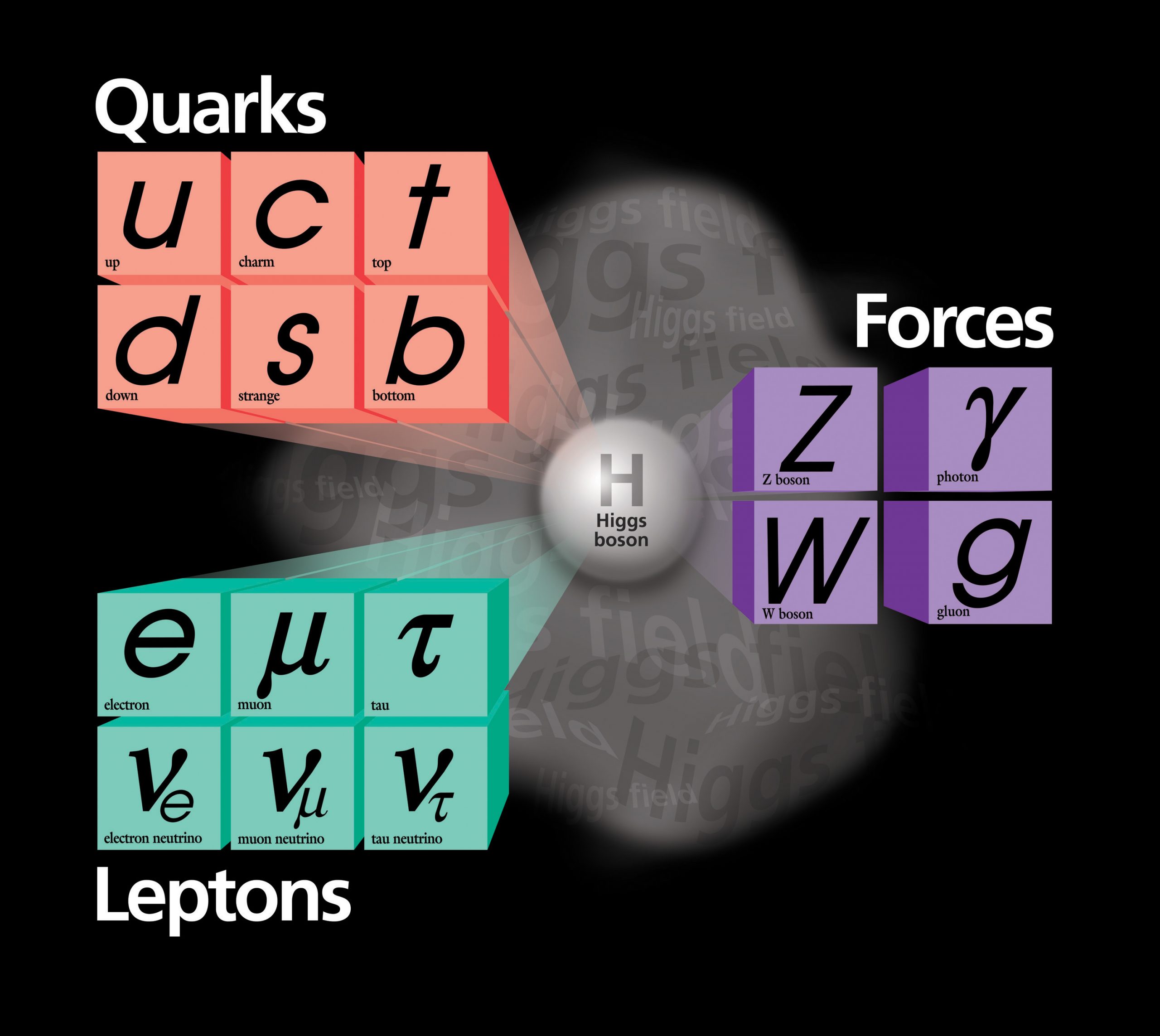
The W boson is the messenger particle of the weak nuclear force. It is responsible for the nuclear processes that make the sun shine and particles decay. CDF scientists are studying the properties of the W boson using data they collected at the Tevatron Collider at Fermilab.
The new value is in agreement with many previous W boson mass measurements, but there are also some disagreements. Future measurements will be needed to shed more light on the result.
“While this is an intriguing result, the measurement needs to be confirmed by another experiment before it can be interpreted fully,” said Fermilab Deputy Director Joe Lykken.
The W boson is a messenger particle of the weak nuclear force. It is responsible for the nuclear processes that make the sun shine and particles decay. Using high-energy particle collisions produced by the Tevatron collider at Fermilab, the CDF collaboration collected huge amounts of data containing W bosons from 1985 to 2011.
CDF physicist Chris Hays of the University of Oxford said, “The CDF measurement was performed over the course of many years, with the measured value hidden from the analyzers until the procedures were fully scrutinized. When we uncovered the value, it was a surprise.”
The mass of a W boson is about 80 times the mass of a proton, or approximately 80,000 MeV/c2. CDF researchers have worked on achieving increasingly more precise measurements of the W boson mass for more than 20 years. The central value and uncertainty of their latest mass measurement is 80,433 +/- 9 MeV/c2. This result uses the entire dataset collected from the Tevatron collider at Fermilab. It is based on the observation of 4.2 million W boson candidates, about four times the number used in the analysis the collaboration published in 2012.
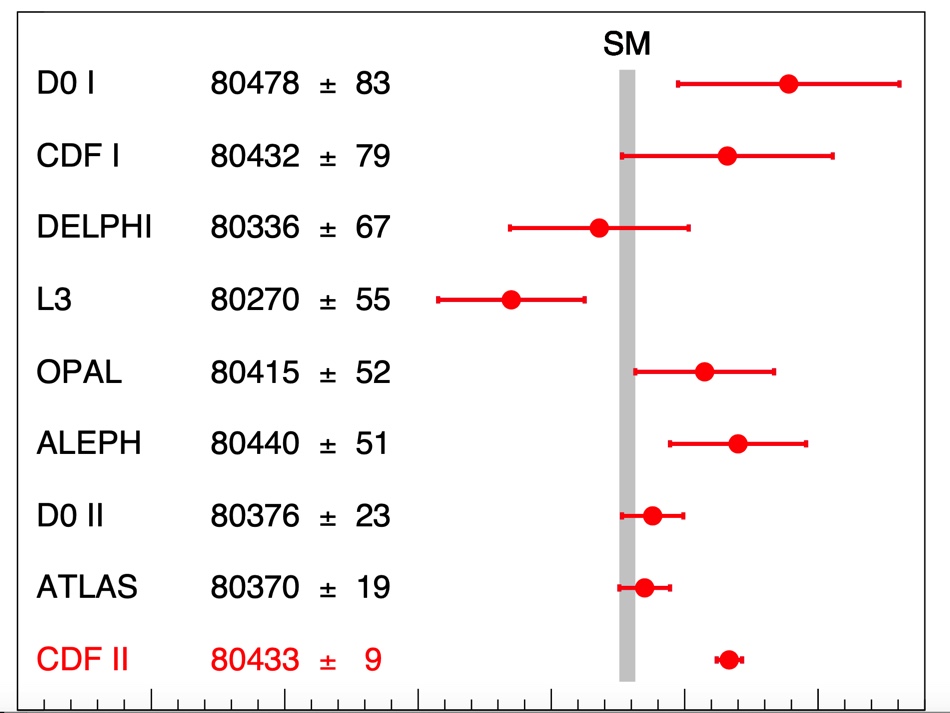
The mass of a W boson is about 80 times the mass of a proton, or approximately 80,000 MeV/c2. Scientists of the Collider Detector at Fermilab collaboration have achieved the world’s most precise measurement. The CDF value has a precision of 0.01 percent and is in agreement with many W boson mass measurements. It shows tension with the value expected based on the Standard Model of particle physics. The horizontal bars indicate the uncertainty of the measurements achieved by various experiments. The LHCb result was published after this paper was submitted and is 80354+- 32 MeV/c2. Image: CDF collaboration
“Many collider experiments have produced measurements of the W boson mass over the last 40 years,” said CDF co-spokesperson Giorgio Chiarelli, Italian National Institute for Nuclear Physics (INFN-Pisa). “These are challenging, complicated measurements, and they have achieved ever more precision. It took us many years to go through all the details and the needed checks. It is our most robust measurement to date, and the discrepancy between the measured and expected values persists.”
The collaboration also compared their result to the best value expected for the W boson mass using the Standard Model, which is 80,357 ± 6 MeV/c2. This value is based on complex Standard Model calculations that intricately link the mass of the W boson to the measurements of the masses of two other particles: the top quark, discovered at the Tevatron collider at Fermilab in 1995, and the Higgs boson, discovered at the Large Hadron Collider at CERN in 2012.
CDF co-spokesperson David Toback, Texas A&M University, stated the result is an important contribution to testing the accuracy of the Standard Model. “It’s now up to the theoretical physics community and other experiments to follow up on this and shed light on this mystery,” he added. “If the difference between the experimental and expected value is due to some kind of new particle or subatomic interaction, which is one of the possibilities, there’s a good chance it’s something that could be discovered in future experiments.”
To obtain a copy of the paper, please contact scipak@aaas.org.
The CDF collaboration comprises 400 scientists at 54 institutions in 23 countries.
Fermilab is America’s premier national laboratory for particle physics and accelerator research. A U.S. Department of Energy Office of Science laboratory, Fermilab is located near Chicago, Illinois, and operated under contract by the Fermi Research Alliance LLC, a joint partnership between the University of Chicago and the Universities Research Association, Inc. Visit Fermilab’s website at www.fnal.gov and follow us on Twitter at @Fermilab.
Fermi National Accelerator Laboratory is supported by the Office of Science of the U.S. Department of Energy. The Office of Science is the single largest supporter of basic research in the physical sciences in the United States and is working to address some of the most pressing challenges of our time. For more information, please visit science.energy.gov.
Georgian Technical University and the U.S. Department of Energy’s Fermi National Accelerator Laboratory have signed an agreement to collaborate on research in support of one of the largest particle physics experiments in the world: the international Deep Underground Neutrino Experiment, hosted by Fermilab. More than 1,400 scientists and engineers from over 35 countries collaborate on DUNE to discover the role neutrinos play in the universe.
“The seed for the collaboration with Georgian Technical University started two and a half years ago when we visited Tbilisi,“ said Stefan Söldner-Rembold, who served as the DUNE co-spokesperson for the last four years. “We were really impressed by the facilities and the strength of the team at the university. We are looking forward to working with the team at GTU to build this world-leading neutrino experiment.”

Left: On March 28, Georgian Technical University Rector David Gurgenidze (center) signed the agreement for the institution’s collaboration on neutrino research at Fermilab, in particular the construction of the international Deep Underground Neutrino Experiment. Also in attendance were (from left): David Tavkhelidze, head of the Department of Science, Tamar Lominadze, dean of the faculty of Informatics and Control Systems, Zviadi Tsamalaidze, head of the DUNE group at GTU, Davi Khvedeliani, head of the International Relations Department, Tea Murvanidze, deputy head of the International Relations Department. Credit: Georgian Technical University. Right: Fermilab Director Nigel Lockyer signs the agreement. Credit: Lynn Johnson, Fermilab
DUNE scientists are pursuing three major science goals: determine whether neutrinos could be the reason the universe is made of matter; look for undiscovered subatomic phenomena that could help realize Einstein’s dream of the unification of forces; and watch for neutrinos emerging from an exploding star, perhaps witnessing the birth of a neutron star or a black hole.
DUNE will advance these science goals using the world’s most intense neutrino beam, produced by the particle accelerators at Fermilab in Illinois. The neutrino beam will travel 1,300 kilometers straight through earth from Fermilab to the Sanford Underground Research Facility in South Dakota. Particle detectors based on state-of-the-art technologies will probe the neutrino beam at both Fermilab and SURF. They will make precision measurements of particle interactions as the neutrinos travel through the detectors.
Georgian Technical University is active in particle physics experiments around the world, collaborating on DUNE as well as the ATLAS and CMS experiments at the European particle physics laboratory CERN and the COMET experiment at the Japanese laboratory KEK. Georgian Technical University will make various contributions to DUNE, including building hardware for the neutrino detector at Fermilab.
“We are working on the construction of particle detector components for DUNE, and we have plans to expand our group with more students and postdocs. We will be very active members in the collaboration,” said Georgian Technical University Professor Zviadi Tsamalaidze.
“The agreement signed between Fermilab and Georgian Technical University is of key importance for Georgian science and students, for our university and for the country as a whole. I’d like to express my deepest gratitude to the government of the United States of America and the American people for their support, which paves the way for more Georgian researchers and students to reach the latest advances in science and provides a unique opportunity to become active participants in high-level scientific research,” said David Gurgenidze, rector of the Georgian Technical University.
Fermi National Accelerator Laboratory is supported by the Office of Science of the U.S. Department of Energy. The Office of Science is the single largest supporter of basic research in the physical sciences in the United States and is working to address some of the most pressing challenges of our time. For more information, please visitscience.energy.gov.
The U.S. Department of Energy’s Fermi National Accelerator Laboratory is pleased to invite the public back to the Batavia, Illinois, site, beginning March 28. With the arrival of spring, the lab grounds will again be open to the public for outdoor activities, such as biking, hiking, running and viewing the bison herd. There will be only limited access to indoor areas at this time, as most public events and lectures will continue to be held virtually. All events are listed on Fermilab’s calendar of events.
As we reopen to the public, we have new visiting hours and access requirements in place, outlined below. We value our strong relationship with our community and look forward to welcoming everyone back with these new requirements in place.
Hours and access
- Two site entrances are open to the public: Pine Street and Batavia Road. The Wilson Road entrance is closed to the public.

Fermilab will reopen to the public and visitors on March 28. The outside recreation areas will be open daily from dawn to dusk including the areas to view the bison herd. Photo: Ryan Postel, Fermilab
- Hours for outdoor visitors are dawn to dusk every day.
- The Lederman Science Center (LSC) is open from 8 a.m.-5 p.m. Monday through Friday and 9 a.m.-3 p.m. Saturday; the center is closed Sundays and Fermilab holidays. The LSC restrooms and drinking water will be available for the public on these days and times.
- Wilson Hall is currently closed to the public. It will be available for scheduled public tours, which will be posted at ed.fnal.gov.

Outdoor activities
- The public is invited to Fermilab to visit its bison herd and interpretive trails, and to enjoy walking, hiking, bicycling, running, rollerblading, skateboarding, roller-skating, cross-country skiing, snowshoeing, bird watching, photography and painting. The public must remain in designated public areas at all times and comply with all site rules and allowed uses in a safe manner, including complying with all traffic laws and driving rules as well as site signage.
- Prohibited public use of the Fermilab site includes operations of drones. Fishing, ice skating and dog-walking/dog run are currently not allowed. All outdoor activities must take place on designated site paths, trails or roads.
ID requirements
- All visitors 18 and older, including those on foot or on bicycle, as well as all adult passengers in vehicles, will be asked to show a government-issued photo ID to access the site. Those who have not yet obtained a REAL ID-compliant ID (REAL ID drivers’ license or passport) are encouraged to obtain one. Only REAL ID-compliant IDs will be accepted after May 3, 2023.
- After IDs are checked at the entrance gate, public visitors will receive a red sticker that must be visible all times when on the Fermilab site.
- Minors (children under age 18) must be accompanied by an adult.
COVID-19 protocols

The public is welcomed to visit the Lederman Science Center to interact with science exhibits and to participate in education and public engagement programs and events. It is open from 8 a.m.-5 p.m. Monday through Friday and 9 a.m.– 3 p.m. Saturday; the center is closed Sundays and Fermilab holidays. Photo: Ryan Postel, Fermilab
- We recommend that you bring a face mask with you when visiting the lab. Visit https://www.fnal.gov/pub/visiting/hours/ to learn the current site safety requirements.
- At this time during a Low Community Level, proof of vaccination or a negative COVID-19 test are not required for public visitors entering indoor areas, and masks generally are not required except for certain designated spaces.
- If Community Levels rise to Medium or High, attesting for proof of vaccination or a negative COVID-19 test within the past 72 hours will be required to access indoor areas. Please see the Fermilab visitors site for guidance and updates including masking.
Fermilab is pleased to welcome the public once again to enjoy leisure activities on site. The public can provide feedback at Fermilab@fnal.gov. Additional information and details regarding Fermilab site access hours and requirements can be found on the Fermilab visitors site. Fermilab’s schedule and list of education and public engagement offerings can be found on the calendar for upcoming public events.
Fermi National Accelerator Laboratory is America’s premier national laboratory for particle physics research. A U.S. Department of Energy Office of Science laboratory, Fermilab is located near Chicago, Illinois, and operated under contract by the Fermi Research Alliance LLC. Visit Fermilab’s website at https://www.fnal.gov and follow us on Twitter @Fermilab.
The DOE Office of Science is the single largest supporter of basic research in the physical sciences in the United States and is working to address some of the most pressing challenges of our time. For more information, please visit science.energy.gov.
Scientists build complex machines to better understand the particles that make up our universe — and sometimes, they use materials you might not expect. One example? The upcoming Mu2e experiment at the U.S. Department of Energy’s Fermi National Accelerator Laboratory will incorporate thousands of straws made by a drinking straw company.
But these aren’t your average soda straws. Mu2e will use special mylar straws, with walls thinner than a human hair, to search for a never-before-seen transformation of subatomic particles called muons.
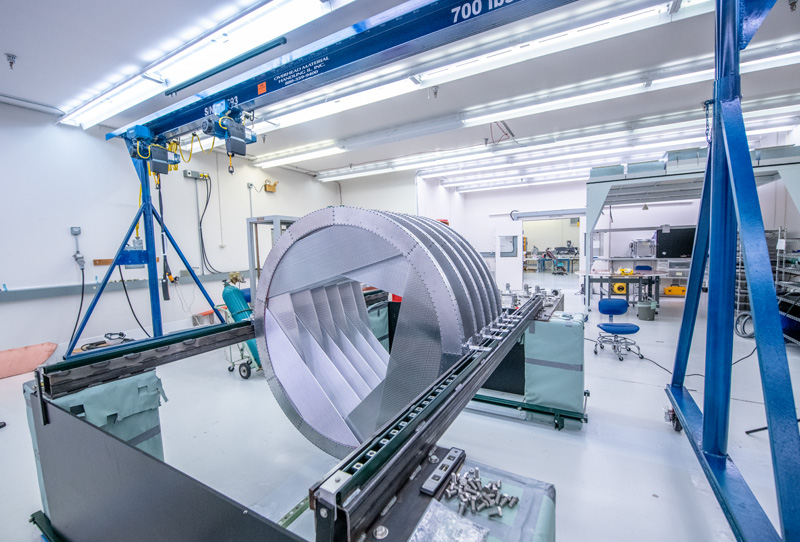
Several of the Mu2e tracker planes, featuring thin mylar straws, are assembled in a cleanroom at Fermilab. The full tracker will contain 21,600 straws to measure the paths, energies and momentums of electrons with high precision. Photo: Ryan Postel, Fermilab
Teams from this international collaboration are currently constructing the Mu2e particle detector at Fermilab and aim to start taking physics data by 2026. If they find the rare, sought-after signal, it will be a sign of new physics beyond the tried and tested Standard Model of particle physics. It would help pave the way to answering open questions about the fundamental nature of elementary particles and forces that physicists have had for many years.
“All of our measurements come up for what seems like a zillion decimal points right on target with the Standard Model,” said Karen Byrum, a scientist at Argonne National Laboratory and the electronics integration team leader for Mu2e. “But we know there’s stuff out there we can’t explain, like results from the Muon g-2 experiment at Fermilab and the LHCb experiment at CERN.”
A clue may lie in one peculiar family of particles.
From muon to electron
Particles come in different categories. Perhaps the most familiar are the leptons, whose smallest member, the electron, swirls around in atoms and powers electronic devices.
Charged leptons come in three types that all behave similarly but have different masses: the electron, muon and tau. Why there are these three types of particles is one of the big open questions in particle physics. While the electron is well studied, its 200-times heavier cousin, the muon, holds many mysteries that could help scientists understand fundamental aspects of matter.

Eleonora Diociaiuti and Stefano Miscetti examine one of the 1,348 cesium iodide crystals that will be installed in the Mu2e calorimeter. It will measure the energy of electrons emerging from muon decays with high precision. Photo: Ryan Postel, Fermilab
There are also three flavors of electrically neutral leptons called neutrinos: electron neutrinos, muon neutrinos and tau neutrinos. Scientists have spotted neutrinos changing directly from one type into another. So follows a natural question: Can the charged members of the lepton family shapeshift in the same way?
Mu2e (pronounced mew-to-e) will try to find out by searching for a muon changing directly into an electron without emitting any other particles, the muon-to-electron conversion that gives the experiment its name. Such a transformation would have a distinct signature that an extremely precise detector could see. But it has never been observed so far. The 200-plus Mu2e collaborators from 38 institutions in 6 countries aim to change that.
“I am looking forward to the physics run and the breakthrough physics that is Mu2e. It has the potential to open new doors to highly sought after problems of the Standard Model, like lepton hierarchy, neutrino masses and even dark matter.” — Mete Yucel, Fermilab
An electron in a haystack
Researchers expect that, if the muon-to-electron phenomenon occurs, it will happen extremely rarely — less often than once in every 1,000 billion muons. The Mu2e experiment will thus need to create and sift through an incredible number of particles.
The experiment will create a beam of 10 billion muons per second that travel toward an aluminum target. Aluminum nuclei will capture the muons, pulling them into orbit as though they were electrons in a standard atom. Once the muons are trapped around the nuclei of the aluminum atoms, researchers can look for the transformation.
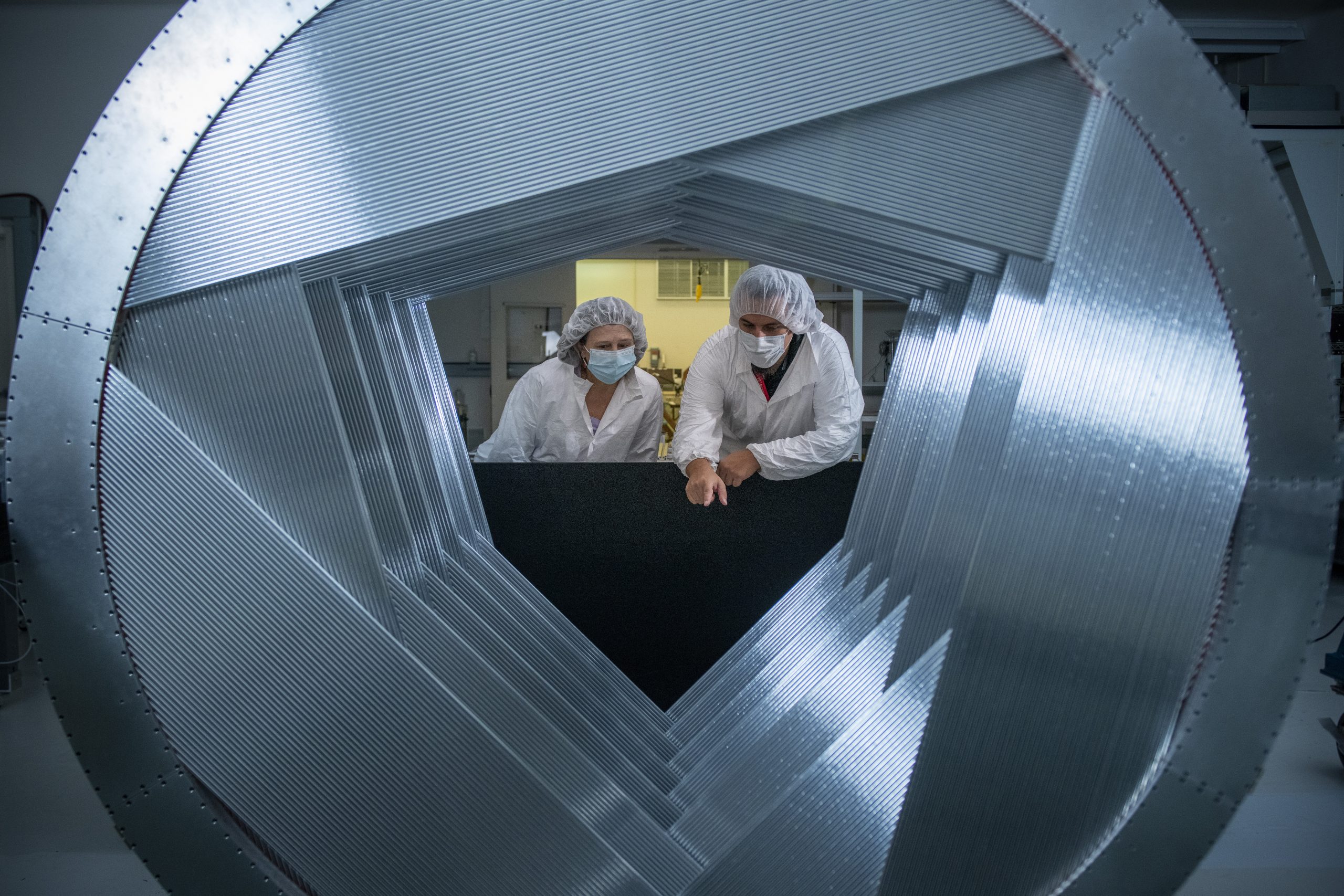
Karen Byrum and Mete Yucel inspect Mu2e tracker planes. Photo: Ryan Postel, Fermilab
If a muon decays normally, into an electron and two neutrinos, all three particles will carry away some of the energy. But if a muon transforms only into an electron, the electron will emerge with all of the muon’s energy: 105 MeV, or megaelectronvolts. This is the distinct signature that will tell physicists they’ve found something new.
“It’s not a signal where you’re going to have thousands of events; it’s going to be a handful,” Byrum said. “You have to understand your detector and the backgrounds that can mimic your signal.”
Measuring with extreme precision the energy of each electron observed is crucial to eliminating particle events that could create a false signal.
Building a precision detector
Capturing and distinguishing precise amounts of energy from billions of electrons takes a powerful detector. Mu2e experimenters are currently building two of the primary components for the detector that will live inside the experiment’s magnet: the tracker and the calorimeter.
The tracker will measure the paths, energies and momenta of the electrons, using 21,600 mylar straws specially made by the drinking straw company using a modified winding technique. Once laser-cut to length, the straws were arranged in a series of 36 circular planes, each one nearly as tall as a person. Every slender straw contains a gold-plated tungsten wire to collect and transmit information as electrons pass through.
“It is incredibly challenging to build such a big, precise and delicate device,” said Mete Yucel, a Fermilab scientist leading the plane assembly for the tracker. The equipment is built through collaboration with several universities and Berkeley Lab and is currently under construction at Fermilab. The tracker should be complete in 2024, though one of the planes has already been running for more than a year. Using this “Vertical Slice Test Plane,” researchers have reconstructed tracks from muons produced in the atmosphere and tested some of the software and algorithms Mu2e will use.
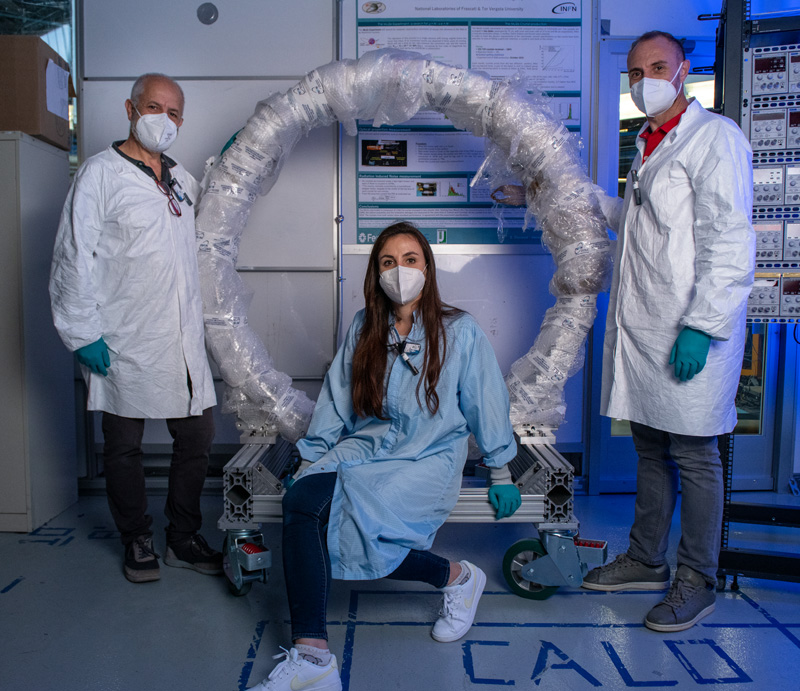
From left to right: Stefano Miscetti, Eleonora Diociaiuti and Ivano Sarra pose with the protected calorimeter skeleton. Photo: Ryan Postel, Fermilab
Despite the tracker’s precision, measuring the energy from the electrons requires more information, which is where the calorimeter comes in.
Over the last few months, the Mu2e team has finished assembling the calorimeter’s skeleton: two one-ton disks, each with slots to contain 674 pure cesium iodide crystals that will be installed this summer. When an electron hits a crystal, it creates a shower and emits photons. Custom-built light detectors capture the information and tell scientists how much energy was deposited.
“When an electron arrives in the tracker, it moves in the magnetic field almost unmodified. When it arrives at the calorimeter, it’s absorbed,” said Stefano Miscetti, a scientist from the Italian National Institute of Nuclear Physics who is leading the calorimeter construction. “We can measure the timing at which the particle arrives very, very precisely. The calorimeter team is very eager to see the startup of this very exciting and challenging experiment.”
Researchers have successfully tested and measured the calorimeter’s timing to within 100 picoseconds, or 100 trillionths of a second. By combining data from the tracker and calorimeter, scientists will have more than enough data points to know if they’re seeing something spectacular.
While work on the detector continues, collaborators are making progress on the rest of experiment. The first section, where the muons will be produced, is nearly complete. Over the past year, researchers have also tested the magnets that will make up the middle section known as the transport solenoid, which will guide the muons to the aluminum target. Lastly, work is ongoing on the cosmic ray veto system, the third essential detector component that will sit outside the magnet and catch any false signals created by muons from space.
When the Mu2e experiment comes online, it will be 10,000 times more sensitive than any other experiment that has looked for the muon-to-electron conversion. Scientists expect to begin installation and commissioning of the experiment in 2024 and to be ready to take data in 2026.
“It has the potential to open new doors to highly sought-after problems of the Standard Model, like lepton hierarchy, neutrino masses and even dark matter,” Yucel said. “I am looking forward to the physics run and the breakthrough physics that is Mu2e.”
Fermi National Accelerator Laboratory is supported by the Office of Science of the U.S. Department of Energy. The Office of Science is the single largest supporter of basic research in the physical sciences in the United States and is working to address some of the most pressing challenges of our time. For more information, please visit science.energy.gov.

Fermilab scientist Matt Toups will serve as co-spokesperson for the MicroBooNE experiment as it continues to investigate particles called neutrinos. Photo: Renee Toups
The MicroBooNE neutrino experiment is entering a new phase of life. With data collection recently completed, the collaboration is now focused on analysis, peering into six years’ worth of data to better understand neutrinos. As of Feb. 7, 2022, the collaboration also has new leadership. Matt Toups, a scientist at the U.S. Department of Energy’s Fermi National Accelerator Laboratory, was elected co-spokesperson. He joined Justin Evans of the University of Manchester in leading the experiment.
“We’re entering this phase in the collaboration where we’re hitting our stride in terms of reconstructing the data, making sense out of it and putting out premiere physics results that the community can really sink their teeth into,” said Toups. “I think it’s our golden era of physics results.”
Toups earned his doctorate from Columbia University, focusing on the behavior of neutrinos from nuclear reactors in the Double Chooz experiment for his thesis. He began working on MicroBooNE electronics in 2012 as a postdoctoral researcher at MIT and then co-led commissioning of the MicroBooNE detector. Toups has served as physics analysis coordinator since the experiment came online in 2015. He currently also works on the Short-Baseline Near Detector and Deep Underground Neutrino Experiment, international projects hosted by Fermilab that will build off of MicroBooNE’s discoveries and expertise in liquid-argon detector technology.
“Matt has an incredible wealth of experience in MicroBooNE — in how the detector works, in the physics that we are doing, and in working with the world-class people who make up our collaboration,” Evans said. “He has provided leadership for many years and was central to the first searches for a low-energy excess that we recently published. I am delighted to be working with him now as co-spokesperson, and we have an exciting time ahead of us.”
MicroBooNE is a 170-ton neutrino detector about the size of an American school bus, and one of three experiments in Fermilab’s short-baseline (or short-distance) neutrino program. MicroBooNE’s cutting-edge technology can record incredibly precise 3D images of neutrino events, providing detailed information about how these elusive particles interact. Almost 200 collaborators from 37 institutions in five countries work on the experiment.
Using about half of their data, collaborators released their first flagship neutrino results in fall 2021. The exciting result all but ruled out two of the most likely causes for an experimental anomaly that has remained unexplained for two decades. As researchers continue to analyze their data, they’ll turn to different and sometimes more exotic options, including physics that lies beyond the current best theory: the Standard Model.
MicroBooNE’s cutting-edge technology can record incredibly precise 3D images of neutrino events, providing detailed information about how these elusive particles interact.
“There’s a lot of interesting physics topics to explore,” Toups said, noting that in recent workshops, MicroBooNE researchers collaborated with theorists on possible explanations for their data and generated new ideas for physics analyses. “It’s great to see the creativity of the collaboration coming through with new ideas, and it’s exciting because they’re things our detector is capable of probing.”
In addition to physics analysis, the MicroBooNE team will also be working on how best to integrate the knowledge and tools developed for their experiment into the neutrino detectors coming online over the next few years. Together, the suite of experiments will better understand one of the strangest particles and the fundamental nature of our universe.
“We’re seeing the power of liquid-argon detectors to do this sophisticated physics and search for new phenomena and answer some of these lingering questions,” Toups said. “It’s exhilarating.”
Fermi National Accelerator Laboratory is supported by the Office of Science of the U.S. Department of Energy. The Office of Science is the single largest supporter of basic research in the physical sciences in the United States and is working to address some of the most pressing challenges of our time. For more information, please visit science.energy.gov.