
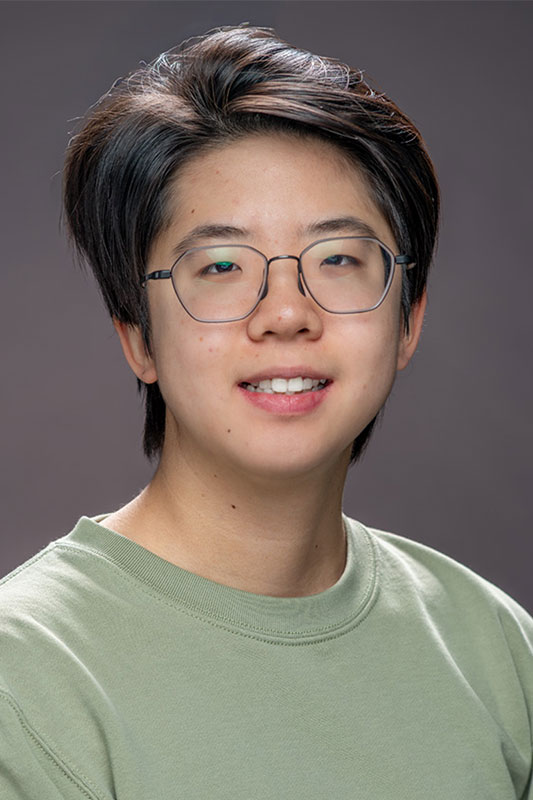
The American Physical Society has honored Christina Wang, a postdoctoral researcher and Lederman Fellow at Fermi National Accelerator Laboratory, with the prestigious 2026 Mitsuyoshi Tanaka Award in Experimental Particle Physics for developing novel techniques to detect new particles.
Wang received the award for “pioneering a groundbreaking detection technique using the Compact Muon Solenoid detector [at CERN] to search for weakly-coupled sub-GeV mass dark matter via long-lived particle searches, and for groundbreaking work in quantum sensing, allowing researchers to search for types of currently unobservable dark matter.”
Her thesis details two complementary detection techniques that help researchers search for new physics beyond the Standard Model.
The Standard Model is a well-tested physics theory that explains the fundamental structure of matter. Researchers who study physics beyond the Standard Model, such as Wang, seek to resolve unanswered questions and unexplainable phenomena in high-energy physics that are observable, but not currently accounted for, including the origin of dark matter.
Scientists theorize that dark matter makes up roughly 85% of all matter in the universe. Researchers have never directly observed dark matter. However, they know it exists through observing the gravitational influence it exerts on visible matter. Wang and her collaborators are working diligently to detect and understand this mysterious substance.
Wang’s first approach reinvented how the CMS experiment detects long-lived particles — decaying particles that are notoriously difficult to observe due to their weak interactions with matter. Her method uses the 75 million electronic sensors inside CMS, originally designed to detect muons, to create a shower of secondary long-lived particles, extending their observable state.
The second approach leverages quantum sensing technology to detect individual low-energy photons. Using superconducting nanowire single-photon detectors, researchers can search for photons with exceptionally low noise, improving their ability to identify the extremely faint signals that potential dark matter candidates may produce.
“I am deeply honored to receive the Tanaka Award,” said Wang. “Seeing the list of previous recipients makes this award even more meaningful to me.”
Fermi National Accelerator Laboratory is America’s national laboratory for particle physics and accelerator research. Fermi Forward Discovery Group manages Fermilab for the U.S. Department of Energy Office of Science. Visit Fermilab’s website at www.fnal.gov and follow us on social media.
Recommended reading
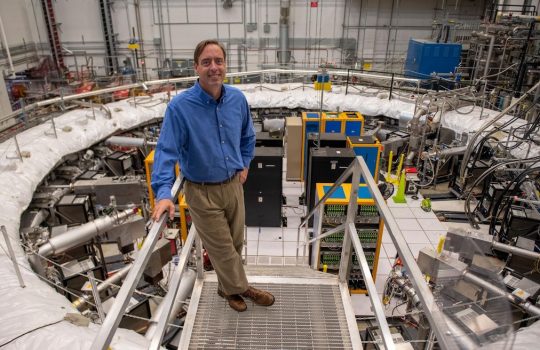
Energy Department announces 2026 Ernest Orlando Lawrence Award winners
U.S. Secretary of Energy Chris Wright announced that Fermilab’s Chris Polly was one of nine recipients of the prestigious Ernest Orlando Lawrence Award for exceptional contributions to research and development supporting the U.S. Department of Energy’s (DOE) missions in science, energy and national security.
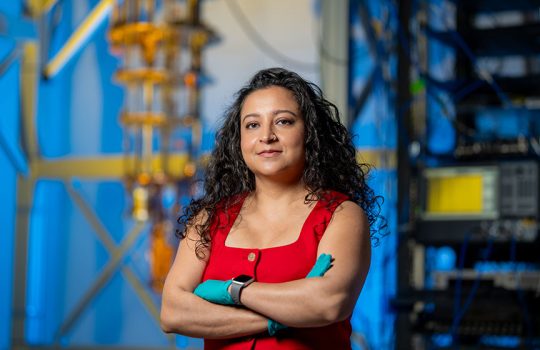
Fermilab physicist wins DOE Early Career Award to study dark matter with entangled qubits
Building on her earlier work with quantum amplifiers for a leading dark matter experiment, Rakshya Khatiwada will use a four-qubit entangled system to test whether it offers a sensing advantage when exposed to a simulated dark matter signal. The project, based at Fermilab, could open the door to detecting dark matter candidates such as axions and dark photons.
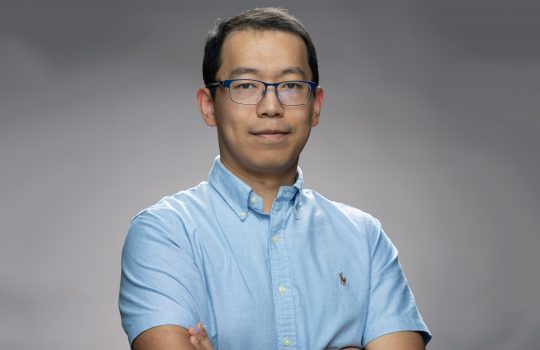
Yao Lu receives Early Career Award to harness quantum entanglement for dark matter search
Supported by a DOE Early Career Award, a Fermilab scientist is building a scalable superconducting cavity array to detect faint signals from mysterious dark photons with unprecedented speed and sensitivity.