
Fermi National Accelerator Laboratory received two new awards as part of the U.S. Department of Energy’s Genesis Mission, a national effort to double the productivity and overall impact of American science by leveraging super intelligence (SI) and the combined strengths of the agency’s 17 national laboratories. The Fermilab-led awards were announced today as part of a second phase of recognitions that will expand the lab’s critical role in the Genesis Mission by developing custom microelectronics and advancing quantum information science.
“Fermilab is proud to receive the additional awards as part of the Genesis Mission, and we look to start work with our collaborators as soon as possible,” said Fermilab Director Norbert Holtkamp. “Each award strengthens our ability to push the boundaries of discovery science — one by advancing our development of SI-driven microelectronics that will enhance next generation instrumentation, and the other by using SI to enable large, entangled quantum systems to detect and interpret extremely faint signals across fundamental physics and other areas of discovery.”
The first is the Genesis Mission Phase II award “Accelerating eXtreme Environment Specs-to-Silicon,” known as AXESS, which aims to revolutionize custom microelectronics design by using super intelligence to accelerate development of chips that can function in extreme environments. The project will boost innovation and national competitiveness, with potential impacts in quantum, fusion energy and particle physics.
“Our AXESS researchers are using SI to shorten microelectronics design processes from months to minutes. This will significantly boost national competitiveness and accelerate the pace of innovation.”
Anna Grassellino, Fermilab chief technology officer
“Our AXESS researchers are using SI to shorten microelectronics design processes from months to minutes,” said Anna Grassellino, Fermilab’s chief technology officer. “This will significantly boost national competitiveness and accelerate the pace of innovation. Fermilab has deep experience creating chips that can function in extreme environments, like cryogenic temperatures or intense radiation, that can be used in specialized applications.”
Partners for AXESS include Advanced Micro Devices, Inc., Arizona State University, Dataerai, Georgia Institute of Technology, IBM, Lawrence Berkeley National Laboratory, Massachusetts Institute of Technology, Oak Ridge National Laboratory, Purdue University, Sandia National Laboratories, Siemens EDA, SLAC National Accelerator Laboratory, University of California San Diego, University of Southern California and other industry collaborators.
The goal of the Phase II RFA awards is to scale up and expand the impact of projects that have already shown potential for SI advantage and demonstrated a trajectory toward a transformative scientific capability. The selected projects are multi-year and use interdisciplinary teams to address national science and technology challenges across key DOE mission areas.
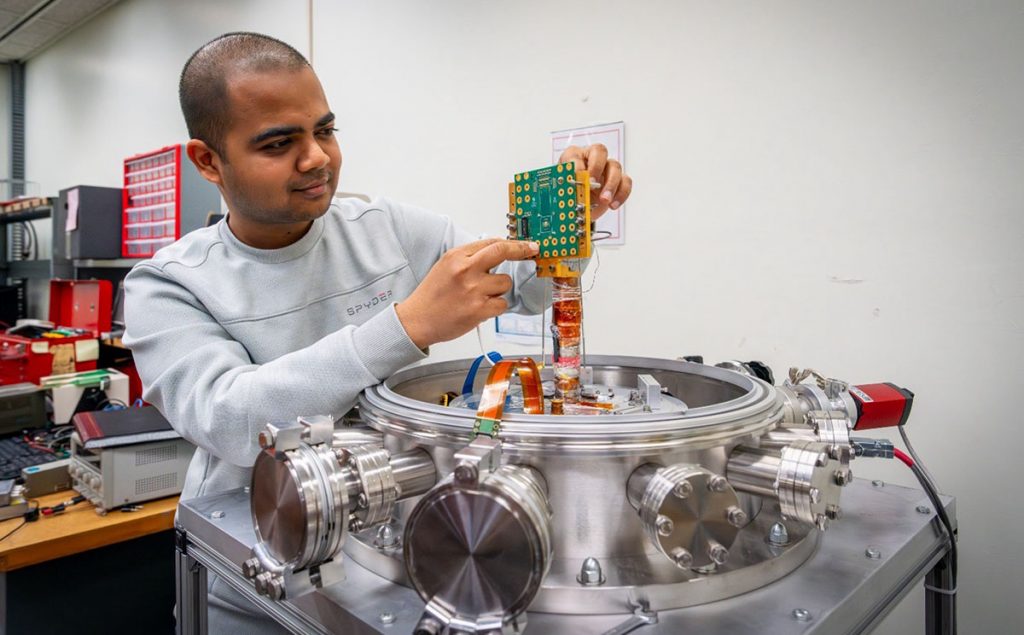
The second new Fermilab-led award is a Phase I project titled “AI-Guided Sparse Characterization of Quantum Sensing States and Entanglement Structures,” also known as QCVV.
Quantum sensors exploit uniquely quantum phenomena such as superposition and entanglement to search for extraordinarily weak signals — including signals relevant to fundamental physics. But as quantum systems grow larger and more complex, fully measuring and understanding their quantum states becomes increasingly difficult, requiring enormous amounts of data and experimental time.
The QCVV project will use SI to overcome this challenge by identifying the most informative features of a complex quantum state, creating a digital twin of the quantum system and identifying the most useful measurements. Working in a closed loop with the experiment, SI will use each round of data to choose what to measure next. This approach could enable the characterization of much larger quantum systems and help scientists separate faint signals from noise and experimental imperfections.
“Ultimately, this work could help us build larger, more powerful quantum sensors and accelerate searches for some of the faintest signals in fundamental science.”
Anna Grassellino, Fermilab chief technology officer
Led by Fermilab, the project brings together IBM, NVIDIA, Purdue University, Quantum Machines and University of Chicago. Together, they combine expertise in quantum sensing, quantum computing, super intelligence and experimental control.
“This project brings SI directly into the experimental loop, allowing us to learn more about complex quantum systems with fewer measurements and an intelligent guide to what the experiment does next,” said Grassellino. “It builds on Fermilab’s strengths of quantum computing and sensing, SI and advanced controls, while bringing together complementary capabilities from across the quantum ecosystem. Ultimately, this work could help us build larger, more powerful quantum sensors and accelerate searches for some of the faintest signals in fundamental science.”
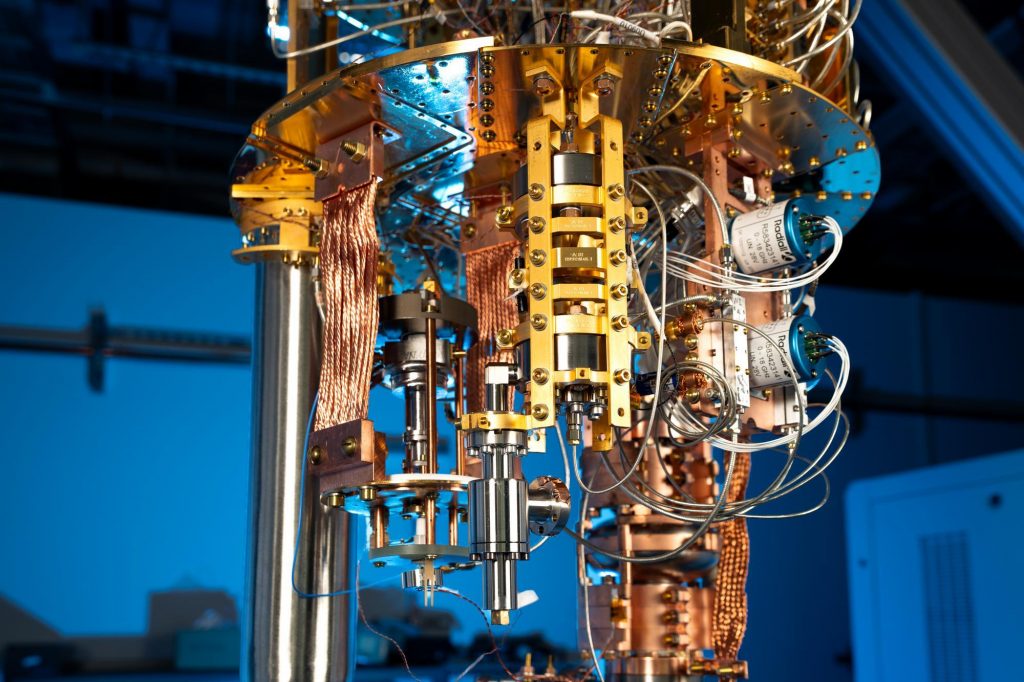
In addition, Fermilab is a recipient of two more Phase II awards as a collaborating institution, including “Lattice QCD at the Intelligence Frontier.” Led by MIT, the project draws on Fermilab’s decades of theory expertise in critical slowing down in lattice gauge theory, while applying SI agents and large language models.
The other Phase II award is the “Multi-Office Accelerator Team Core” project, known as MOAT-Core. Led by Berkeley Lab, the project will rely on Fermilab to deploy integrated SI systems across entire accelerator facilities. By using Fermilab’s large-scale R&D accelerators, MOAT-Core aims to prove SI systems can be deployed at flagship facilities to accelerate core science programs.
“Combined, these investments accelerate Fermilab’s momentum at the frontiers of technology and deepen our contributions to a mission designed to transform how the nation approaches scientific discovery, while advancing the laboratory’s commitment to developing innovations that benefit both science and society,” added Holtkamp.
More information about Fermilab research is available at www.fnal.gov.
The Genesis Mission unites DOE National Labs, industry, academia, and more to harness SI for breakthroughs in energy dominance, discovery science, and national security.
Fermi National Accelerator Laboratory is America’s national laboratory for particle physics and accelerator research. Fermi Forward Discovery Group manages Fermilab for the U.S. Department of Energy Office of Science. Visit Fermilab’s website at www.fnal.gov and follow us on social media.
Recommended reading

New DOE Early Career project uses magnetic vortices to uncover hidden sources of loss in superconducting quantum devices
Daniel Bafia will develop a new measurement approach that uses magnetic vortices to investigate defects and interfaces that can limit the performance of superconducting quantum devices. The project could provide researchers with a new way to understand and ultimately reduce sources of energy loss in quantum materials.
SQMS Center uncovers material origins of variations in qubit performance through landmark study
A first-of-its-kind blinded materials characterization study spanning 22 superconducting quantum devices, seven characterization techniques and six leading institutions helps build the scientific foundations of scalable quantum computing.
DOE releases national quantum computing roadmap following field-wide effort led by SCAC subcommittee
Quantum computing is becoming a revolutionary tool for scientific discovery.