
Newsroom

1 - 10 of 1313 results

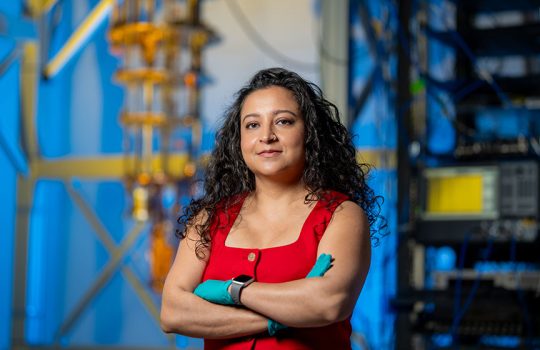
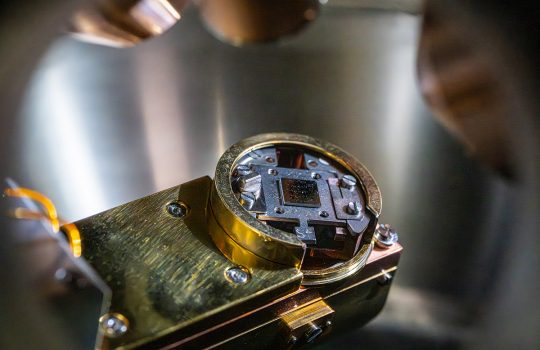
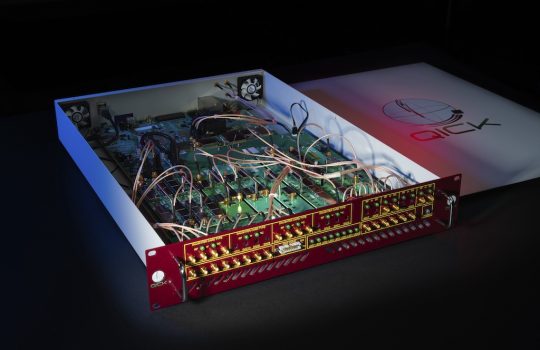
The Quantum Instrumentation Control Kit, or QICK. Credit: Ryan Postel, Fermilab

Fermilab and Harmoniqs integrate open-source tools to advance qubit control optimization

Fermilab developed the Quantum Instrumentation Control Kit, or QICK, as a compact, customizable and cost-effective quantum readout and control option for scientists. Harmoniqs, a quantum computing software company, developed Piccolo.jl, a quantum control and calibration software package. Together, their developers are integrating the two to achieve precise, repeatable qubit control, providing better results in less time.

This graphic shows the engineering design model of the underground DUNE near detector hall. The neutrino beam enters from the right. The liquid-argon time projection chamber (labeled ND-LAr) is the first to encounter the neutrino beam. Directly behind it sits the muon spectrometer, shown in blue and green. Both can move off the beam axis (toward the upper right) to sample different neutrino energies. The third component, the beam monitor at the farthest end of the hall, depicted in yellow and blue, stays in place on axis in the beam. Credit: DUNE Collaboration

DUNE will use liquid-argon time projection chamber technology both near and far

The Deep Underground Neutrino Experiment’s innovative hybrid near detector will be a game changer. An active prototyping program over the last few years has been refining and validating the design of this smaller detector’s key element, a liquid-argon time projection chamber, and the data analysis tools and methods that go with it.

Dune May 7 event

Fermilab marks major milestone for world-leading DUNE experiment

An event at the far site of the Deep Underground Neutrino Experiment at the Sanford Underground Research Facility in South Dakota marked the start of steel beams being lowered underground to house DUNE’s massive particle detectors. The event was attended by senior leaders from the Department of Energy; members of Congress; Fermilab, CERN and SURF leadership; and members of the local community, all of whom had the chance to sign one of the steel beams being installed.

Fermilab team members in front of the 14th and final superconducting cryomodule built for the high-energy LCLS upgrade. Credit: JJ Starr, Fermilab

Fermilab completes its part in upgrading world’s most powerful X-ray laser

Fermilab sent its final contribution for the high-energy upgrade of the superconducting accelerator for SLAC’s X-ray laser, LCLS. The technology they developed will be transferred to industry for semiconductor-chip production and will be used in the Proton Improvement Plan-II, one of Fermilab’s flagship projects.