Fermilab to Lead 2 New Genesis Mission Awards
HPC Wire, October 9, 2026
Two new awards will expand Fermilab’s critical role in the Genesis Mission by developing custom microelectronics and advancing quantum information science.
1 - 10 of 22 results
HPC Wire, October 9, 2026
Two new awards will expand Fermilab’s critical role in the Genesis Mission by developing custom microelectronics and advancing quantum information science.
The University of Alabama News Center, August 11, 2026
The University of Alabama and Fermilab received an award from the Genesis Mission to build an AI tool to help sift through floods of data, speeding up the pace of discovery so scientists can focus on the science itself.
Northwestern Now, July 31, 2026
Northwestern University, University of Chicago and Fermilab scientists have developed a new AI tool that automatically determines where a telescope should point.
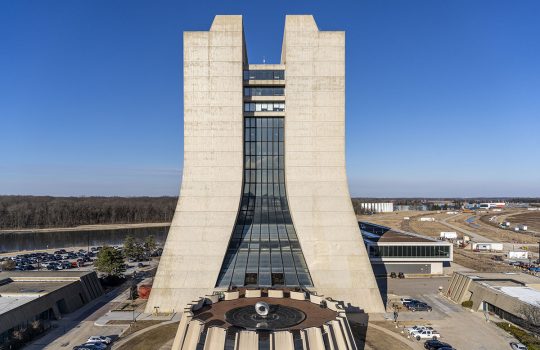
The Genesis Mission is leveraging the strength of the U.S. Department of Energy’s 17 national laboratories, including Fermilab, alongside American research universities and industry partners. The collaborative effort aims to supercharge innovation by integrating the transformative power of artificial intelligence across the national research landscape.
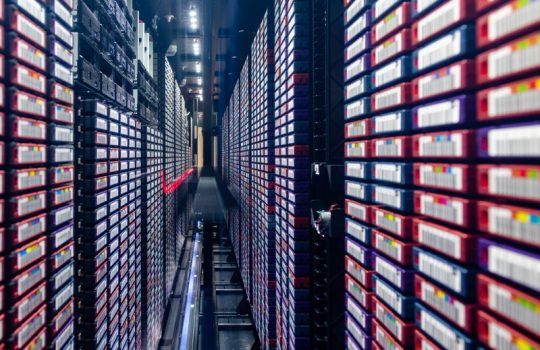
President Trump issued an Executive Order on November 24 to launch the Genesis Mission, a historic national effort led by the US Department of Energy.
From Argonne National Laboratory, Nov. 10, 2023
The Trillion Parameter Consortium was recently launched bringing together science teams to address key challenges in advancing AI for science. Fermilab is part of this international group that includes researchers from federal laboratories, research institutes, academia, and industry.
From the DOE Office of Science, October 6, 2022: Fermilab will receive part of the $6.4 million in funding for artificial intelligence research for high energy physics as announced by the Department of Energy Office of Science. Fermilab principal investigator, Jennifer Ngadiuba received the grant for the project, “Designing Efficient Edge AI with Physics Phenomena.”
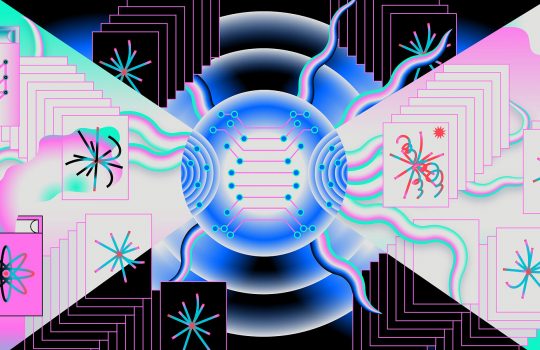
Fast electronics and artificial intelligence are helping physicists working on experiments with massive amounts of data, such as the CMS experiment, decide which data to keep and which to throw away.

Whether in Serbia or Chicago, Fermilab postdoctoral researcher Aleksandra Ćiprijanović is working to unlock the secrets of the night sky. As a member of the Deep Skies Lab, an international collaboration of physicists, she’s figuring out how to use artificial intelligence and machine learning to better handle the huge amounts of data needed for discovery science.
From AI Business, June 16, 2021: Fermilab was part of a consortium helping in the development of the TinyML benchmark from MLCommons to measure machine learning performance that will bring intelligence to devices like wearables, thermostats, and cameras.