Muon g-2 experiment places new constraints on a forbidden property of muons
The experiment, designed to measure the magnetic moment of the muon, is also sensitive to a particle property called the electric dipole moment.

1 - 5 of 5 results
The experiment, designed to measure the magnetic moment of the muon, is also sensitive to a particle property called the electric dipole moment.
Argonne National Laboratory, April 7, 2026
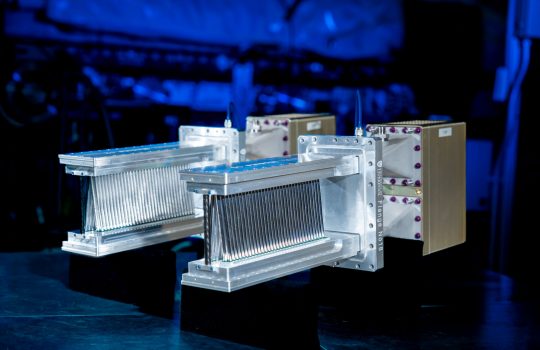
Argonne researchers commissioned a device that filters out background signals in the Mu2e experiment at Fermilab, which seeks to observe a rare particle physics process. Such an observation would fundamentally change our understanding of the universe.
Phys.org, Sept. 13, 2024
Physicists from the Muon g-2 collaboration have measured the magnetic moment of the muon to unprecedented precision and the collaboration’s latest work has been published in Physical Review D. What is next for Muon g-2?
Smart Water Magazine, Feb. 16, 2024
Researchers at Fermilab, in collaboration with 3M, have successfully demonstrated that an electron beam can destroy the two most common types of PFAS in water. Perfluoroalkyl and polyfluoroalkyl substances are commonly known as PFAS and often called forever chemicals. The new research shows an electron beam can destroy the forever chemicals quickly, enabling a large volume of water to be treated in the same amount of time as some other methods.

Astronomers are championing a relatively new technique as a method to understand the structure of the early universe in three dimensions.