
The U.S. Department of Energy’s Fermi National Accelerator Laboratory, IBM and NVIDIA intend to collaborate on a modular quantum computing co-design platform aimed at accelerating the development of scalable, fault-tolerant quantum computers for scientific discovery.
The initiative would build on the longstanding collaboration between IBM and Fermilab’s Superconducting Quantum Materials and Systems Center, a DOE National Quantum Information Science Research Center, to advance superconducting quantum technologies and interconnects. It would take that work a step further by bringing together quantum hardware, accelerated computing and the scientific community. The goal is to determine how to connect and operate future fault-tolerant quantum systems.
Fermilab aims to make the proposed platform a focal point for high-energy and nuclear physics (HENP) researchers, bringing together its own particle physics scientists and domain expertise with the broader scientific community across national laboratories, universities and international institutions. Together, they would develop quantum algorithms, shared software and benchmarks for demanding problems such as particle interactions, neutrino physics and nuclear simulations. This work would help translate those scientific needs into requirements for future quantum computing systems.
“This intended platform presents an extraordinary opportunity to bring together IBM’s leadership in quantum processors and networking, NVIDIA’s breakthroughs in accelerated computing and superintelligence, and Fermilab’s scientific community and SQMS expertise in ultracoherent quantum hardware,” said Anna Grassellino, Fermilab chief technology officer and director of the SQMS Center. “Our ambition is to help lead the development of quantum computers built for discovery. By bringing high-energy and nuclear physicists into the process, we can co-design the applications, algorithms and modular architectures needed to make fault-tolerant quantum computing useful for science. This would be an important step toward the capabilities and community needed for a future DOE quantum computing user facility.”
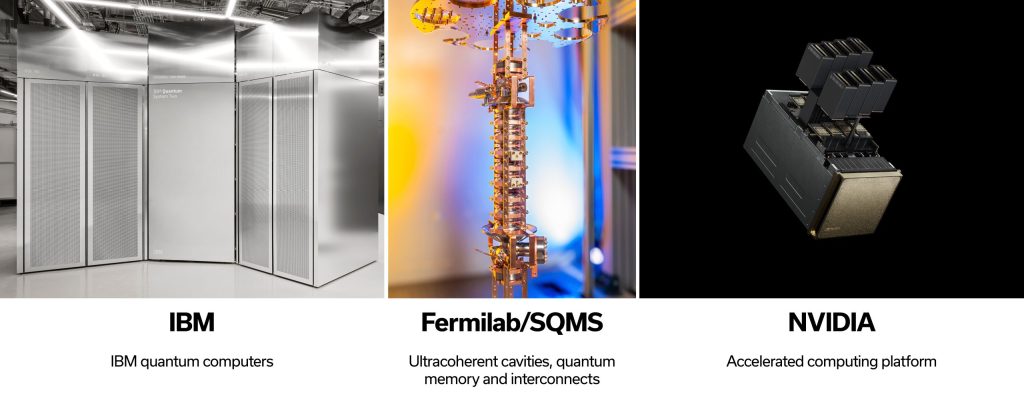
From powerful processors to interconnected quantum systems
The proposed initial platform would physically co-locate IBM quantum computers with NVIDIA accelerated computing. Fermilab would lead the HENP application engagement and help to coordinate software workflows and researcher access through its HEPCloud infrastructure. Researchers would use the platform to develop and test algorithms, error correction, SI-assisted optimization and real-time quantum–classical control.
A central challenge is modularity: connecting quantum processors so they can work together on calculations too demanding for a single device. Initially, researchers would model and emulate communication between modules, studying how link errors, latency and feedback affect performance. Those findings would guide the SQMS–IBM effort to develop optimal physical quantum interconnects.
In a later phase, Fermilab’s SQMS intends to integrate its own ultracoherent superconducting cavity hardware to the platform. Alongside interconnects, researchers would investigate cavities as quantum memories, entanglement buffers and resources for bosonic error correction.
Complementary strengths, a shared scientific ambition
IBM would contribute advanced superconducting quantum processors, software, application development and quantum networking expertise. NVIDIA would bring expertise in accelerated computing and SI technologies for decoding, simulation, optimization and real-time feedback. Fermilab would provide the SQMS cavity and interconnect R&D, HENP applications development in addition to scientific leadership and experience supporting large research communities. Together, the partners would aim to connect quantum hardware design with the needs of scientific users from the outset.
The long-term goal of the Fermilab–IBM–NVIDIA co-design platform is to help establish the technology, software and scientific user community needed for future scalable quantum computing facilities.
The proposed platform would complement the recently launched co-design platform with IBM, Oak Ridge National Laboratory and AMD, which is powering new research in quantum error correction and materials-oriented applications. Through joint activities among DOE’s National Quantum Information Science Research Centers, the teams could exchange software, benchmarking methods and lessons for future user facilities.
“Some of the most fundamental problems in science remain out of reach for classical computers alone. Scaling quantum and classical together will open new frontiers in high-energy and nuclear physics and beyond,” said Jerry Chow, IBM Fellow and chief technology officer of Quantum-Centric Computing. “With Fermilab and NVIDIA, we’re exploring how these real-world problems can help us shape the modular, interconnected architectures that will define the next generation of quantum computers and accelerated classical computing.”
“Integrating quantum computing with superconducting workflows has the potential to dramatically expand how scientists can explore nature’s most fundamental questions,” said Krysta Svore, vice president of applied research for quantum computing at NVIDIA. “Fermilab, IBM and NVIDIA are showing how quantum can be brought into the heart of scientific research with hybrid quantum-classical systems – making quantum processors into powerful new instruments of discovery.”
Fermi National Accelerator Laboratory is America’s national laboratory for particle physics and accelerator research. Fermi Forward Discovery Group manages Fermilab for the U.S. Department of Energy Office of Science. Visit Fermilab’s website at www.fnal.gov and follow us on social media.
The Superconducting Quantum Materials and Systems Center at Fermilab is supported by the DOE Office of Science.
The Superconducting Quantum Materials and Systems Center is one of the five U.S. Department of Energy National Quantum Information Science Research Centers. Led by Fermi National Accelerator Laboratory, SQMS is a collaboration of more than 40 partner institutions — national labs, academia and industry — working together to bring transformational advances in the field of quantum information science. The center leverages Fermilab’s expertise in building complex particle accelerators to engineer multiqubit quantum processor platforms based on state-of-the-art qubits and superconducting technologies. Working hand in hand with embedded industry partners, SQMS will build a quantum computer and new quantum sensors at Fermilab, which will open unprecedented computational opportunities. For more information, please visit www.sqmscenter.fnal.gov.
Recommended reading

‘Genesis Agent Skills’ release to support innovation across the Genesis Mission
New public software release gives researchers plain-language access to reusable guidance and tools for building, evaluating, and improving Super Intelligence (SI) enabled systems

Six years of SQMS: asking what limits quantum systems and building the answers
The founding director provides perspective on the first six years of a DOE National Quantum Information Science Research Center — the Superconducting Quantum Materials and Systems Center, led by Fermi National Accelerator Laboratory.

New DOE Early Career project uses magnetic vortices to uncover hidden sources of loss in superconducting quantum devices
Daniel Bafia will develop a new measurement approach that uses magnetic vortices to investigate defects and interfaces that can limit the performance of superconducting quantum devices. The project could provide researchers with a new way to understand and ultimately reduce sources of energy loss in quantum materials.