
Zachary Burton

1 - 5 of 5 results

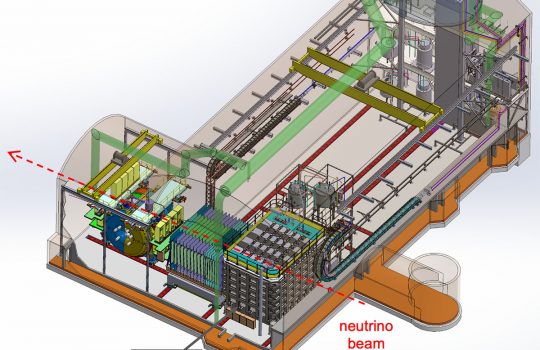
This graphic shows the engineering design model of the underground DUNE near detector hall. The neutrino beam enters from the right. The liquid-argon time projection chamber (labeled ND-LAr) is the first to encounter the neutrino beam. Directly behind it sits the muon spectrometer, shown in blue and green. Both can move off the beam axis (toward the upper right) to sample different neutrino energies. The third component, the beam monitor at the farthest end of the hall, depicted in yellow and blue, stays in place on axis in the beam. Credit: DUNE Collaboration

DUNE will use liquid-argon time projection chamber technology both near and far

The Deep Underground Neutrino Experiment’s innovative hybrid near detector will be a game changer. An active prototyping program over the last few years has been refining and validating the design of this smaller detector’s key element, a liquid-argon time projection chamber, and the data analysis tools and methods that go with it.

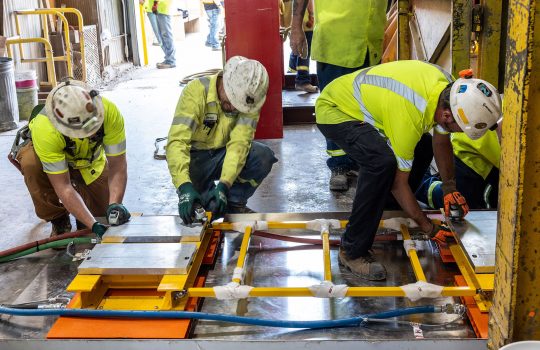
A crew installs beam clamps to connect the L-beam to the air cart. Photo: Matthew Kapust, SURF

Engineering innovation meets history in groundbreaking neutrino experiment hosted by Fermilab

At the Sanford Underground Research Facility, hovercraft technology is being used to efficiently move massive steel beams for the Long-Baseline Neutrino Facility/Deep Underground Neutrino Experiment. Named after a beloved workhorse at the former gold mine that now contains the science facility, “Maggie II” is an innovative solution for the challenges of transporting heavy, awkwardly shaped beams underground to construct one of the largest physics experiments in the world.