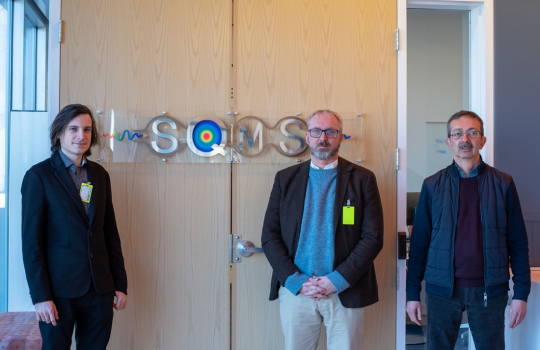
The US and UK team up to advance quantum information science
Royal Holloway University of London and the National Physical Laboratory bring expertise and research capabilities to the SQMS Center as new partnership institutions.
11 - 20 of 54 results
Royal Holloway University of London and the National Physical Laboratory bring expertise and research capabilities to the SQMS Center as new partnership institutions.
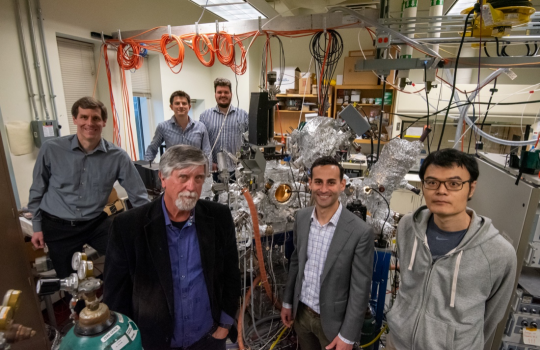
SQMS Center researchers have identified a new contribution to a qubit’s performance by probing and simulating several-atom-thick layers called silicides.
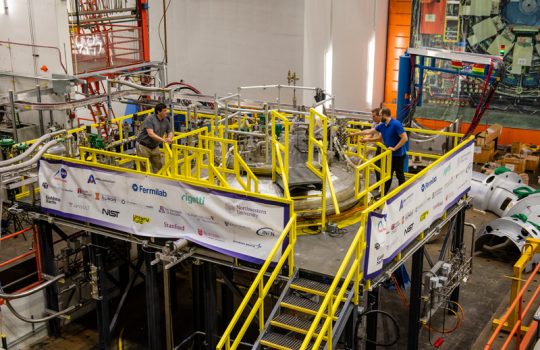
To cool quantum computing components, researchers use machines called dilution refrigerators. Researchers and engineers from the SQMS Center are building Colossus, the largest, most powerful refrigerator at millikelvin temperatures ever made. The new machine will enable new physics and quantum computing experiments.
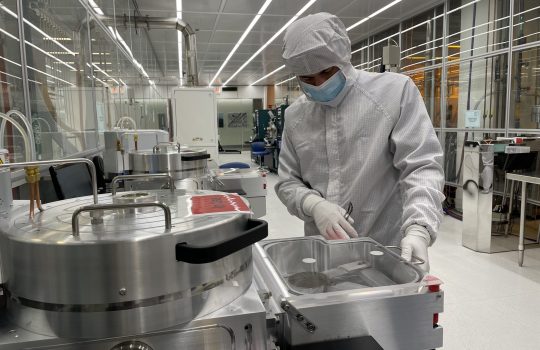
SQMS Center researchers have fabricated quantum devices to evaluate the effect of different materials on qubit performance, thanks to proximity to the Pritzker Nanofabrication Facility.

Koch has assumed the leadership role previously held by Jim Sauls, who will remain active at SQMS.
From Yahoo Notizie (Italy), September 22, 2022: Congratulations to SQMS Center director, Anna Grassellino who received the New Horizon Prize in fundamental physics for the discovery of major improvements in the performance of superconducting radio frequency niobium cavities, with applications ranging from accelerator physics to quantum devices.
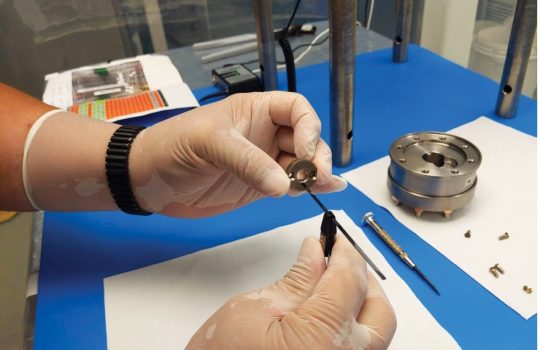
Scientists at the SQMS Center have directly probed silicon’s impact on the lifespan of superconducting qubits. The uniquely sensitive measurement helped researchers quantify how the material impacts qubit performance.
From Radiology Business, July 21, 2022: Read more about the research collaboration between NYU Langone and SQMS in a pilot program which will pair two young researchers from each institution. The aim of the program is for researchers to develop algorithms used by future SQMS quantum computers to make accurate and rapid estimations of multiple tissue properties from MRI scans.
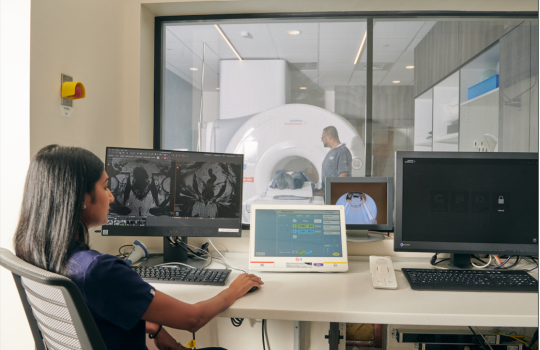
Researchers look toward quantum computing to help medical-imaging scientists achieve the goal of accurately measuring tissue properties with MRI scans.
From Seneca’s 100 Women to Hear, July 7, 2022: A podcast interview with Fermilab’s Anna Grassellino on leading the team on developing the most powerful quantum computer on earth to hopefully one day answer questions like, “What is the world made of and what are its most fundamental components?”