Quantum researchers strike the right chord with silicides
SQMS Center researchers have identified a new contribution to a qubit’s performance by probing and simulating several-atom-thick layers called silicides.
21 - 30 of 40 results
SQMS Center researchers have identified a new contribution to a qubit’s performance by probing and simulating several-atom-thick layers called silicides.
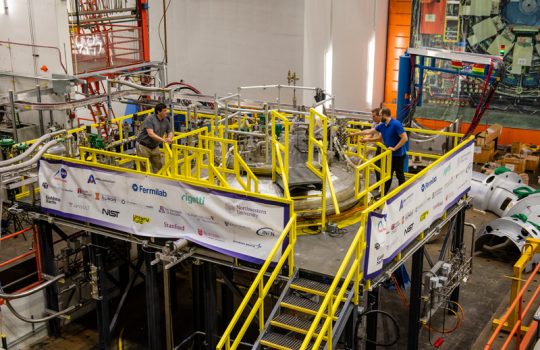
To cool quantum computing components, researchers use machines called dilution refrigerators. Researchers and engineers from the SQMS Center are building Colossus, the largest, most powerful refrigerator at millikelvin temperatures ever made. The new machine will enable new physics and quantum computing experiments.
From Whitehouse.gov, Dec. 5, 2022: Last week the White House Office of Science and Technology Policy hosted the thirteen National Quantum Initiative and National Defense Authorization Act research centers to discuss the most pressing scientific and workforce challenges affecting quantum information science and the impacts and benefits of the field to society. Fermilab’s Sam Posen and Jens Koch attended the summit to present SQMS’s mission, major scientific impacts, as well their approaches to building multi-disciplinary research teams, engagement with industry, and education and outreach.

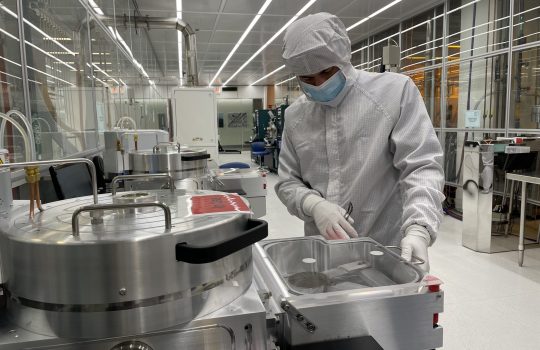
SQMS Center researchers have fabricated quantum devices to evaluate the effect of different materials on qubit performance, thanks to proximity to the Pritzker Nanofabrication Facility.
Koch has assumed the leadership role previously held by Jim Sauls, who will remain active at SQMS.
From Semiconducting Engineering, September 12, 2022: How do you extend the lifespan of qubits? Researchers at the Supercomputing Quantum Materials and Systems Center say silicon limits the lifespan of qubits because of quantum decoherence. Fermilab’s Alexander Romanenko discusses recently published research on how individual sub-components contribute to the decoherence of the qubits. Could sapphire be a better choice for future quantum chips?
Scientists at the SQMS Center have directly probed silicon’s impact on the lifespan of superconducting qubits. The uniquely sensitive measurement helped researchers quantify how the material impacts qubit performance.
From Radiology Business, July 21, 2022: Read more about the research collaboration between NYU Langone and SQMS in a pilot program which will pair two young researchers from each institution. The aim of the program is for researchers to develop algorithms used by future SQMS quantum computers to make accurate and rapid estimations of multiple tissue properties from MRI scans.
Researchers look toward quantum computing to help medical-imaging scientists achieve the goal of accurately measuring tissue properties with MRI scans.
Quantum computing experiments now have a new control and readout electronics option that will significantly improve performance while replacing cumbersome and expensive systems. Developed by a team of engineers at Fermilab in collaboration with the University of Chicago, the Quantum Instrumentation Control Kit, or QICK for short, is easily scalable.