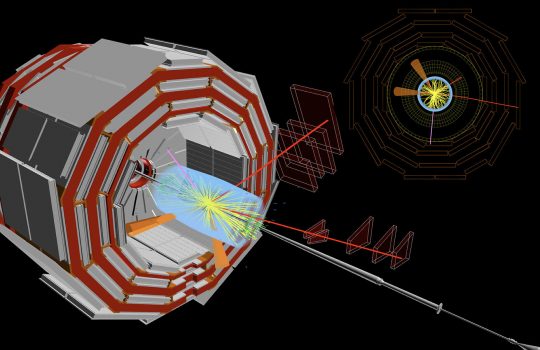
Heavy boson triplets test Standard Model
A recent observation of an extremely rare subatomic process allows scientists to test the Standard Model’s boundaries.

21 - 27 of 27 results
A recent observation of an extremely rare subatomic process allows scientists to test the Standard Model’s boundaries.

Scientists on an experiment at the Large Hadron Collider see massive W particles emerging from collisions with electromagnetic fields. How can this happen?
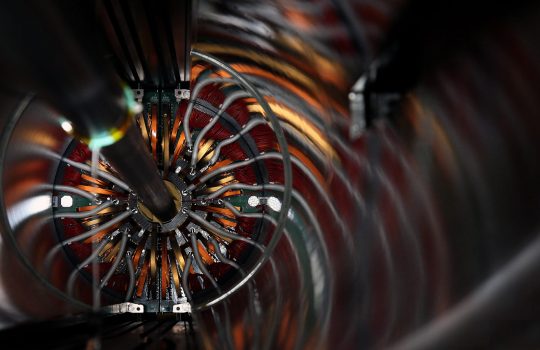
Scientists on Large Hadron Collider experiments can learn about subatomic matter by peering into the collisions and asking: What exactly is doing the colliding? When the answer to that question involves rarely seen, massive particles, it gives scientists a unique way to study the Higgs boson. They can study rare, one-in-a-trillion heavy-boson collisions happening inside the LHC.
From Brookhaven National Laboratory, Feb. 12, 2018: Fermilab scientist Bo Jayatilaka is quoted in this article on ATLAS’s measurement of the mass of the W boson, a particle that plays a weighty role in a delicate balancing act of the quantum universe.
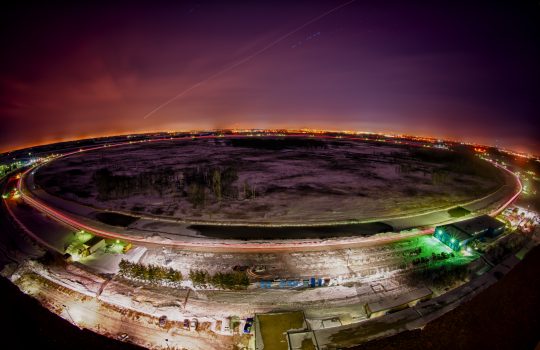
The world’s most precise measurement of the mass of the W boson, one of nature’s elementary particles, has been achieved by scientists from the CDF and DZero collaborations at the Department of Energy’s Fermi National Accelerator Laboratory.
Scientists of the DZero collaboration at the Department of Energy’s Fermi National Accelerator Laboratory have achieved the world’s most precise measurement of the mass of the W boson by a single experiment.
Scientists of the CDF collaboration at the Department of Energy’s Fermi National Accelerator Laboratory announced today (January 8, 2007) the world’s most precise measurement by a single experiment of the mass of the W boson, the carrier of the weak nuclear force and a key parameter of the Standard Model of particles and forces.