Tell me about what you do at Fermilab.
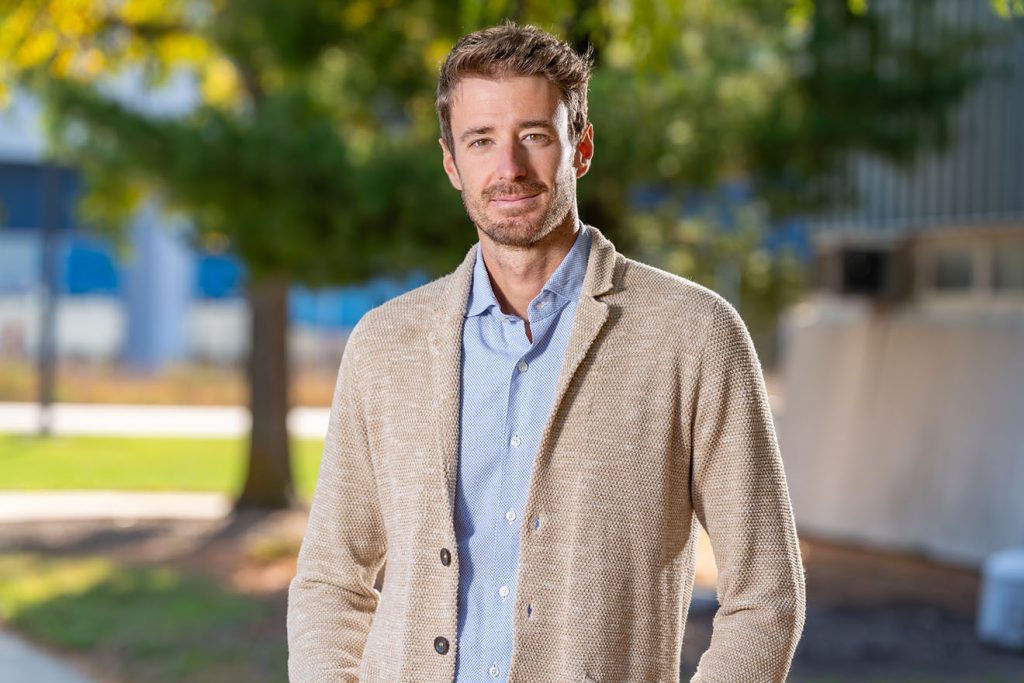
I’m a mechanical engineer, and I work in the Applied Physics and Superconducting Technology Directorate for the Proton Improvement Plan-II project. Back in August, I was appointed the position of level-3 manager for the 650-megahertz system under the superconducting radio-frequency and cryogenics branch of PIP-II.
PIP-II is building a linear accelerator, and it will be made up of 23 cryomodules of different flavors. In my position, I’m responsible for the delivery of 13 low-beta and high-beta 650-megahertz cryomodules. I’m also sub-project manager for the design and assembly of the single-spoke resonators and 650 cryomodules.
That’s an important job; those cryomodules are a major component to the upgrade of Fermilab’s Accelerator Complex. What does that role entail?
The PIP-II project involves a close collaboration with partners from Europe and India. The HB650 cryomodules are being built in the U.K., and the LB650 cryomodules are being built in France with SRF cavities delivered from Italy. Several cryomodule components are also being built in India. So, a lot of my job is to deal with partners and to control the design of the cryomodule, the interfaces between different cryomodules, the infrastructure and so on.
How did your education and career path lead you to Fermilab?
I studied mechanical engineering in Italy at the Polytechnic University of Turin, and I did the last part of my master’s degree in mechanical and industrial engineering at the University of Illinois at Chicago in 2019. After that, I started looking for a job. I knew of Fermilab, so I applied to different positions. I started work in the year 2020 — right in the middle of the covid pandemic.
It sounds like a difficult time to begin a new job! What was that like?
I was in Italy before the pandemic started because I went back for the Christmas period. Then when I got the job offer, I was still in Italy, and when I was planning to come back to Fermilab to start my position at the end of March, it was the week that international arrivals were restricted because of the pandemic. I couldn’t return to the U.S. for quite some time, like half a year, and I was actually able to arrive at Fermilab in November 2020.
What do you find most challenging about your work?
My job is quite broad in scope. It’s interesting because I started here working on the design of the SSR2 cryomodule. After some time, I started working with different subsystems that are involved in the cryomodule design, like cavities, couplers and magnets. From design, you have to transition to procurement, so you have to work with industry, write procurement specifications, manage vendors and also handle incoming quality controls.
And what do you find most rewarding about the work you do?
It’s always very rewarding to see something that I design, or I took part in the design of, to be actually built.
What I also find very exciting is the work with partners, as I’m exposed to many different people working at different laboratories, both in Europe and India. I get to know different cultures and also different ways of working in the same field: superconducting radio frequency.
I feel like there is quite a strong bonding between people, especially the people I work with. I like working with people at Fermilab, and I like being at the lab and seeing hands-on activity taking place.
When you’re not at the lab, how do you like to spend your time?
I do triathlons, so I swim, bike and run most of the time when I’m not working; my favorite of those is biking. The latest triathlon I did was the Ironman 70.3 in Rockford, Illinois. I’d like to compete in a long-distance triathlon next year, which includes a 2.4-mile swim, a 112-mile ride and a 26-mile run.
Fermi National Accelerator Laboratory is America’s national laboratory for particle physics and accelerator research. Fermi Forward Discovery Group manages Fermilab for the U.S. Department of Energy Office of Science. Visit Fermilab’s website at www.fnal.gov and follow us on social media.
Recommended reading
URA honors Fermilab researchers advancing laboratory’s top priorities
Tyler Barrett, Charis-Kleio Koraka, Kevin Kelly and Silvia Zorzetti are the recipients of the 2026 URA Honorary Awards. The awards are presented each year by Universities Research Association to recognize significant contributions to research at Fermilab.
Associate lab directors help shape future of Fermilab
Fermilab’s recent reorganization brings its accelerator, physics and technology programs under three unified directorates, each charged with advancing the laboratory’s most important scientific priorities. Together, these directorates form a coordinated leadership structure designed to deliver world class research and guide Fermilab’s future.
Scientists travel to Fermilab to discuss future of high-energy physics
Fermilab recently hosted over 500 physicists for the American Physical Society’s biennial Division of Particles and Fields meeting. With presentations by Fermilab Director Norbert Holtkamp and CERN Director-General Mark Thomson, the meeting provided particle physicists the opportunity to come together and consider the future of high-energy physics research.