With a sharp focus on Fermilab’s core scientific mission, Norbert Holtkamp is establishing clear priorities and a disciplined strategy that align the laboratory with the nation’s most ambitious research goals. His leadership is positioning Fermilab for long‑term success.
Norbert Holtkamp said he wanted to be Fermilab director because of “the challenge.”
It’s not the managerial side that is challenging for him. Holtkamp is a seasoned leader with more than 20 years of experience managing large, complex scientific projects at SLAC National Accelerator Laboratory in California, Oak Ridge National Laboratory in Tennessee, and ITER, the International Thermonuclear Experimental Reactor in France.
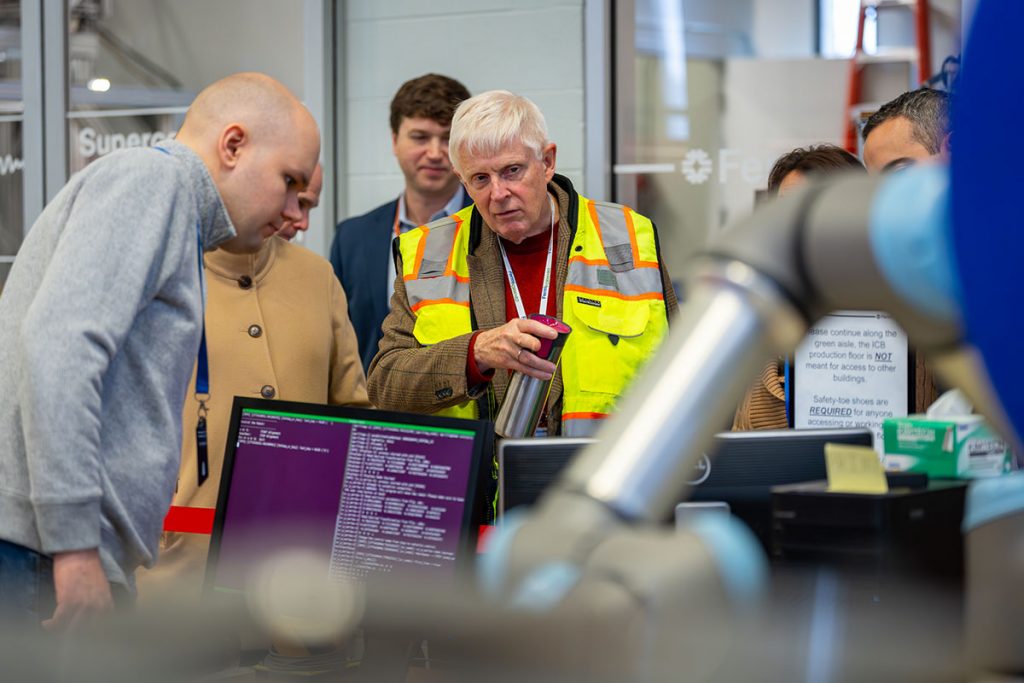
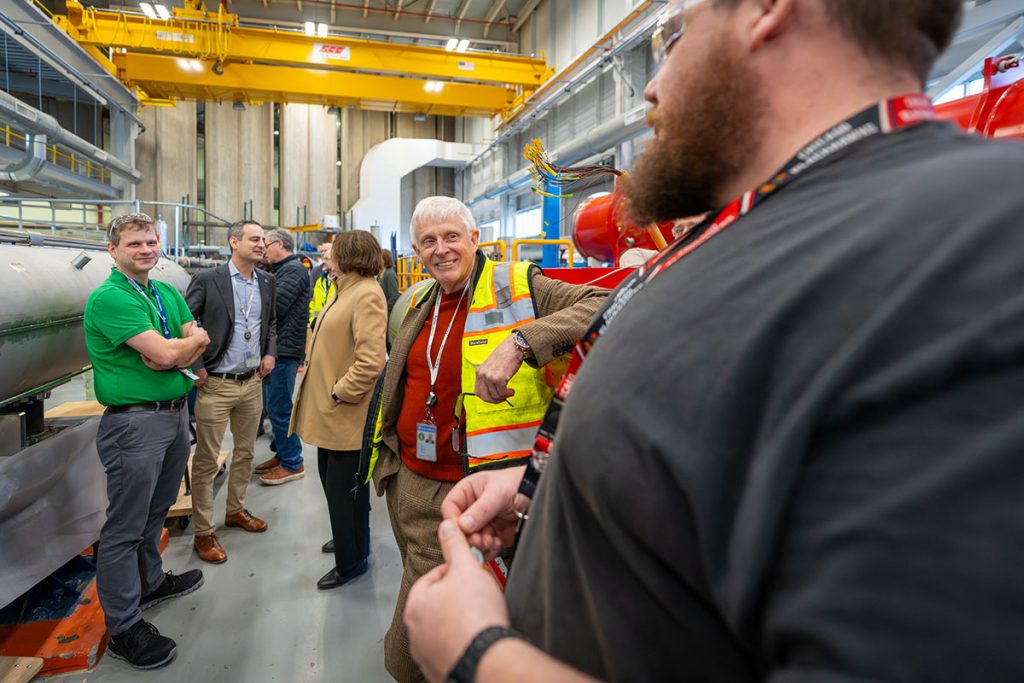
Fermilab Director Norbert Holtkamp talks with staff inside ICB — the Industrial Center Building — at Fermilab. Credit: JJ Starr, Fermilab
Rather, Holtkamp is drawn by the challenge of answering the questions that the U.S. Department of Energy’s Fermi National Accelerator Laboratory — and the entire DOE national lab system — was created to solve.
“We are here to ask the difficult questions: the key questions that the nation needs to answer in science and technology,” Holtkamp said. “As a community, we need to make sure we ask these questions broadly, define their priorities and then think about the instruments needed to answer them. That has been the fabric of the national labs from their inception.”
“We are here to ask the difficult questions: the key questions that the nation needs to answer in science and technology.”
Norbert Holtkamp, director of Fermilab
Holtkamp stepped into his role as director of Fermilab on Jan. 12, 2026. In the 100 days since, he has defined the lab’s direction and strategy — like focusing a particle beam to its target. The result is that Fermilab has a clear course forward that is grounded in focus, execution and safe delivery of the laboratory’s and the nation’s highest scientific objectives.
One of his boldest early moves was to identify and promote three clear and concrete priorities to guide the lab’s work:
Delivering a powerful particle beam for the Deep Underground Neutrino Experiment at the Long-Baseline Neutrino Facility by 2031
Supporting the High-Luminosity Large Hadron Collider upgrade and the CMS experiment at CERN
Driving technological innovation for the benefit of science and society
Holtkamp also made clear that these initiatives must be done safely, with quality and on schedule — in that order. “Focus is the key to success for organizations facing daunting projects,” he said. “Hopefully, I achieved that.”
Delivering the world’s leading neutrino program
Delivering DUNE — efficiently and effectively — is Fermilab’s top institutional priority and central to maintaining U.S. leadership in neutrino science. DUNE is an international flagship experiment hosted by Fermilab and designed to unlock the mysteries of neutrinos — subatomic particles that may hold the key to understanding why the balance was tipped toward there being more matter than antimatter in our universe. The Long-Baseline Neutrino Facility for DUNE comprises two state-of-the-art particle detectors: a smaller detector at Fermilab in Illinois, and a much larger detector a mile below Earth’s surface at the Sanford Underground Research Facility in South Dakota.
The experiment will be powered by a new linear accelerator being built by the Proton Improvement Plan-II, another flagship project at Fermilab. Together, DUNE at LBNF and PIP-II will shape the next generation of discovery by not only answering fundamental questions about our universe but also driving next-generation technologies.
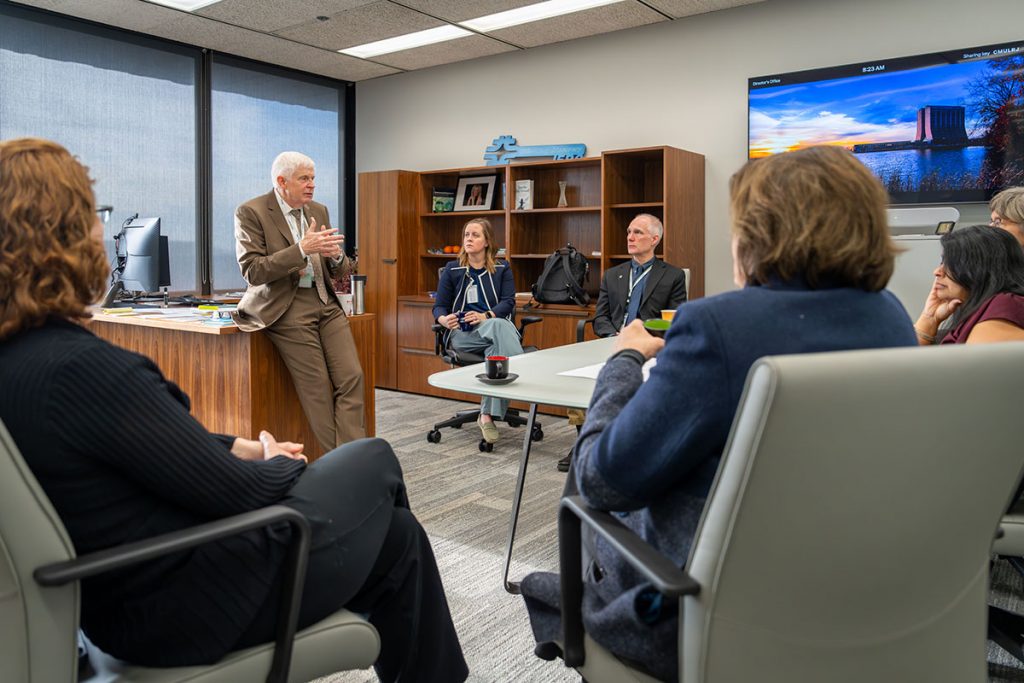
Fermilab Director Norbert Holtkamp leads a meeting in his office at Wilson Hall. Credit: JJ Starr, Fermilab
In the last 100 days, the LBNF/DUNE-US project team hosted several successful “critical decision” reviews required by the Department of Energy, including the essential CD-2/3 review that approved the project’s performance baseline and start of construction. This successful review signals that the project is fully planned and ready for execution.
At the South Dakota site, the collaboration is preparing to move 6,000 tons of massive steel components underground for installation of the particle detector cryostats. With this, the project enters its third and final phase there — the installation of the DUNE detector.
“We are extremely grateful for Norbert’s direction and focus. I think it will greatly benefit the DUNE at LBNF effort and enable us to achieve and execute at the highest level.”
Steve Brice, head of Fermilab DUNE Coordination Office
“We are extremely grateful for Norbert’s direction and focus,” said Steve Brice, head of the Fermilab DUNE Coordination Office. “I think it will greatly benefit the DUNE at LBNF effort and enable us to achieve and execute at the highest level.”
Meanwhile, the PIP-II team continues to make progress on Fermilab’s campus in Illinois. In 2026, the team is focusing on what they call the “warm front end” — the source where negatively charged hydrogen ions will be created to feed into the accelerator and eventually form the neutrino beam. The collaboration recently began installing piping for the cryogenic distribution system, and they are preparing for the first piece of the beamline — the radio-frequency quadrupole — to be brought into the PIP-II tunnel in the coming weeks.
Enabling U.S. leadership in global particle physics
The Large Hadron Collider at CERN is the largest, most powerful particle accelerator in the world. Fermilab plays a critical role in enabling its next stage, an upgrade called the High-Luminosity LHC. As the host U.S. laboratory for the CMS experiment at CERN, Fermilab is vital to its success and will deliver next-generation magnets, detector systems and computing infrastructure that will greatly expand the data output of the CMS experiment. These contributions help reinforce Fermilab’s role as a key integrator of U.S. participation in global particle physics, ensuring America fully realizes the scientific return on its investment in the HL-LHC.
“The three priorities from the director provide focus on all critical aspects of day-to-day work in the HL-LHC AUP,” said Giorgio Apollinari, Fermilab senior scientist and project director of the HL-LHC Accelerator Upgrade Project, the U.S. in-kind contribution to the LHC upgrade. “There is an appreciation for the emphasis on the AUP effort, but also a renewed awareness that our first mandate is to plan and execute work with safety on the forefront of our activities.”
“The three priorities from the director provide focus on all critical aspects of day-to-day work in the HL-LHC AUP.”
Giorgio Apollinari, project director of the HL-LHC Accelerator Upgrade Project
Fermilab’s scope of work for the HL-LHC upgrade was established in 2021. Already, Fermilab has shipped five cryoassemblies containing niobium-tin magnets for use in the collider. The magnets will focus the beam at the CMS and ATLAS interaction points, increasing the number of collisions in the high-luminosity era.
Fermilab will deliver five additional cryoassemblies by mid-2027. The innovative superconducting magnet system, developed through a consortium of U.S. national laboratories and institutions, including Lawrence Berkeley National Laboratory, Brookhaven National Laboratory and Fermilab, is an important element in the major upgrade that will transform the Large Hadron Collider into the HL-LHC. Fermilab’s leadership and participation in the upgrade demonstrate the lab’s commitment to its ongoing collaboration with CERN and DOE national laboratories.
Driving innovation
Holtkamp’s third priority is driving innovation by advancing quantum science, artificial intelligence, accelerator research and development, and detector technologies to create impact far beyond particle physics. Fermilab’s innovation program will advance foundational technologies at the edge of what’s possible — with applications that ripple across medicine, national security, computing and beyond.
As the home to collaborations like the Superconducting Quantum Materials and Systems Center, one of five DOE National Quantum Information Science Research Centers, Fermilab is primed to drive innovation for the benefit of society.
“Norbert’s emphasis on technology as a driver of growth and expanding our impact beyond traditional boundaries is both timely and essential for modernizing the laboratory,” said Anna Grassellino, Fermilab chief technology officer and director of SQMS. “It reflects a modern vision where scientific excellence and technological innovation go hand in hand.”
In quantum information science, SQMS has recently achieved major milestones across materials, devices and systems. The center set new performance records for the duration of time quantum devices can reliably store information. SQMS cavity qudit systems have demonstrated record coherence values over 20 milliseconds, while transmon devices using the element rhenium reached coherence for a record 1.2 milliseconds — important steps toward building more powerful and reliable quantum technologies.
SQMS has also developed a liquid-helium cryoplant-based solution delivering an order-of-magnitude increase in cooling power at 4 kelvin — around minus 452 degrees Fahrenheit — paving the way toward more efficient and scalable quantum data centers.
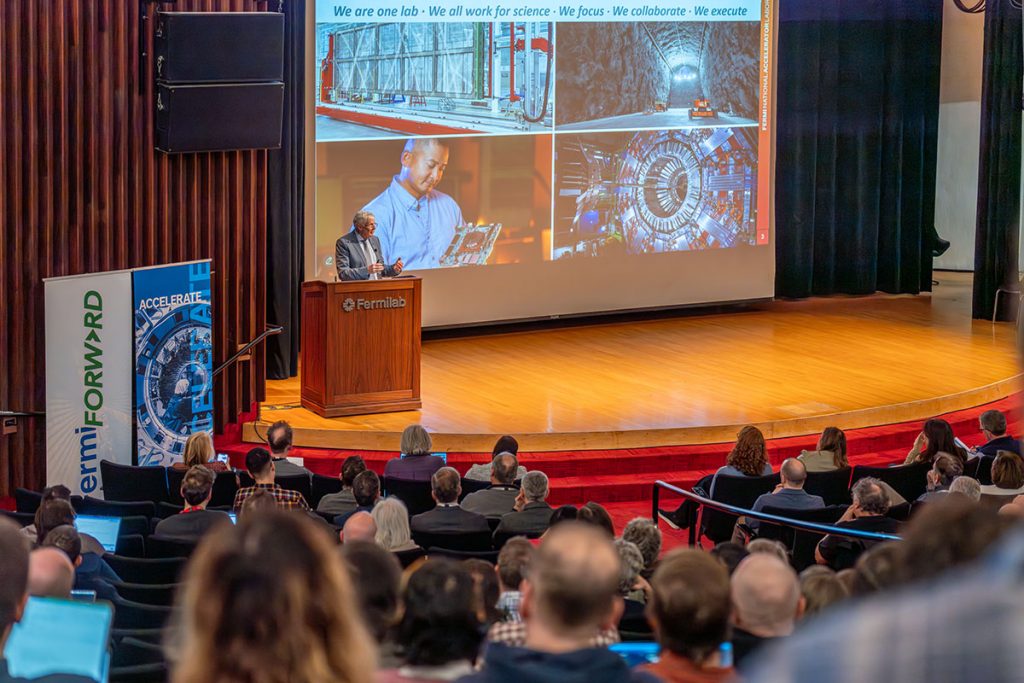
Fermilab Director Norbert Holtkamp leads an all-hands meeting in Ramsey Auditorium at Fermilab’s iconic Wilson Hall. Credit: JJ Starr, Fermilab
Fermilab is also a key contributor to the DOE Genesis Mission, which is uniting all 17 national laboratories with academia and industry to accelerate discovery through AI. SQMS plays a central role in both its quantum and AI components. Industry partnerships with IBM, Maybell Quantum and Rigetti Computing are advancing scalable, fault-tolerant quantum systems while SQMS researchers are leveraging AI to accelerate algorithm and error-correction discovery, automate quantum measurements and reduce background interference.
As a national quantum center, SQMS is leading a cross-center effort to bring together all types of quantum data — from materials to algorithms — into a unified, AI-ready ecosystem. This initiative will enable foundation models and advanced analytics, accelerating breakthroughs, expanding access and positioning DOE as a global leader in AI-driven quantum discovery.
“In just 100 days, Norbert Holtkamp has set a compelling direction for Fermilab — one grounded in focus, execution and growth.”
Anna Grassellino, Fermilab chief technology officer and director of SQMS
More broadly, Fermilab’s contributions to the Genesis Mission include optimizing particle accelerators, advancing microchip design through the AXESS project and supporting the American Science Cloud through the Fermi Data Platform. The laboratory is also applying AI to theoretical physics, making decades of collider data AI-ready through the TREASURE initiative and enhancing astrophysics via the AI Universe project.
In addition, the lab continues to lead in emerging technologies. Fermilab teams completed construction of the laser system for MAGIS-100, the world’s largest vertical atom interferometer. Fermilab and Stanford University researchers achieved 100-picosecond synchronization of distributed quantum systems using the XCOM network, a key step toward scaling interconnections of quantum systems.
“In just 100 days, Norbert Holtkamp has set a compelling direction for Fermilab — one grounded in focus, execution and growth,” said Grassellino. “By defining clear priorities and aligning the laboratory to support them, he has positioned Fermilab to move with greater coherence and purpose.”
Enhancing operational excellence
A central element of Holtkamp’s management approach has been strengthening Fermilab’s operational effectiveness to support disciplined and effective scientific research and project delivery. Part of his early efforts included configuring the Fermilab team to better support DOE’s missions and priorities. The new organizational structure will streamline governance, improve organizational effectiveness, allow for faster decision-making, improve cost efficiency and employee engagement, and reduce bureaucracy.
Incorporating lessons he learned from other labs, Holtkamp has flattened the organizational structure to increase the employee-to-supervisor ratio. The new, simplified structure has scientific research guided under three overarching directorates: Technology, Accelerators, and Physics.
Through a “management by walking around” approach, Fermilab Director Norbert Holtkamp stays connected with staff in all areas of the lab. Credit: JJ Starr, Fermilab
As part of his “management by walking around” approach, Holtkamp has traveled to various parts of the lab to meet with staff in person. “I really appreciated his visits to work areas,” said Apollinari. “This was a great plus for the workforce to have the lab director see where they work and experience their surroundings.”
Holtkamp said he is happy with how the lab community is reacting to all the changes so far. “What I’m most impressed with is how extremely well people are responding to the challenge I put out there and how wonderfully they deliver,” Holtkamp said.
He also noted his appreciation for the strong support Fermilab receives from the Department of Energy’s Office of Science and the collaborative relationship between the laboratory and the DOE Fermi Site Office. Holtkamp expressed gratitude as well for support from the board of directors of Fermi Forward Discovery Group, which is contracted to manage and operate Fermilab on behalf of the Department of Energy.
Successful homecoming
One hundred days into his tenure, Holtkamp has established a clear direction for Fermilab — one that aligns scientific ambition with disciplined execution. By focusing on delivering the world’s leading neutrino program, driving collaboration to enable global particle physics leadership, and advancing technologies that benefit society, Fermilab is reinforcing its position as America’s particle physics laboratory.
Holtkamp said he looks forward to continuing to advocate for Fermilab’s mission and to maintaining and strengthening the lab’s collaboration with other institutions, including with Chicagoland neighbor Argonne National Laboratory and the other DOE national labs.
Ultimately, Holtkamp is happy to return to the institution that first welcomed him and his family to the United States in 1998. “For me, this is a coming-home thing after more than 25 years,” Holtkamp said. “It’s very enjoyable.”
Fermi National Accelerator Laboratory is America’s national laboratory for particle physics and accelerator research. Fermi Forward Discovery Group manages Fermilab for the U.S. Department of Energy Office of Science. Visit Fermilab’s website at www.fnal.gov and follow us on social media.
The founding director provides perspective on the first six years of a DOE National Quantum Information Science Research Center — the Superconducting Quantum Materials and Systems Center, led by Fermi National Accelerator Laboratory.
Daniel Bafia will develop a new measurement approach that uses magnetic vortices to investigate defects and interfaces that can limit the performance of superconducting quantum devices. The project could provide researchers with a new way to understand and ultimately reduce sources of energy loss in quantum materials.
Two new awards will expand Fermilab’s critical role in the Genesis Mission by developing custom microelectronics and advancing quantum information science.