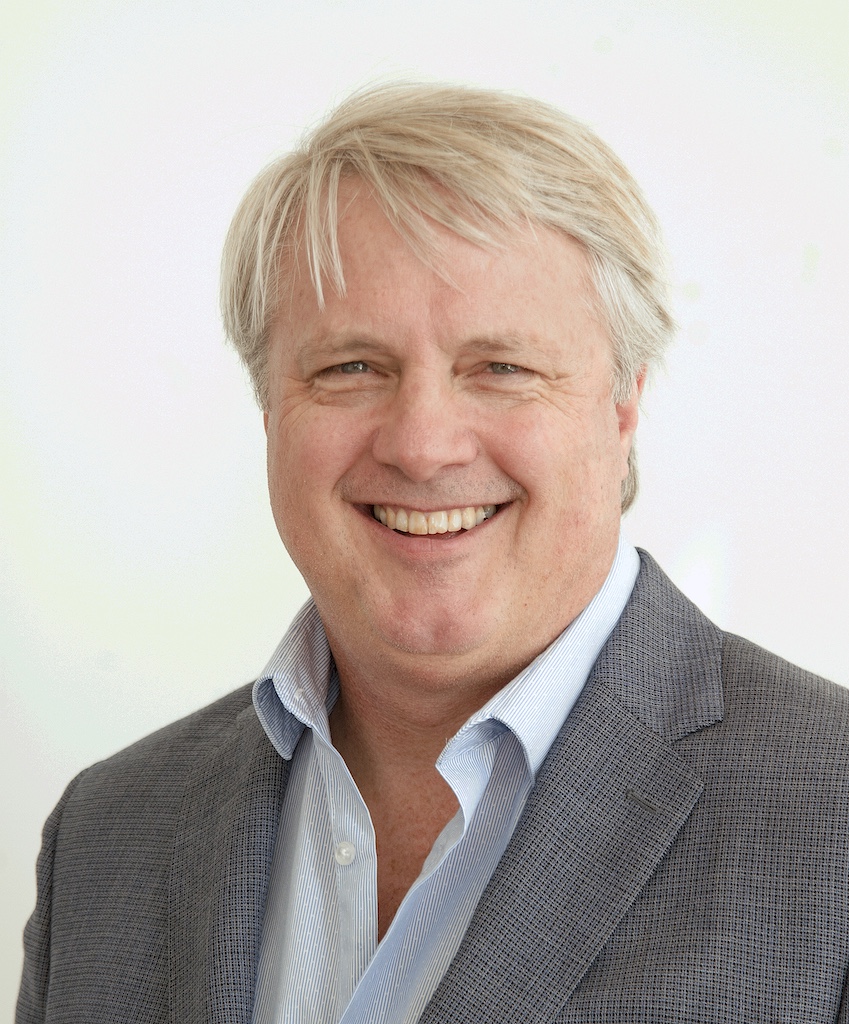
John Byrd has been named director of the U.S. Particle Accelerator School (USPAS). He succeeds Professor Steven Lund of Michigan State University, who has served as director since 2018.
USPAS is the nation’s premier training program in accelerator science and engineering. The school’s collaboration includes seven Department of Energy Office of Science laboratories, one DOE National Nuclear Security Administration laboratory and two universities.
USPAS is the nation’s premier training program in accelerator science and engineering. The school’s collaboration includes seven Department of Energy Office of Science laboratories, one DOE National Nuclear Security Administration laboratory and two universities.
“Being selected as the USPAS director is a true ‘circle-of-life’ moment for me,” said Byrd. “My career in accelerator science began in 1988, inspired by a USPAS course taught by Don Edwards and Mike Syphers, and it has been a privilege to witness and contribute to the field’s extraordinary development over the past three decades. It is both humbling and profoundly meaningful to now have the opportunity to give back to the community and institution that helped shape my professional life.”
After earning his Ph.D. in physics from Cornell University in 1991, Byrd spent 26 years at Lawrence Berkeley National Laboratory (LBNL), contributing to major accelerator facilities, including PEP-II at SLAC, the Advanced Light Source at LBNL, the Linac Coherent Light Source at SLAC, the Large Hadron Collider at CERN and the Free Electron Laser Radiation for Multidisciplinary Investigations at Elettra.
n 2017, he joined Argonne National Laboratory as division director for the accelerator systems division at the Advanced Photon Source (APS), leading efforts for the operation of the APS and contributing to the design, construction and commissioning of the APS upgrade. After retiring from Argonne in 2024, he worked on several industrial accelerator projects before accepting the position of USPAS director.
“The U.S. Particle Accelerator School has educated next-generation accelerator physicists and engineers for decades and through that, made sure that we can build ever better accelerators and develop new important technologies,” said Norbert Holtkamp, director of Fermi National Accelerator Laboratory.
Founded in 1981, USPAS convenes twice each year to offer a broad range of graduate-level courses through an intensive school format. USPAS offers a continually updated curriculum ranging from foundational accelerator science to advanced physics and engineering topics. In addition to meeting the workforce needs of national laboratories, the school educates students and professionals on the many applications of particle accelerators in areas such as science, medicine, security and industry. The training and documentation produced through USPAS sessions are broadly recognized for excellence and have had a profound and lasting impact on the accelerator community.
The USPAS office at Fermilab and the USPAS director are responsible for the operation and management of the school, coordinating across the entire accelerator community through the USPAS Institutional Board and the USPAS Director’s Advisory Council.
“The U.S. Particle Accelerator School has educated next-generation accelerator physicists and engineers for decades and through that, made sure that we can build ever better accelerators and develop new important technologies,”
Norbert Holtkamp, director of Fermi National Accelerator Laboratory
“I am very pleased to hear this news,” said Cameron Geddes, director of the Accelerator Technology & Applied Physics Division at Lawrence Berkeley National Laboratory and a member of the USPAS Institutional Board. “John’s distinguished research perspective will advance the vital role of the school in providing accelerator physics education not available at most universities and help him leverage the contributions of lecturers from around the community.”
“Over the past 45 years, USPAS has become a cornerstone of education and training for national laboratories that rely on accelerator-based research,” said Zhirong Huang of SLAC National Accelerator Laboratory and Stanford University, and also chair of the USPAS Curriculum Committee and the Director Search Committee. “On behalf of the national laboratory and university communities, we extend our sincere thanks to the outgoing director, Steve Lund, for his eight years of dedicated leadership at USPAS. We have also valued our work with John Byrd through his many years of teaching USPAS classes, his years of service on the USPAS Director’s Advisory Council and Curriculum Committee, and we look forward to continuing our work with him as he steps into the role of the USPAS director, furthering this vital mission.”
Particle accelerators are a critical driver of both discovery science and industry that broadly enable the mission of the U.S. Department of Energy Office of Science. As some of the most complex, large-scale systems in the world, DOE’s accelerators play a key role in DOE’s new Genesis Mission, which aims to revolutionize the nation’s science and technology output by leveraging and extending state-of-the-art artificial intelligence. Genesis will open new capabilities and horizons in accelerator science and technology. The world-class training that USPAS provides will ensure that students, scientists and industry professionals in the accelerator field are ready for that future.
“The Office of High Energy Physics has proudly supported the U.S. Particle Accelerator School since the early 1980s, recognizing its critical role in cultivating the next generation of accelerator scientists and engineers,” said Regina Rameika, associate director for the Office of High Energy Physics within DOE’s Office of Science. “Our continued investment, notably through HEP’s General Accelerator Research Development program and the Accelerator Traineeship program, ensures USPAS remains an invaluable resource for developing the future accelerator workforce. We are particularly pleased with the appointment of John Byrd, whose three decades of dedicated involvement in accelerator research, leadership and workforce development make him an exceptional choice to guide USPAS into its next chapter.”
More information on the USPAS and the announcement can be found on the USPAS website.
Recommended reading
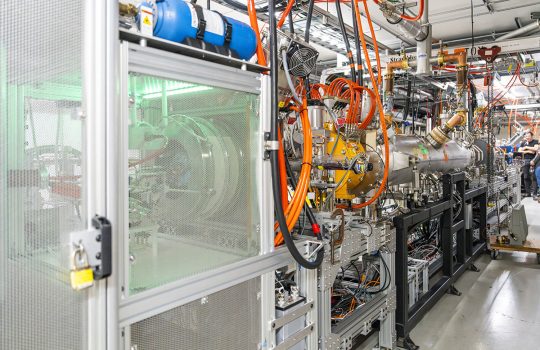
Fermilab’s FAST/IOTA facility achieves major milestone in accelerator research
Fermilab’s FAST/IOTA accelerator test facility has successfully accelerated and stored its first proton beams, marking a major milestone in the lab’s R&D program for next-generation particle accelerator technology. This achievement paves the way for breakthroughs in high-intensity beam physics, artificial intelligence applications and innovations that will power future experiments like the Deep Underground Neutrino Experiment.
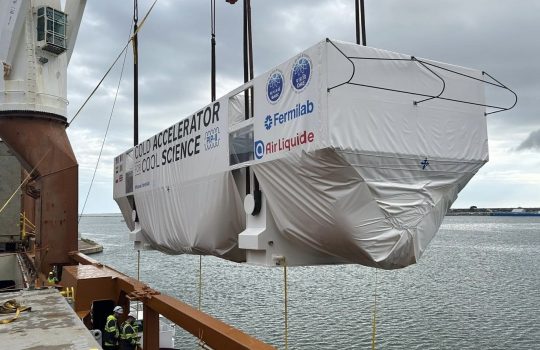
Fermilab expecting 95-ton coldbox delivery
The coldbox, a vital piece of Fermilab’s new linear accelerator, is on a two-month voyage from France to its new home in Batavia, Illinois. It will be at the heart of the cryogenic system for the lab’s upgraded accelerator complex.
Fermilab completes the first-of-its-kind prototype of a superconducting accelerator module
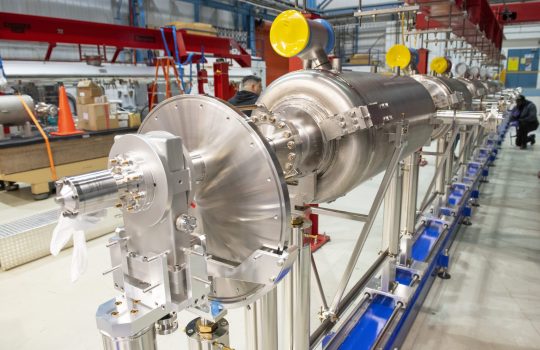
The 10-meter-long cryomodule, part of the PIP-II particle accelerator project at Fermilab, is now undergoing testing to validate all its components and finalize its design. In a few years, Fermilab and international partners will produce four similar cryomodules that will propel particles in the new linear accelerator.