
An accelerator technology test facility with a catchy name has achieved a major milestone at the U.S. Department of Energy’s Fermi National Accelerator Laboratory by successfully accelerating its first proton beams. The achievement marks an important step forward that will support research aimed at pushing the boundaries of stable, high-intensity beams in future particle accelerator programs.
“This marks a major advancement for our R&D program.”
Jonathan Jarvis, director of Fermilab’s Accelerator Research Division
“This marks a major advancement for our R&D program,” said Jonathan Jarvis, director of Fermilab’s Accelerator Research Division. “This new proton-beam capability lets us address the challenges we’ll face as we increase the beam power in Fermilab’s accelerators.”
The dedicated research and development accelerator complex is called FAST/IOTA — shorthand for Fermilab’s Accelerator Science and Technology facility and its Integrable Optics Test Accelerator ring. Particle accelerators empower scientists to study the universe at its smallest scales, and FAST/IOTA helps ensure the United States will continue to hold a preeminent position in high-energy particle physics.
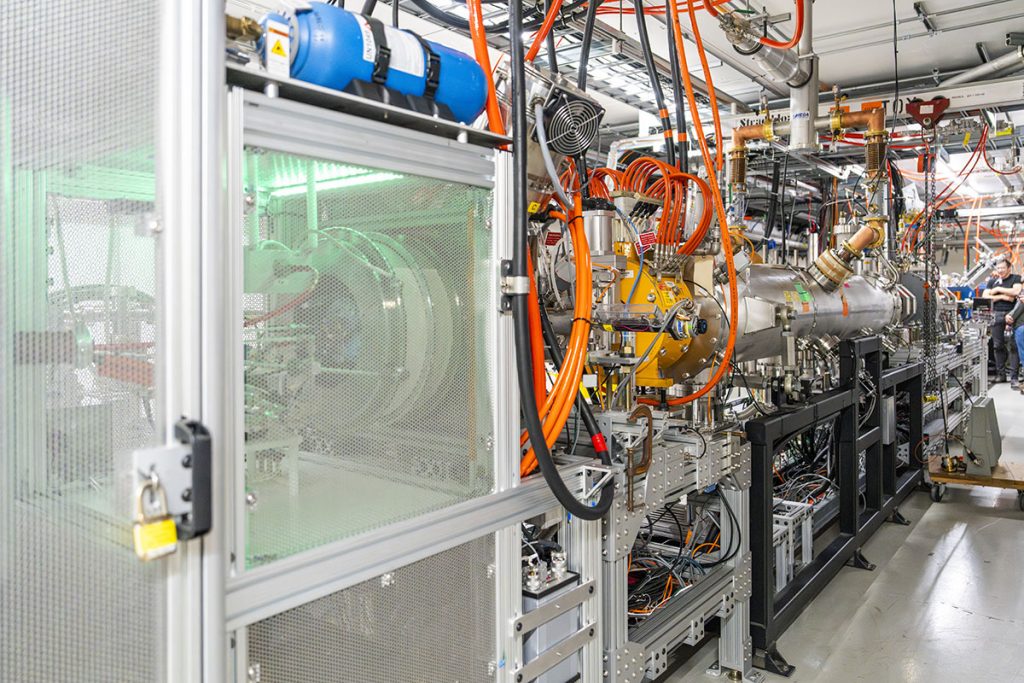
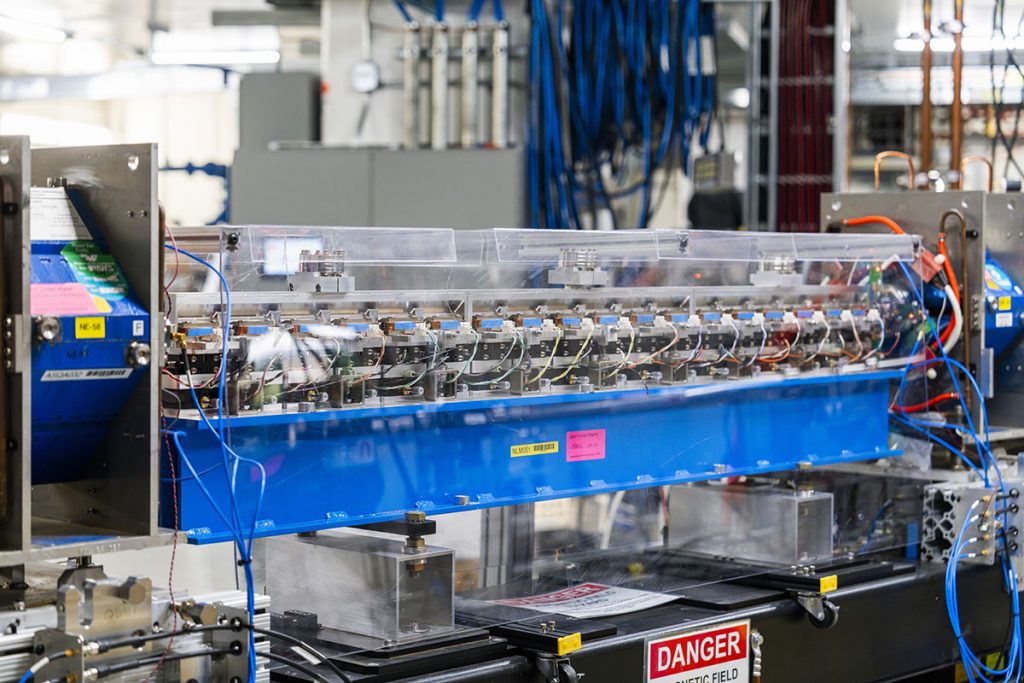
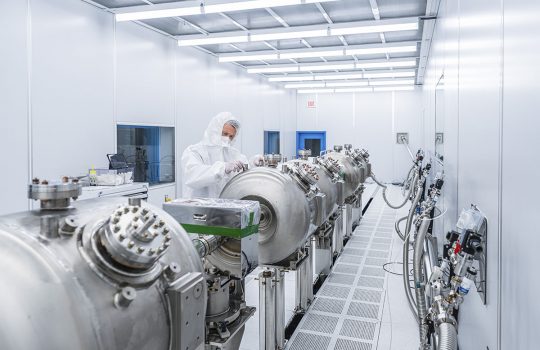
FAST has two linear accelerators that are connected to the IOTA storage ring, one for electrons and now one for protons. The IOTA ring is equipped with unique magnets and other advanced technologies that enable researchers to study new concepts for cutting-edge accelerator systems and high-intensity beam physics.
Compared to Fermilab’s main accelerator complex, a large, well-established workhorse delivering high-energy protons for physics experiments, FAST/IOTA is designed to evaluate technologies that could improve the efficiency, reliability and performance of future particle accelerators.
“FAST/IOTA is a dedicated R&D accelerator complex that provides us the freedom to explore high-risk, high-reward ideas,” explained Jarvis. “These ideas could dramatically improve the way we design, build and operate particle accelerators.”
In accelerator physics, intensity refers to the number of particles packed into a beam and accelerated through the machine. With protons now circling the ring at around 7% of the speed of light, researchers can further investigate methods for mitigating beam instabilities, develop advanced control systems and discover ways to apply artificial intelligence to accelerator operations.
Fermilab is in the process of upgrading its high-power, proton-accelerator complex through the PIP-II project. This upgrade will enable higher-intensity beams for the lab’s neutrino science program, beginning with the Deep Underground Neutrino Experiment. FAST/IOTA will enhance this effort by providing advanced tools and understanding for navigating the challenges of such high-intensity operations.
By figuring out how to increase the number of particles in an accelerator beam and reduce beam losses, researchers can steer more particles toward a target. When more particles hit the target, they generate more secondary particles such as neutrinos. FAST/IOTA’s flexible, modular design makes it especially suited for developing new methods to increase and maintain beam intensity.
“Researchers can conduct tests and experiments without tying up the operations of a larger production facility,” said Trey Thompson, an engineering physicist on the FAST/IOTA team. “We can shut down, swap out part of the ring and install new experiments without the usual constraints.”
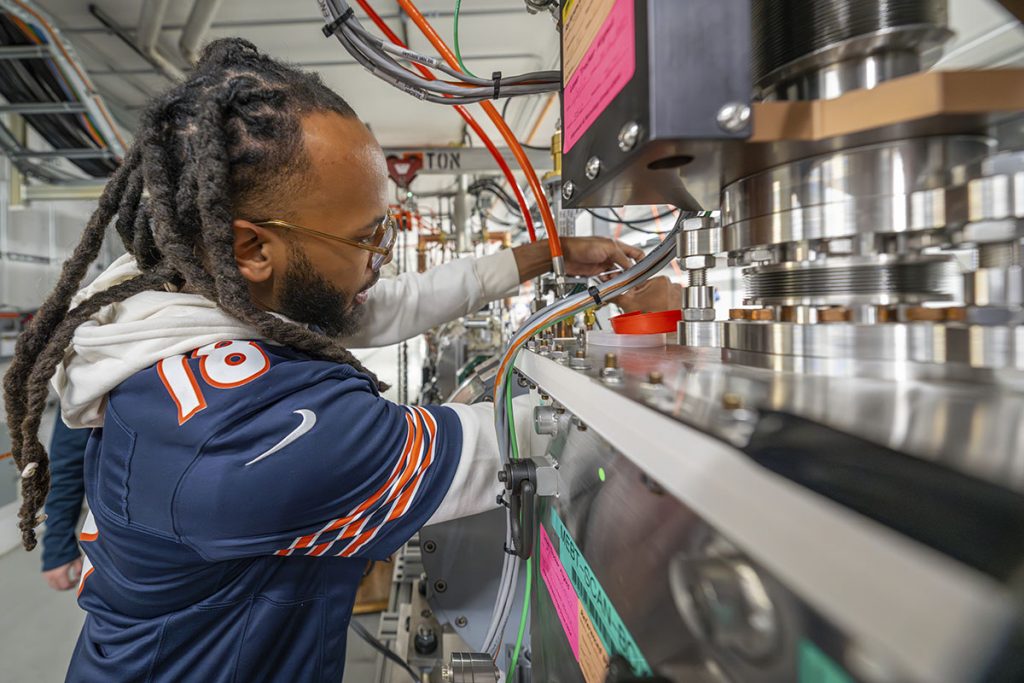
Before this upgrade, FAST/IOTA primarily worked with electron beams. For example, in 2022, Fermilab researchers published a landmark paper in Nature, reporting the first experimental demonstration of optical stochastic cooling — a breakthrough technique that cools a particle beam using its own emitted light. The team also conducted studies on single electrons, using the facility’s unique capabilities to track individual particles for hours at a time.
“Electrons were a perfect starting point and complement to our proton work,” said Jarvis. “They’re easy to work with, and they help us explore the advanced concepts and technologies that we are developing for our core proton program.”
With this upgrade, FAST/IOTA is also helping to pioneer the use of artificial intelligence in accelerator design and operations.
“About half of our program now focuses on enhancing accelerators with AI,” Jarvis said. “We’re building high-fidelity simulation environments that capture the complexity of the real machine and are fully integrated with its control systems. These virtual accelerators allow us to train AI systems to optimize performance and discover new configurations. The key is that we can then test those simulations in a real machine, at scale.”
AI is not only a research focus but also a practical tool in deploying the new proton systems.
“We used AI tools to help optimize the output of the proton source,” said Fermilab engineering physicist Chip Edstrom. “We’ve applied algorithms that treat the system as a black box — meaning we don’t need to understand every internal detail — and instead optimize parameters based on performance.”
This approach reflects Fermilab’s broader core value of ingenuity, which also makes FAST/IOTA an ideal environment for accelerator workforce development. Students and postdoctoral researchers gain “full-stack” experience, from design and construction to operation and data analysis for particle accelerators. At any given time, the program hosts multiple graduate students and postdoctoral researchers, exposing them to cutting-edge R&D spanning physics, engineering and AI.
“There aren’t many places where you can get hands-on experience with a facility of this scale,” Jarvis said. “It’s an incredible opportunity to train the next generation of accelerator scientists and technologists.”
And the impact of FAST/IOTA will extend well beyond Fermilab. “This is the realization of a vision that began over a decade ago,” Jarvis added. “We’ve built a uniquely capable facility that will help guide the operation and design of next-generation accelerators — from Fermilab’s own PIP-II project to machines around the world.”
Fermi National Accelerator Laboratory is America’s premier national laboratory for particle physics and accelerator research. Fermi Forward Discovery Group manages Fermilab for the U.S. Department of Energy Office of Science. Visit Fermilab’s website at www.fnal.gov and follow us on social media.
Recommended reading
Fermilab to lead two new Genesis Mission awards to accelerate development of microelectronics and quantum
Two new awards will expand Fermilab’s critical role in the Genesis Mission by developing custom microelectronics and advancing quantum information science.
DOE selects Fermilab-led AI initiative to advance particle accelerator performance
In a project selected for funding by the Department of Energy’s Genesis Mission, Fermi National Accelerator Laboratory and partners from other national laboratories, universities and industry will apply artificial intelligence and machine learning to enable precise and adaptive resonance control in particle accelerators. Their work aims to lower operating costs by millions of dollars each year and improve accelerator performance, driving scientific discovery.

DUNE uses AI to transform the future of neutrino research
DUNE is pioneering the future of neutrino research by integrating artificial intelligence into its experiment, drawing on decades of machine learning work at Fermilab.