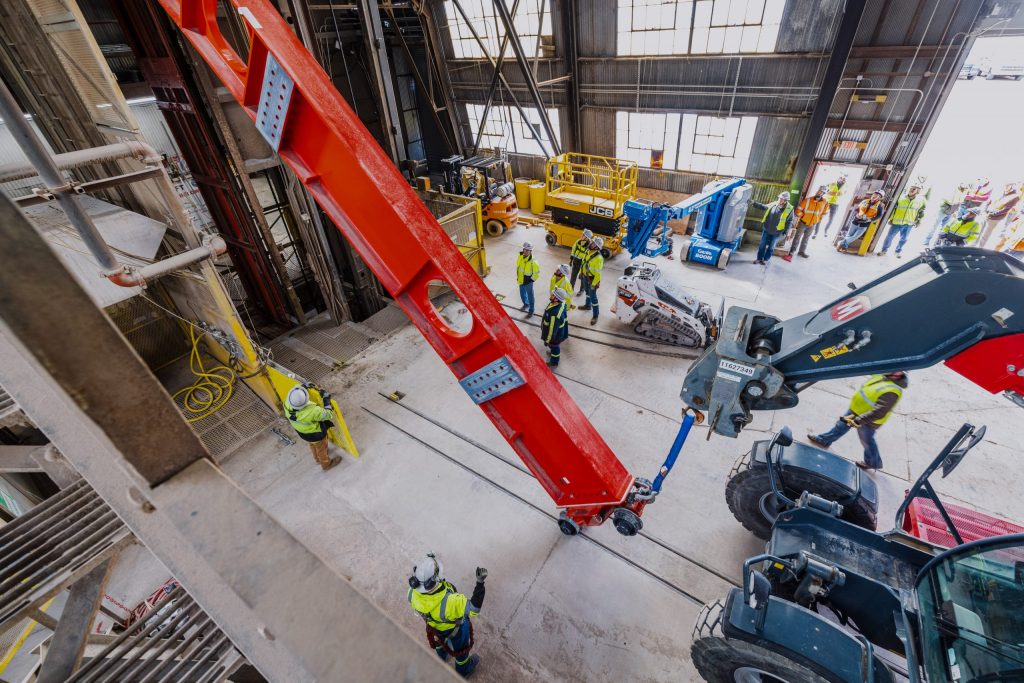
Fermi National Accelerator Laboratory and the Sanford Underground Research Facility held an event today in Lead, S.D., celebrating a significant milestone for the most ambitious neutrino research experiment in the United States, the Deep Underground Neutrino Experiment at the Long-Baseline Neutrino Facility. The event commemorated the start of 10 million pounds of steel beams being moved a mile underground to build the structural elements that will form DUNE’s detector elements.
“Today represents the start of a pivotal phase for DUNE, the development of the far detector structures in South Dakota,” Fermilab Director Norbert Holtkamp said. “As we advance this historic effort, our focus remains on safety, quality and schedule — in that order — to ensure we successfully deliver on behalf of the U.S. Department of Energy, our nation and the world.”
Holtkamp added, “We at Fermilab are grateful for the support from DOE and the close collaboration of our science partners at SURF, CERN and the many international institutions that are contributing to DUNE.”
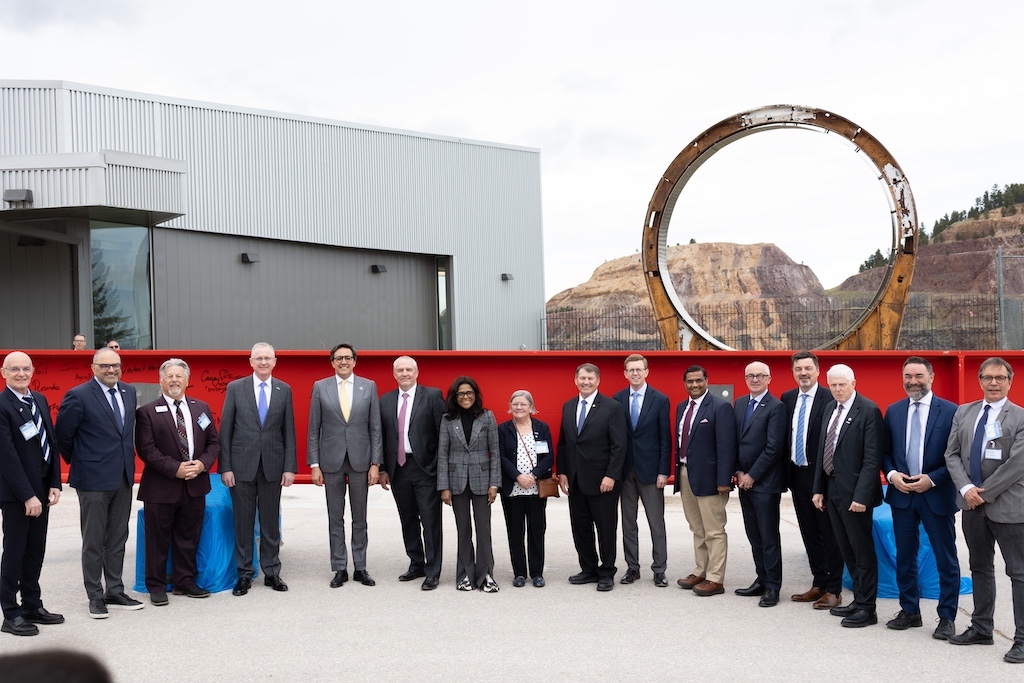
CERN, the European Organization for Nuclear Research, provided personnel, expertise and an in-kind contribution of 10 million pounds of steel for the detectors being assembled underground in South Dakota. This is the first time CERN has invested in infrastructure for an experiment outside of Europe.
The steel cryostat materials contributed by CERN for DUNE are scheduled to be moved underground and prepared for installation this summer. This marks an important transition from construction to detector installation and demonstrates the tangible impact of international in-kind contributions to DUNE.
“This important milestone for DUNE is a testament to the strong scientific partnership between CERN and the United States,” said CERN Director General Mark Thomson. “CERN is playing a pivotal role in the development of its prototype detectors and providing the two enormous cryostats for the experiment itself, while the U.S. Department of Energy national laboratories likewise are playing a critical role for CERN with state-of-the-art superconducting accelerator magnets for the High-Luminosity Large Hadron Collider.”
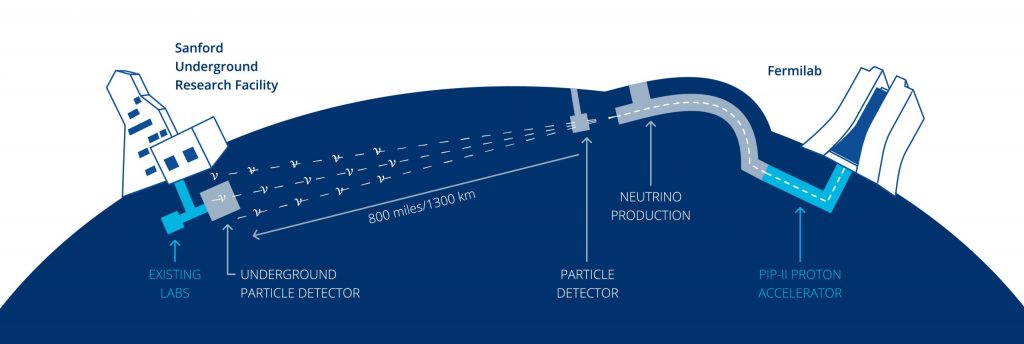
As America’s particle physics laboratory, Fermilab is host to DUNE — a world-leading, flagship experiment that is the largest scientific project supported by the DOE Office of Science and the largest in the United States. The project will study the neutrino, one of the universe’s most abundant yet least understood subatomic particles. DUNE will send the world’s most intense neutrino beam a distance of 800 miles from Fermilab in Illinois to detectors deep underground at SURF, enabling it to explore fundamental questions about the nature of matter, the evolution of the universe and the origin of matter-antimatter asymmetry.
In addition to expanding our fundamental knowledge, neutrino research has the vast potential to drive advances across a range of fields, including national security, communications and medical imaging.
“DUNE is a powerful example of DOE’s commitment to advancing American leadership in science,” said DOE Under Secretary for Science Darío Gil, one of the attendees at today’s event. “On behalf of the entire DOE leadership team, I offer my congratulations to Fermilab and all those involved in this historic initiative, including our partners around the world who helped make this milestone possible.”
Today’s event provided attendees the opportunity to sign one of the steel beams that will be installed underground for DUNE’s first detector module, including a cryostat that will be used to cool thousands of tons of liquid argon to about minus 300 degrees Fahrenheit to capture neutrino interactions with unprecedented precision. Each of the two planned modules will be roughly the size of a five-story building, measuring 216 feet long, 62 feet wide and 60 feet high. Once complete, the two cryostats will each house 17,000 tons of liquid argon nearly a mile underground at SURF.
Mike Headley, the executive director of the South Dakota Science and Technology Authority and laboratory director at SURF, attributes the success of this project to the international collaboration behind this world-class research.
“SURF is proud to be included among the 1,500 scientific collaborators from around the world who are working alongside hundreds of additional engineers and technicians to complete this project,” Headley said. “We’re excited to see the delivery of this steel a mile underground and to assist in the construction of this colossal experiment.”
With the start of the installation of the underground detectors, Fermilab’s priority is to deliver the first neutrino beam to DUNE by 2031.
Fermi National Accelerator Laboratory is America’s national laboratory for particle physics and accelerator research. Fermi Forward Discovery Group manages Fermilab for the U.S. Department of Energy Office of Science. Visit Fermilab’s website at www.fnal.gov and follow us on social media.
The DOE Office of Science is the single largest supporter of basic research in the physical sciences in the United States and is working to address some of the most pressing challenges of our time. For more information, please visit science.energy.gov.
About SURF:
Sanford Underground Research Facility is operated by the South Dakota Science and Technology Authority (SDSTA) with funding from the Department of Energy’s Office of Science. We are America’s Underground Lab. Our mission is to advance world-class science and inspire learning across generations. For more information, please visit www.sanfordlab.org.
About CERN:
CERN, the European Organization for Nuclear Research, is one of the world’s leading laboratories for particle physics. The Organization is located on the French-Swiss border, with its headquarters in Geneva. Its Member States are: Austria, Belgium, Bulgaria, Czech Republic, Denmark, Estonia, Finland, France, Germany, Greece, Hungary, Israel, Italy, Netherlands, Norway, Poland, Portugal, Romania, Serbia, Slovakia, Slovenia, Spain, Sweden, Switzerland and the United Kingdom. Cyprus is an Associate Member State in the pre-stage to Membership. Brazil, Chile, Croatia, India, Ireland, Latvia, Lithuania, Pakistan, Türkiye, and Ukraine are Associate Member States. Japan and the United States of America currently have Observer status, as do the European Union and UNESCO. The Observer status of JINR is suspended in accordance with the CERN Council Resolution of 25 March 2022. For more information, please visit home.cern.
Recommended reading

URA honors Fermilab researchers advancing laboratory’s top priorities
Tyler Barrett, Charis-Kleio Koraka, Kevin Kelly and Silvia Zorzetti are the recipients of the 2026 URA Honorary Awards. The awards are presented each year by Universities Research Association to recognize significant contributions to research at Fermilab.
Associate lab directors help shape future of Fermilab
Fermilab’s recent reorganization brings its accelerator, physics and technology programs under three unified directorates, each charged with advancing the laboratory’s most important scientific priorities. Together, these directorates form a coordinated leadership structure designed to deliver world class research and guide Fermilab’s future.
Scientists travel to Fermilab to discuss future of high-energy physics
Fermilab recently hosted over 500 physicists for the American Physical Society’s biennial Division of Particles and Fields meeting. With presentations by Fermilab Director Norbert Holtkamp and CERN Director-General Mark Thomson, the meeting provided particle physicists the opportunity to come together and consider the future of high-energy physics research.