
Decades of pioneering work to create powerful superconducting magnets for particle physics research also laid the foundation for technologies that have benefited society, such as MRI machines used for medical imaging. Since building the Tevatron, once the world’s most advanced particle collider, Fermi National Accelerator Laboratory has developed expertise across advanced superconducting materials, magnet prototypes, diagnostics tools and analysis tools.
Now, Fermilab is launching the MAGNet Environment Simulator, or MAGNES. Jointly funded by the DOE Office of Fusion and the DOE Offices of High Energy Physics and Nuclear Physics, it will support research aimed at harnessing nearly limitless fusion energy.
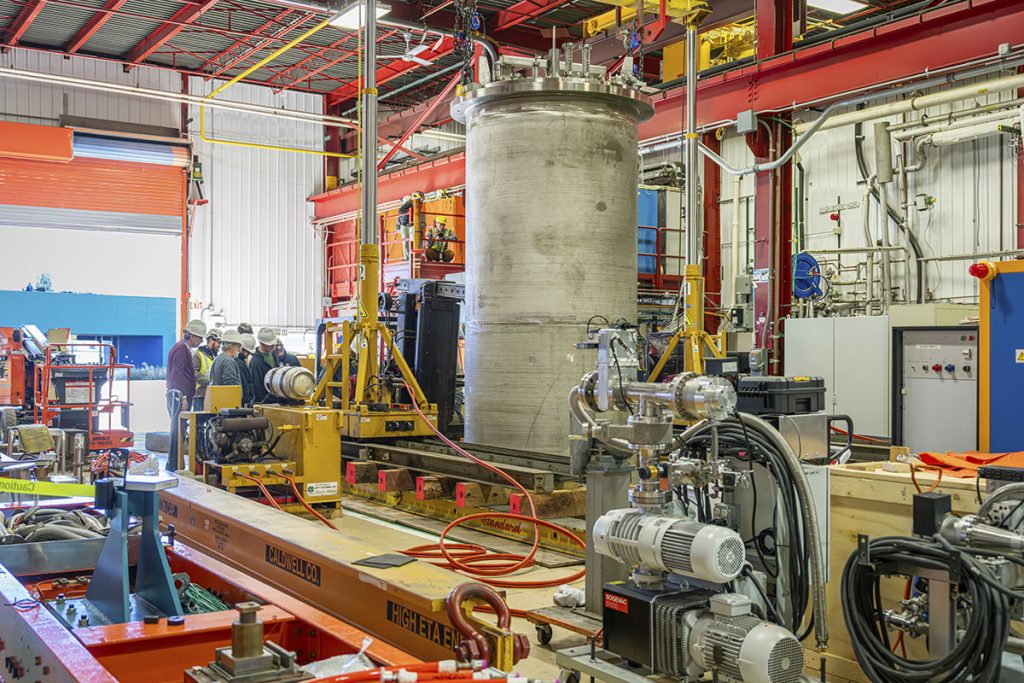
The latest advances in magnet technologies often pull particle physics and fusion research together. Fermilab has spent decades designing and building some of the most powerful superconducting magnets in the world for particle accelerators. Fusion reactors — particularly the tokamak designs at the frontier of research — require similarly powerful magnets to confine the superheated plasma where fusion reactions occur. Fermilab’s combination of magnet engineering expertise, test infrastructure, and scientific depth makes it a natural partner for the global push toward fusion energy.
Testing superconducting cables in an advanced cryogenic facility
According to Greek legend, a shepherd named Magnes first discovered the phenomenon of magnetism when the iron in his staff and sandals became attracted to a naturally magnetic rock, later known as lodestone. That ancient observation inspired the concept — and ultimately the word — magnetism. Over the centuries, this simple curiosity evolved into one of the most transformative forces in science and technology, culminating in the 20th-century discovery of superconductivity, which made possible the powerful magnets that underpin modern particle accelerators, fusion devices and medical imaging.
“We chose the name MAGNES to reflect both the history and the future of magnetism,” said Stephen Gourlay, director of the Magnet Technology Division at Fermilab. “For a facility dedicated to advancing extreme-field superconducting magnet technologies for fusion energy and particle accelerators, it provides both an appropriate foundation and an inspiration for the breakthroughs yet to come.”
Certain materials, when cooled to extreme temperatures, lose all electrical resistance and can carry extraordinary currents, making them capable of generating magnetic fields far beyond what conventional electromagnets can achieve. Today, superconducting magnets are essential to both high energy physics and fusion energy research.
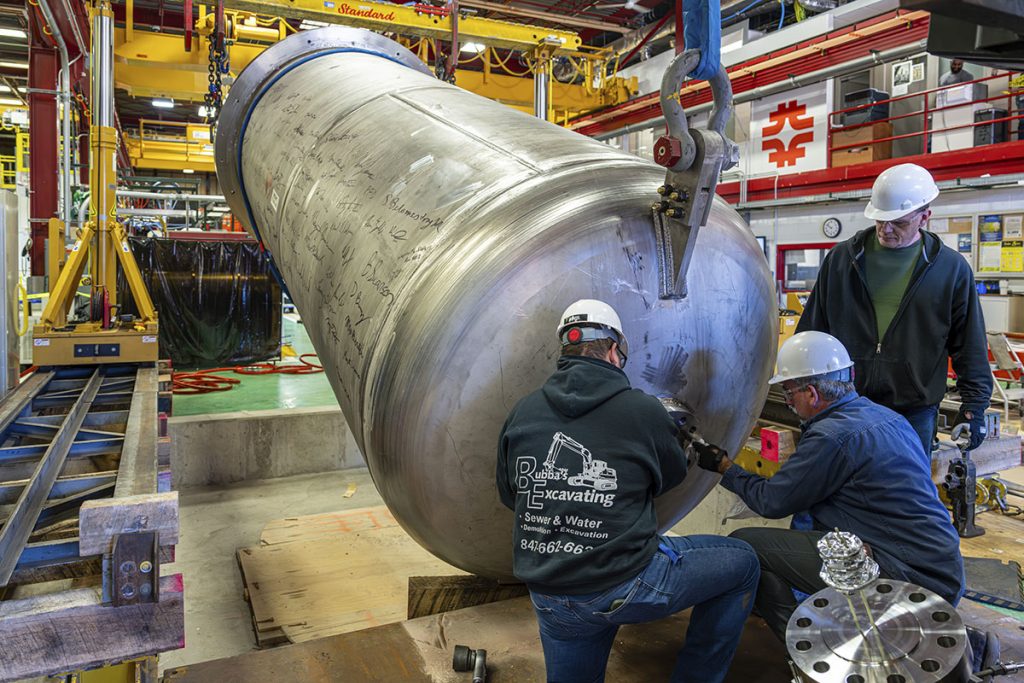
In particle accelerators, magnetic fields are used to steer charged particles toward their targets; in fusion research, magnetic fields confine the intensely hot plasma necessary to facilitate and sustain nuclear fusion reactions. Cables made from superconducting materials could carry the strong electrical currents required for magnets inside a future fusion reactor. If researchers can use powerful magnetic fields to reliably control sustained fusion reactions, they could set the stage for a method to generate nearly limitless energy by replicating the same nuclear process that powers the Sun.
The MAGNES test bed at Fermilab will be unique in the United States for its ability to provide access to a volume of high magnetic field that can be used for testing the superconducting cables that would go into such a reactor.
MAGNES will also help us explore the upper limits of operational temperatures for superconductors, since higher temperatures could widen the application of superconducting materials and lower the costs of running cryogenic systems used to cool the materials.”
Stephen Gourlay, Magnet Technology Division director
“MAGNES is designed to simulate the environment that cables would experience inside a magnet,” said Gourlay. “The test magnet provides a strong, stable background magnetic field, and we pass current — up to 100,000 amps — through the superconducting cables to test their performance in realistic conditions. MAGNES will also help us explore the upper limits of operational temperatures for superconductors, since higher temperatures could widen the application of superconducting materials and lower the costs of running cryogenic systems used to cool the materials.”
The controlled environment of MAGNES is also designed with safety in mind. When a superconducting cable is pushed beyond its limits, it undergoes a rapid transition called a “quench” — a sudden loss of superconductivity that releases energy. Understanding and managing this process safely is critical before any cable design can be used in a fusion reactor. This testing capability enables researchers to push cables to their performance limits, setting the stage for deeper analysis of how much current the materials can sustain before losing their superconducting properties.
“By testing the critical current-carrying capacity of these cables, we can determine how much current they can handle before they lose their superconducting properties, which depend on the background magnetic field,” said Yuhu Zhai, principal engineer at Princeton Plasma Physics Laboratory. “With a higher background field, we can use lower power supplies to test these cables.”
At the heart of MAGNES is a powerful magnet designed and fabricated by Lawrence Berkeley National Laboratory. It features an extra-large bore to accommodate the high-current cables and also facilitate a wide variety of other experiments.
“The 15-tesla dipole magnet made by Berkeley Lab — about 300,000 times stronger than Earth’s magnetic field — will be installed in an 18-foot-deep and nearly 5-foot-diameter pit that can reach temperatures colder than outer space,” said Gueorgui Velev, of Fermilab’s Magnet Technology Division.
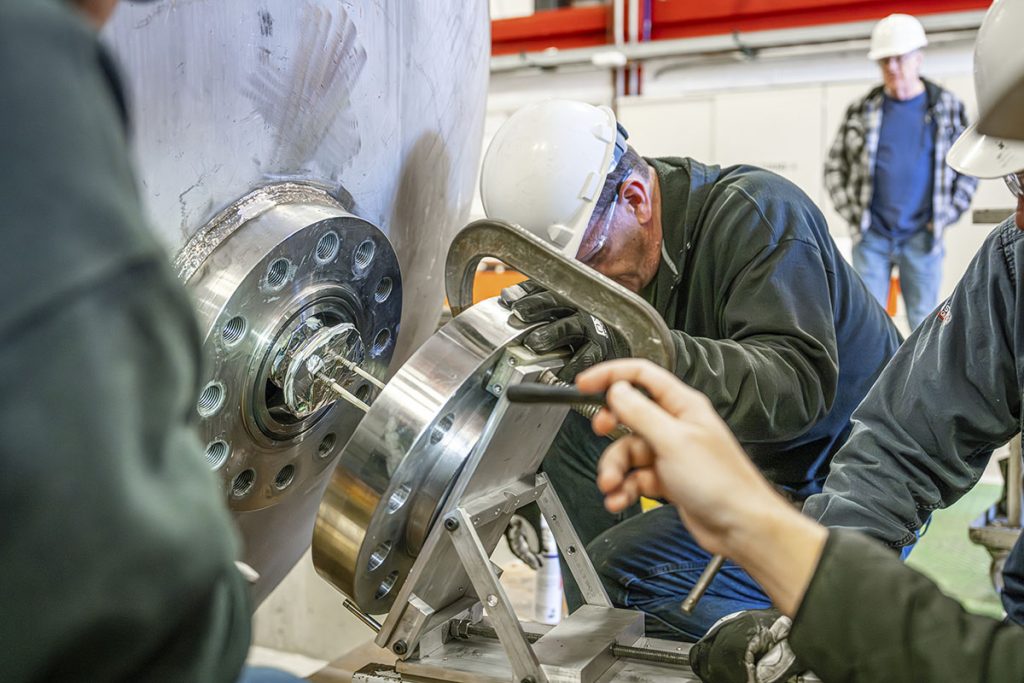
To put that field strength in perspective, a typical hospital MRI machine generates between 1.5 and 3 tesla. At 15 tesla, MAGNES can recreate the intense magnetic environment that superconducting cables would experience deep inside a next-generation fusion reactor — conditions that no other U.S. facility can currently replicate for cable testing at this scale.
MAGNES’ cryostat — the system that chills samples to roughly 2 to 4 degrees above absolute zero — was built by a company in Illinois. Senior Fermilab engineer Vlad Nikolic coordinated the cryostat design and construction.
“This unique system required precise machining in critical areas. The cryostat — which cools the magnet — needs an especially precise seal where superfluid helium meets normal liquid helium. That seal must be flat to within two-thousandths of an inch across a 14-foot circumference,” said Nikolic.
“Now that we’ve carefully installed the cryostat, our next step is to build the anti-cryostat, which enables temperature control of test samples from cryogenic to room temperatures.”
Vlad Nikolic, senior engineer
“Now that we’ve carefully installed the cryostat, our next step is to build the anti-cryostat, which enables temperature control of test samples from cryogenic to room temperatures,” Nikolic continued. “The anti-cryostat allows us to change the sample’s temperature without warming up the main magnet that generates the background magnetic field. Without it, warming the magnet would take about a month. With the anti-cryostat, the sample can be changed in just one day.”
This ability to test samples across a spectrum of temperatures allows researchers to map how cable performance changes under different thermal conditions and magnetic fields — critical data for fusion reactor design. As cables warm, their current-carrying capacity falls and the risk of quenching rises. By quantifying exactly where those thresholds lie, researchers can determine whether a given cable material is suitable for a reactor’s operating environment, and whether new high-temperature superconductors might eventually replace more costly, harder-to-cool alternatives.
With construction of MAGNES well underway and the first cable tests expected to begin in the summer of 2028, Fermilab is positioning itself as a key player in the Department of Energy’s push to achieve sustainable and scalable fusion energy. The facility’s research will directly inform the design of magnets for next-generation fusion devices, providing the foundational data that government labs, universities and private fusion companies need to move from prototype to power plant. In doing so, Fermilab’s decades-long legacy of magnet innovation may prove as consequential to the future of energy as it has been to the frontiers of physics.
Fermi National Accelerator Laboratory is America’s national laboratory for particle physics and accelerator research. Fermi Forward Discovery Group manages Fermilab for the U.S. Department of Energy Office of Science. Visit Fermilab’s website at www.fnal.gov and follow us on social media.
Recommended reading

National laboratory and industry leaders to discuss the future of fusion at Fermilab
Leaders from U.S. national laboratories and industry will come together at Fermilab on October 13 to participate in a special public evening focused on the future of fusion energy.
National laboratories’ magnet designers look to the future of light sources with new prototype
- Argonne
- Argonne National Laboratory
- Berkeley Lab
- magnet
- result
- superconducting magnet
- superconducting technology
After more than 15 years of work, scientists at three DOE national laboratories have succeeded in creating and testing an advanced, more powerful superconducting magnet made of a niobium-tin compound for use in the next generation of light sources.