What is a “particle”?
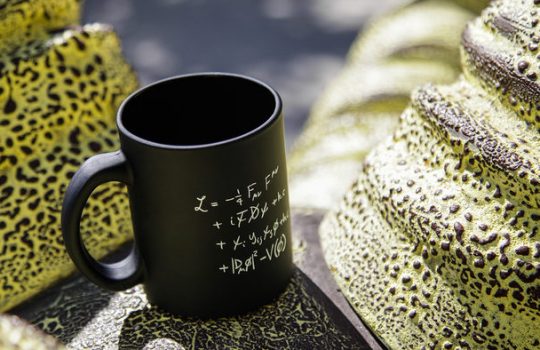
Quantum physics says everything is made of particles, but what does that actually mean?
741 - 750 of 800 results
Quantum physics says everything is made of particles, but what does that actually mean?
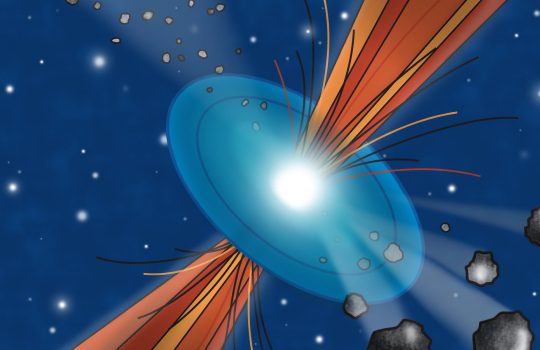
Simulations are key to showing how neutrinos help stars go supernova.
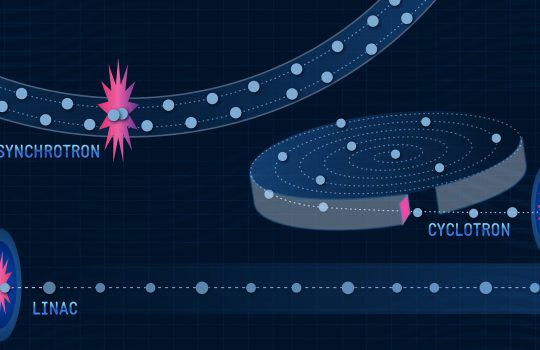
A new radio-frequency quadrupole, designed and built by Lawrence Berkeley National Laboratory, will help provide intense, focused beams to the entire Fermilab accelerator complex.
The Planck scale sets the universe’s minimum limit, beyond which the laws of physics break.
The Brazilian user community at Fermilab consists of nearly 80 researchers from 15 institutions working across 13 different projects and experiments.
A reader asks, “If atoms are mostly empty space, then why does anything feel solid?” James Beacham, a researcher with the ATLAS Experiment Group at Ohio State University, explains in this two-minute video.
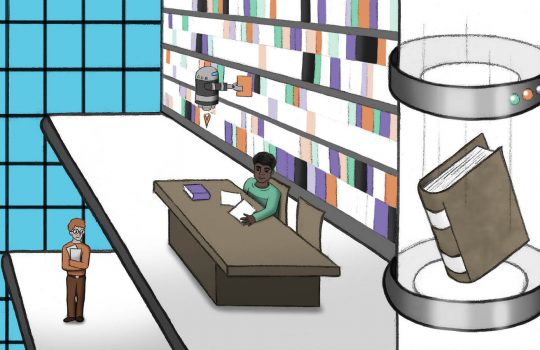
Theorists map and navigate the sea of possible particle discoveries.
Physicists up and down the Western Hemisphere are fans of neutrinos, and experiments to study the subtle particle are flourishing at Fermilab and throughout Latin America.
On April 27, Fermilab broke ground on the building that will house the future Short-Baseline Near Detector. The particle detector is one of three that, together, Fermilab scientists and collaborators will use to search for the sterile neutrino.