
Quantum researchers strike the right chord with silicides
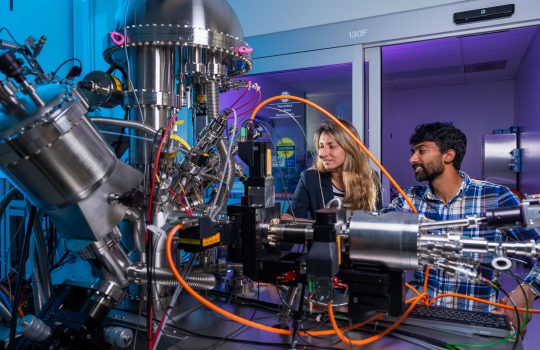
SQMS Center researchers have identified a new contribution to a qubit’s performance by probing and simulating several-atom-thick layers called silicides.
11 - 20 of 37 results
SQMS Center researchers have identified a new contribution to a qubit’s performance by probing and simulating several-atom-thick layers called silicides.
From Nasdaq, Dec. 15, 2022: Quantum computing can perform calculations in ways that are impossible for classical computers. It was recently announced that Google’s Sycamore quantum processor was used by researchers from Caltech, Google, Fermilab, MIT and Harvard to generate and control what is equivalent to an Einstein-Rosen bridge, or more commonly referred to as a wormhole.
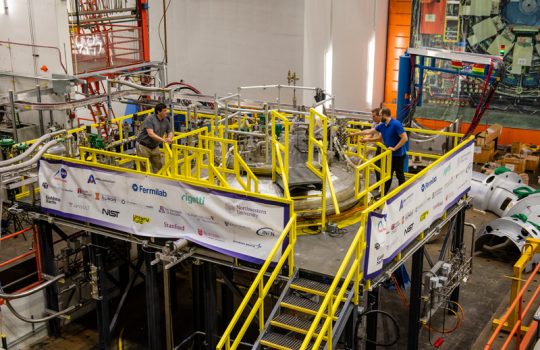
To cool quantum computing components, researchers use machines called dilution refrigerators. Researchers and engineers from the SQMS Center are building Colossus, the largest, most powerful refrigerator at millikelvin temperatures ever made. The new machine will enable new physics and quantum computing experiments.
From the New York Times, Nov. 30, 2022: Yesterday, a science team led by Cal Tech announced they had simulated a pair of black holes in a quantum computer and sent a message between them through a shortcut in space-time called a wormhole. Fermilab’s Joe Lykken co-authored the paper published in Nature yesterday and provides details on what the team uncovered.
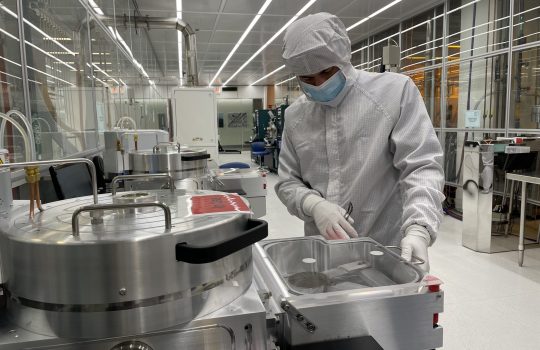
SQMS Center researchers have fabricated quantum devices to evaluate the effect of different materials on qubit performance, thanks to proximity to the Pritzker Nanofabrication Facility.
From Semiconducting Engineering, September 12, 2022: How do you extend the lifespan of qubits? Researchers at the Supercomputing Quantum Materials and Systems Center say silicon limits the lifespan of qubits because of quantum decoherence. Fermilab’s Alexander Romanenko discusses recently published research on how individual sub-components contribute to the decoherence of the qubits. Could sapphire be a better choice for future quantum chips?
Scientists at the SQMS Center have directly probed silicon’s impact on the lifespan of superconducting qubits. The uniquely sensitive measurement helped researchers quantify how the material impacts qubit performance.
From the Polsky Center, July 26, 2022: Fermilab’s quantum ASIC group leader Shaorui Li founded Lismikro, a new start-up dedicated to developing innovative low-power microchip controllers to solve the hardware bottleneck and unleash the full potential of quantum computers. Lismikro was awarded a $200,000 co-investment from the Polsky Center’s George Shultz Innovation Fund and is capable of scaling the control electronics beyond today’s 100 qubits for superconducting, ion trap, and photonic quantum processors.
From Quantum Computing Report, April 30, 2022: A Fermilab quantum engineering team has collaborated with the University of Chicago to create a new open-source design for control electronics for superconducting quantum processors called the Quantum Instrumentation Control Kit.
Scientists at the Fermilab-led SQMS Center investigate qubits at the atomic level to identify sources of various impurities. By having a deeper understanding of how impurities affect how long a qubit can store information, scientists will be able to figure out how to further improve the performance of quantum computers.