For 70 years, physicists around the world have designed elaborate detectors and experiments to study a mysterious particle called the neutrino, with the U.S. Department of Energy’s Fermi National Accelerator Laboratory playing a leading role in this quest.
Since its founding in 1967, Fermilab scientists have pioneered multiple generations of experiments to learn more about the neutrino, what it could mean for our understanding of physics and its potential benefits for society. Today, Fermilab has embarked on a massive effort to integrate scientists, engineers, technicians, and partners across the globe to safely deliver the most comprehensive neutrino experiment in the world, the Deep Underground Neutrino Experiment at the Long Baseline Neutrino Facility.
Fermilab’s top institutional priority is delivering a neutrino beam to DUNE at LBNF by 2031. Once in operation, this experiment will allow scientists to delve even deeper into the mysteries of the neutrino and understand whether neutrinos could be the reason we live in a matter-dominated universe. DUNE at LBNF could also drive innovation in fields that include detector design, cryogenics, medical imaging and high-performance computing, resulting in benefits far beyond particle physics.
“For more than half a century, Fermilab has been at the forefront of unlocking the secrets of neutrinos — particles that hold some of the deepest clues about our universe.”
Norbert Holtkamp, director of Fermilab
“For more than half a century, Fermilab has been at the forefront of unlocking the secrets of neutrinos — particles that hold some of the deepest clues about our universe,” said Fermilab Director Norbert Holtkamp. “Today, that legacy continues as we drive forward DUNE at LBNF. DUNE is the largest science project in our laboratory’s history, and its success will define the future of neutrino research for decades to come.”
Fermilab will produce the world’s most intense beam of neutrinos with the Proton Improvement Plan-II project using the PIP-II linear accelerator to send neutrinos from Fermilab in Illinois to Lead, South Dakota, 800 miles away. Underpinning all of the work on DUNE at LBNF, PIP-II and efforts across the lab to prepare to operate the experiment are disciplined execution and operational focus on safety, quality and schedule.
“The combination of size and precision in DUNE is unlike anything we’ve had before,” said Anne Schukraft, scientist in the Intensity Frontier Division at Fermilab. “I’m actually hoping that we find something that we cannot even think of now — something completely unexpected that changes the way we think about neutrinos and the Standard Model of particle physics.”
Decades of neutrino physics at Fermilab
After Fermilab began operations in 1967, it didn’t take long for it to take up the neutrino cause. Beginning with early experiments, including a 15-foot bubble chamber and the E1A experiment, the stage was set for neutrino research. Scientists at Fermilab discovered the tau neutrino, a third type of neutrino, through the Direct Observation of Nu Tau, or DONUT, experiment in 2000.
Leveraging the strength of Fermilab’s Tevatron —the most powerful particle accelerator in the world at the time — the NuTeV experiment made measurements in the late 1990s using beams of high energy neutrinos and antineutrinos.
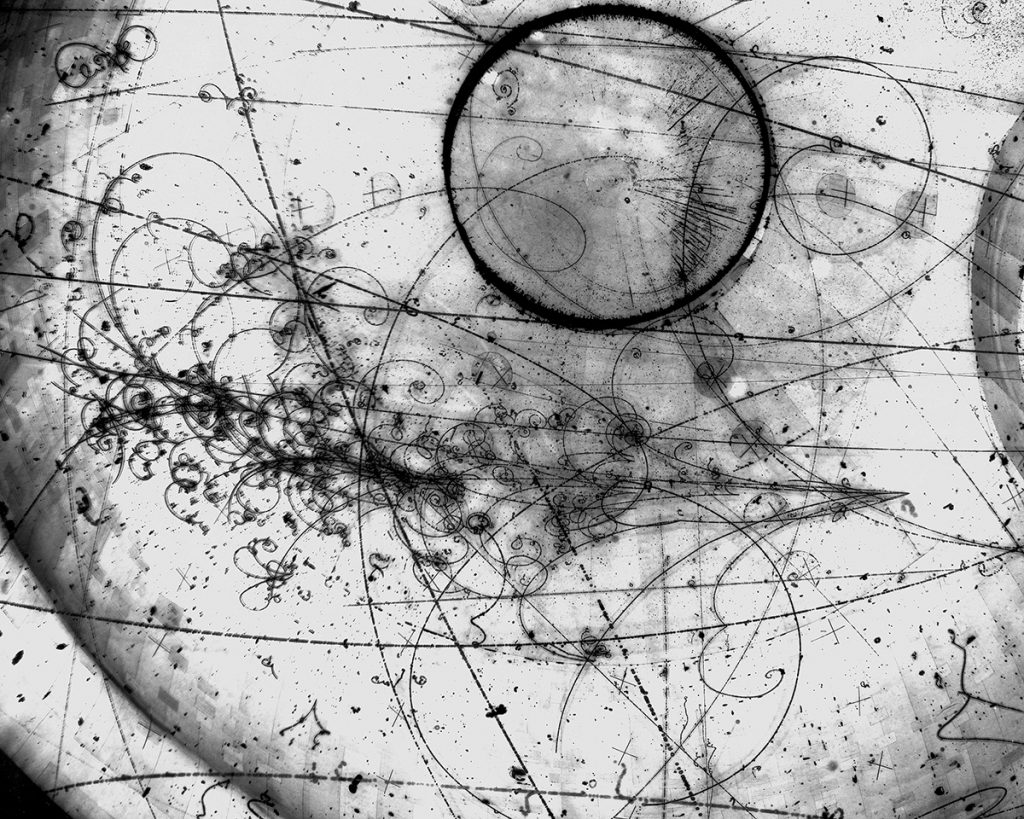
“NuTeV was the culmination of a long series of precision neutrino experiments at Fermilab that used neutrinos to probe the structure of matter and the weak interaction,” said Bob Bernstein, Fermilab senior scientist and former NuTeV co-spokesperson. “It also helped train many of the scientists who went on to lead the next generation of neutrino experiments.”
With the completion of the Main Injector in 1999 — a 2-mile circular accelerator — and an intense beam of neutrinos called NuMI, Fermilab launched a new era of neutrino research that brought the MINOS, MINERvA and NOvA experiments.
MINERvA took data to study neutrino-nucleus interactions from 2010 to 2019, and physicists are still analyzing those data and publishing new results today.
MINOS, the lab’s first long-baseline neutrino experiment, provided some of the world’s most precise measurements of a phenomenon called neutrino oscillations, which describes how the neutrino’s flavor changes as it travels over space and time. It also laid the groundwork for future long-baseline neutrino experiments like DUNE.
NOvA, another crucial neutrino experiment hosted by Fermilab, is the only currently operating long-baseline neutrino experiment in the United States and is producing some of the most precise measurements of neutrino behavior. With its near detector at Fermilab and its far detector in Ash River, Minnesota, NOvA is taking data and measuring neutrino oscillations over a 500-mile distance.
“By increasing this travel distance to 800 miles, DUNE will take a giant leap forward in pushing such neutrino exploration into a new era of precision and discovery potential.”
Sam Zeller, Fermilab senior scientist
“By increasing this travel distance to 800 miles, DUNE will take a giant leap forward in pushing such neutrino exploration into a new era of precision and discovery potential,” said Sam Zeller, Fermilab senior scientist and deputy project director for the DUNE at LBNF near detector.
Fermilab is the only facility in the world that simultaneously also operates a second accelerator-based beamline. This low energy Booster Neutrino Beam was born with MiniBooNE and has since expanded into the Short-Baseline Neutrino program, consisting of SBND, MicroBooNE and ICARUS. The short-baseline trio of experiments produces high-precision measurements, and it is designed to investigate the possible existence of a theorized fourth type of neutrino called sterile neutrino.
“We are one of the only facilities in the world that can produce neutrinos in an accelerator beam — in a controlled environment with high intensity,” said Schukraft.
While MicroBooNE stopped taking data in 2021, SBND and ICARUS are still active today. Future combined results promise to shed more light on the fourth-neutrino mystery.
Paving the way for innovation
All of Fermilab’s previous neutrino research and detector development has not only established the laboratory as a global leader in neutrino science, but also significantly contributed to DUNE. For example, MINOS paved the way as the world’s first long-baseline neutrino experiment. The SBN program’s liquid-argon time projection chambers provided a proving ground for the same technology that will be used in DUNE’s detectors.
“We are one of the only facilities in the world that can produce neutrinos in an accelerator beam — in a controlled environment with high intensity.”
Anne Schukraft, Fermilab scientist
Going forward, Fermilab researchers will continue to use neutrino research to drive innovation. For example, at DUNE, artificial intelligence tools will rapidly analyze millions of particle interactions, help identify rare signals such as early supernova signatures and support detector operations. Seventy years after neutrinos were first detected, Fermilab continues to lead the world in neutrino science. Through DUNE at LBNF, PIP-II and the expertise built through generations of discovery, Fermilab is delivering the scientific capabilities that will define the next era of particle physics and strengthen America’s leadership in discovery and innovation.
Fermi National Accelerator Laboratory is America’s national laboratory for particle physics and accelerator research. Fermi Forward Discovery Group manages Fermilab for the U.S. Department of Energy Office of Science. Visit Fermilab’s website at www.fnal.gov and follow us on social media.
Recommended reading

Nobel Prize in physics awarded to Francis Halzen for groundbreaking neutrino research
The Royal Swedish Academy of Sciences has awarded the 2026 Nobel Prize in physics to Francis Halzen of the University of Wisconsin–Madison.

URA honors Fermilab researchers advancing laboratory’s top priorities
Tyler Barrett, Charis-Kleio Koraka, Kevin Kelly and Silvia Zorzetti are the recipients of the 2026 URA Honorary Awards. The awards are presented each year by Universities Research Association to recognize significant contributions to research at Fermilab.
Associate lab directors help shape future of Fermilab
Fermilab’s recent reorganization brings its accelerator, physics and technology programs under three unified directorates, each charged with advancing the laboratory’s most important scientific priorities. Together, these directorates form a coordinated leadership structure designed to deliver world class research and guide Fermilab’s future.