
More than 500 scientists and researchers from around the world recently gathered at the U.S. Department of Energy’s Fermi National Accelerator Laboratory for the 2026 American Physical Society Division of Particles and Fields meeting. Over the course of the event, held July 20-24, participants shared scientific results, explored emerging research opportunities and considered the long-term future of high-energy physics.
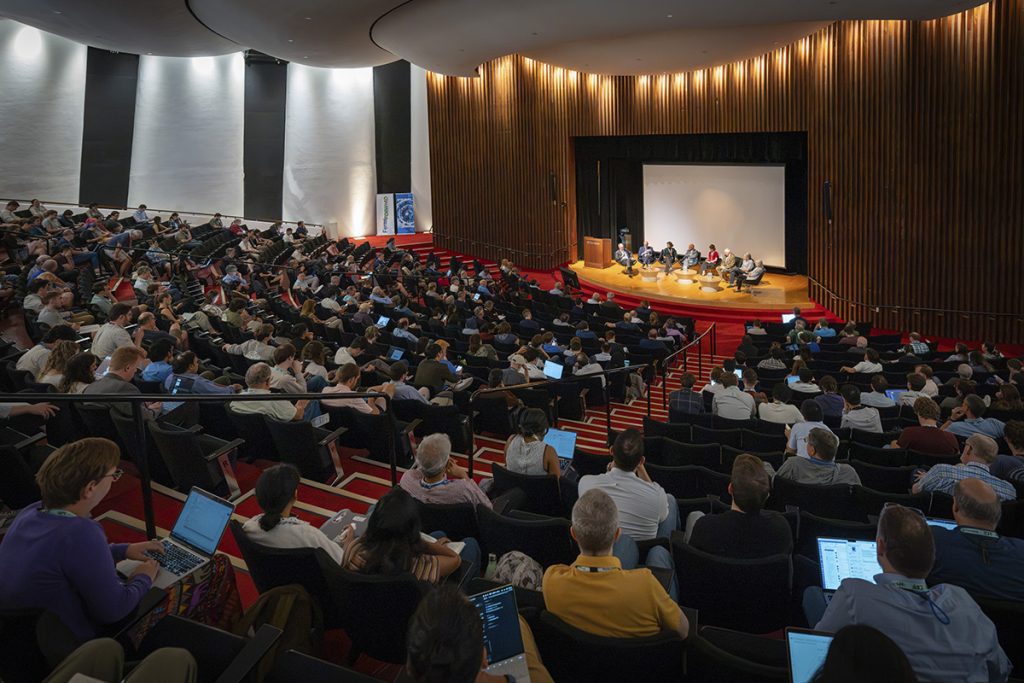
Fermilab was proud to host DPF 2026, which represented the largest gathering of the U.S. particle physics community this year. Patricia McBride, Fermilab’s deputy director for science and chief research officer, played a key role as a member of the APS DPF program committee, which developed the conference’s scientific program. Fermilab staff supported the event throughout the week, helping create a seamless and welcoming experience for visiting scientists and researchers.
“We are the main lab in the U.S. for particle physics, so it’s natural that the meeting is happening here at Fermilab, where there are current and future experiments that will be the central part of the U.S. effort,” said McBride.
“We are the main lab in the U.S. for particle physics, so it’s natural that the meeting is happening here at Fermilab, where there are current and future experiments that will be the central part of the U.S. effort.”
Patricia McBride, Fermilab deputy director for science and chief research officer
For Fermilab Director Norbert Holtkamp, the meeting came at an important moment for high-energy physics. In his opening remarks, he encouraged the community to think beyond today’s experiments and look at the long-term scientific questions that should shape the field’s future.
“We need to agree on the most important questions first and then build the instruments to answer them, not the other way around,” Holtkamp said. He also challenged the community to consider how particle physics can effectively establish shared priorities and communicate its value to governments, sponsors and the public. “Who speaks for high energy physics, and who are they speaking to?” he asked. “Who has the mandate to speak, and where does it come from? This is the ultimate question, especially in the fast-changing environment of today.”
This year’s meeting came at what Holtkamp described as an opportune time, with two of particle physics’ most ambitious scientific programs set to come online in the coming decade. These include the Deep Underground Neutrino Experiment at the Long Baseline Neutrino Facility, hosted by Fermilab, and the High-Luminosity upgrade to CERN’s Large Hadron Collider, to which Fermilab is contributing technology and expertise. Together, they will provide unprecedented opportunities to investigate neutrinos, the Higgs boson and some of the universe’s most fundamental mysteries.
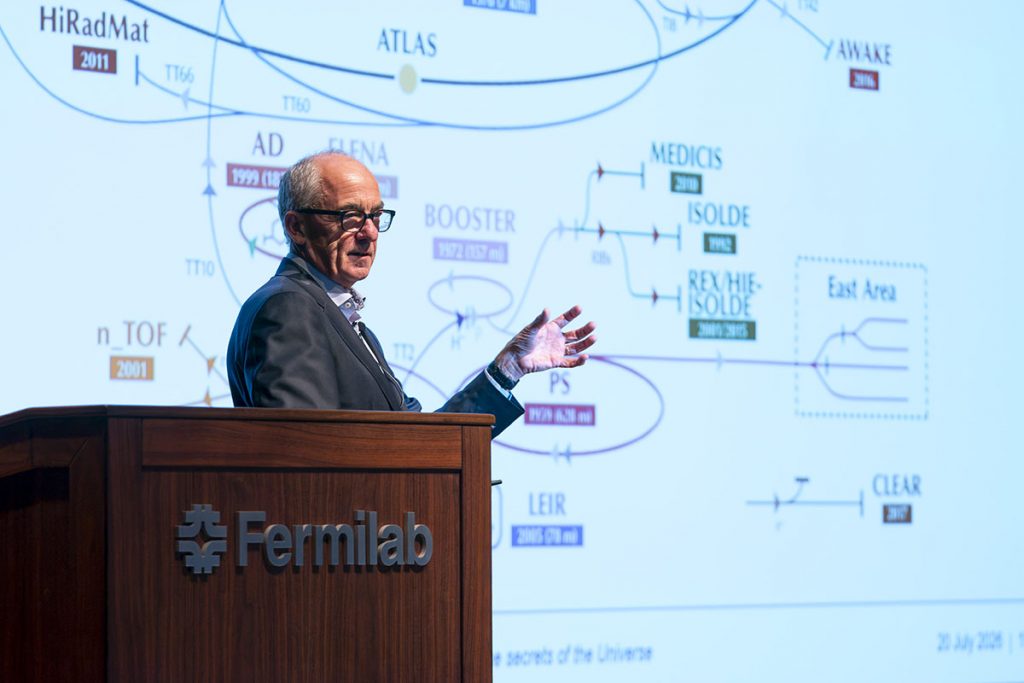
The conference also highlighted the global nature of the field. During the opening evening, CERN Director-General Mark Thomson delivered a public lecture in Ramsey Auditorium at Fermilab’s iconic Wilson Hall, describing how the next generation of major scientific facilities will build on decades of discovery.
“Despite the amazing progress we have made in understanding the nature of the universe, including the Higgs boson, there are many remaining big questions,” Thomson said. “These big questions will be explored in the next large particle physics projects in Europe and the U.S.”
Thomson referenced the High-Luminosity LHC and the proposed Future Circular Collider at CERN, alongside DUNE at LBNF in the United States, complementary efforts that will advance our understanding of the fundamental building blocks of the universe.
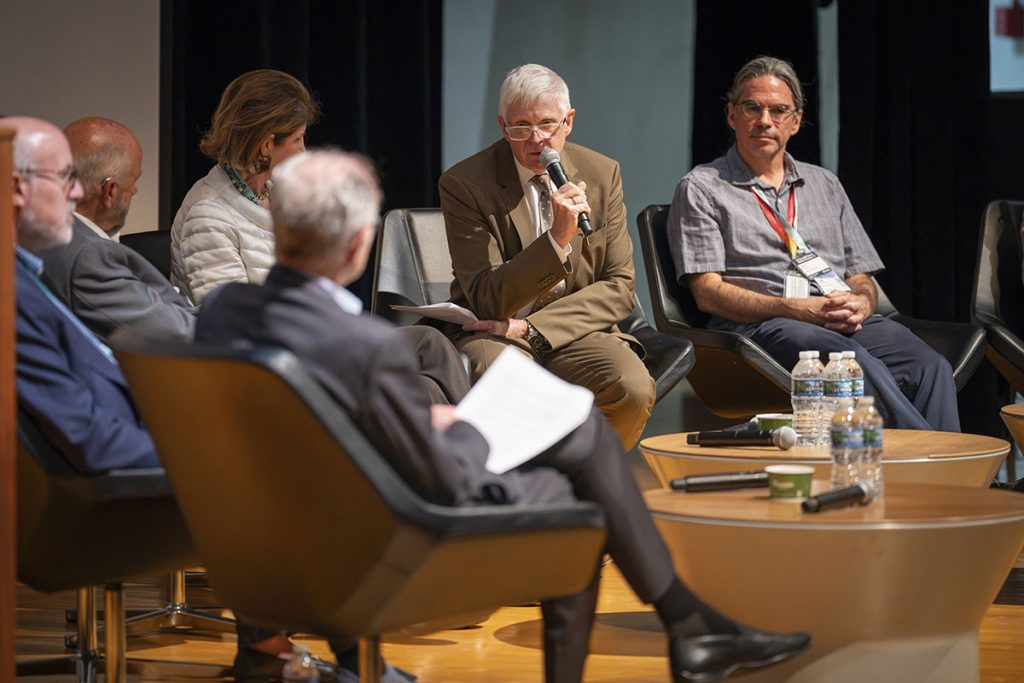
The event concluded with a panel discussion featuring several of the field’s influential leaders, including Fermilab Director Norbert Holtkamp, former Fermilab Director Pier Oddone, former CERN Director-General Fabiola Gianotti and former Fermilab and Lawrence Berkeley National Laboratory Director Mike Witherell, who moderated the conversation. Their discussion explored the future of particle physics, from the technologies emerging from fundamental research to the scientific priorities that will shape the next generation of discovery.
Looking ahead, Holtkamp emphasized the importance of continuing to lead technological innovation. “We need to be at the front of that wave, not behind it,” he said.
Fermi National Accelerator Laboratory is America’s national laboratory for particle physics and accelerator research. Fermi Forward Discovery Group manages Fermilab for the U.S. Department of Energy Office of Science. Visit Fermilab’s website at www.fnal.gov and follow us on social media.
Recommended reading
URA honors Fermilab researchers advancing laboratory’s top priorities
Tyler Barrett, Charis-Kleio Koraka, Kevin Kelly and Silvia Zorzetti are the recipients of the 2026 URA Honorary Awards. The awards are presented each year by Universities Research Association to recognize significant contributions to research at Fermilab.
Associate lab directors help shape future of Fermilab
Fermilab’s recent reorganization brings its accelerator, physics and technology programs under three unified directorates, each charged with advancing the laboratory’s most important scientific priorities. Together, these directorates form a coordinated leadership structure designed to deliver world class research and guide Fermilab’s future.
DUNE uses AI to transform the future of neutrino research
DUNE is pioneering the future of neutrino research by integrating artificial intelligence into its experiment, drawing on decades of machine learning work at Fermilab.