The Deep Underground Neutrino Experiment at the Long-Baseline Neutrino Facility recently began installing the structural elements of its massive neutrino detector modules. At the same time, the DUNE collaboration is working on integrating artificial intelligence into all facets of the experiment to improve measurements, provide rapid detection and optimize operations — ultimately empowering DUNE scientists to accelerate discovery.
“With DUNE, researchers are taking innovative approaches to try and impact every aspect of the experiment.”
Sowjanya Gollapinni, co-spokesperson for DUNE
Neutrino scientists at the U.S. Department of Energy’s Fermi National Accelerator Laboratory have been working at the cutting edge of AI and machine learning integration for decades. Two of the lab’s neutrino experiments, NOvA and MicroBooNE, were among the first high-energy physics experiments to use a deep neural net — a type of machine learning that’s intended to mirror the capabilities of the human brain — to identify particle interactions.
“With DUNE, researchers are taking innovative approaches to try and impact every aspect of the experiment,” said Sowjanya Gollapinni, co-spokesperson for DUNE. “These approaches are going to really accelerate DUNE in terms of the commissioning process and the sensitivity of the experiment to reach our full discovery potential.”
Tracking particle interactions
Sometimes called the ghost particles of the universe, neutrinos are incredibly elusive because they only interact through the weak force and gravity. Trillions are streaming through your body every second, but only one may interact in your entire lifetime. That’s why scientists use intense sources — like Fermilab’s accelerator complex — and massive detectors to increase the odds of capturing them.
DUNE at LBNF will consist of a near detector located at Fermilab and a far detector installed a mile underground at the Sanford Underground Research Facility in South Dakota, creating the experiment’s long baseline. Both detectors will use liquid-argon time projection chamber technology to record the rare interactions that neutrinos will have with the argon atoms in the detector.
While liquid-argon TPCs are fantastic at capturing neutrino interactions, reconstructing the signals can get pretty tricky. This is especially true for DUNE, which will enable scientists to study the properties of neutrinos with unprecedented precision.
“We’ve had great success in implementing these tools in previous Fermilab experiments.”
Jianming Bian, DUNE AI/ML co-lead
“We are going to have very high resolution, almost photographic-quality images of these interactions,” said Leigh Whitehead, DUNE AI/ML co-lead. “Which is great, but also brings challenges such as making reconstruction more difficult because we see such fine detail.”
The AI algorithms used in DUNE will be able to recognize that a neutrino interaction took place inside the detector. They can then analyze the resulting particle tracks visible within the detector, trace back to where the interaction occurred, and extrapolate the energy and direction of the neutrino at the time it entered the detector.
“We’ve had great success in implementing these tools in previous Fermilab experiments,” said Jianming Bian, DUNE AI/ML co-lead. “And now DUNE is taking the leading role to further develop these algorithms and explore new AI methods that take advantage of its complex, large-scale data, making it a platform for AI/ML development.”
These AI-driven tools are orders of magnitude faster than traditional methods, leading to enhanced signal processing, event classification and particle identification. This will enable the collaboration to tackle their main science goals more efficiently and ultimately unlock the secrets of neutrinos.
Locating exploding stars
While DUNE researchers are using AI to reconstruct the more common neutrino signals within the detector, they are also training algorithms to identify rare phenomena. Referred to as triggers, these are fast decision-making systems that are trained to sort through thousands of interactions and save only the most interesting for physics.
One of the major triggers for DUNE would occur if a supernova goes off in our galaxy.
When a large enough star runs out of fuel and “dies,” it rips itself apart in an explosion that sends stellar remains flying into space. Particles like photons get trapped in the resulting gas and dust, neutrinos — which rarely interact — can breeze right through. This means that the neutrinos will arrive to Earth a few hours before the light burst, offering scientists a rare glimpse into the processes unfolding deep inside an exploding star.
The early alert from the neutrino burst also enables researchers to quickly identify where the supernova occurred so that astrophysicists know where to point their telescopes in time to see light from the event.
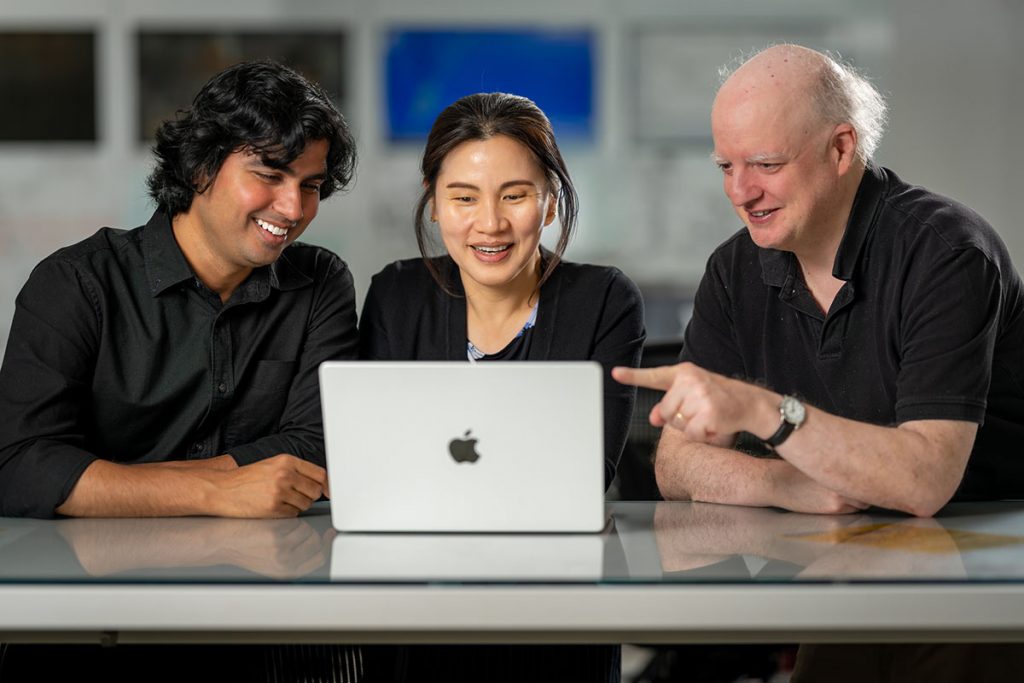
That’s where the trigger comes in. “An algorithm will be constantly scanning the stream of data from the detector, searching for interesting interactions,” said Thomas Junk, senior scientist at Fermilab. The instant the algorithm suspects a signal is from a supernova, “it will tell the system to record data from 10 seconds before and 100 seconds after the candidate signal to capture the full picture of neutrino interactions from this event. An AI algorithm will then run on these data to find the most likely position in the sky where the supernova burst happened.”
Aside from acting as an early warning system for astronomers to observe a supernova in real time, neutrinos may also provide crucial insight into the stellar objects left behind, either a neutron star or black hole.
Running massive detectors
Detecting neutrinos isn’t the only complicated part of DUNE, the detectors are comprised of thousands of components that need to be monitored to ensure that they’re working in concert as designed.
After the detector is installed and commissioned, operators must actively monitor the system during data collection. If there is an error, it is critical that the team can respond quickly and knowledgably to any situation.
To better empower operators to tackle more unique scenarios, the DUNE collaboration is looking into whether a large language model can be used to quickly scan logbooks detailing successful documented fixes to provide immediate citations to solutions. Fermilab is coordinating with six other national labs to develop a similar tool for particle accelerators.
The DUNE collaboration is also looking into how machine learning can be used to automate detector operation a step further to potentially predict detector anomalies before they happen.
Setting the stage
DUNE has been actively investigating AI integration for years. But now the Department of Energy’s Genesis Mission is compounding that effort to accelerate scientific discovery.
“The Genesis Mission has strengthened the already existing collaboration across the national labs and universities on AI efforts,” said Gollapinni. “It is taking everything to the next level and will maximize our capabilities to accelerate DUNE.”
Integrating AI into the detector itself isn’t the only approach that DUNE is taking when it comes to AI. The collaboration is actively working with the DOE’s national labs and partnering institutions to enhance their existing AI infrastructure and prepare for the workflows necessary to process the petabytes (quadrillions of bytes) of data DUNE will produce.
DUNE is also involved in training the next-generation AI workforce.
“We have over a thousand people from around the globe collaborating on DUNE,” said Whitehead. “We’re training hundreds of students a year, which is a pretty impressive pipeline of people that should have all the tools to become leaders in the field.”
Fermi National Accelerator Laboratory is America’s national laboratory for particle physics and accelerator research. Fermi Forward Discovery Group manages Fermilab for the U.S. Department of Energy Office of Science. Visit Fermilab’s website at www.fnal.gov and follow us on social media.
Recommended reading
Fermilab to lead two new Genesis Mission awards to accelerate development of microelectronics and quantum
Two new awards will expand Fermilab’s critical role in the Genesis Mission by developing custom microelectronics and advancing quantum information science.
Nobel Prize in physics awarded to Francis Halzen for groundbreaking neutrino research
The Royal Swedish Academy of Sciences has awarded the 2026 Nobel Prize in physics to Francis Halzen of the University of Wisconsin–Madison.
URA honors Fermilab researchers advancing laboratory’s top priorities
Tyler Barrett, Charis-Kleio Koraka, Kevin Kelly and Silvia Zorzetti are the recipients of the 2026 URA Honorary Awards. The awards are presented each year by Universities Research Association to recognize significant contributions to research at Fermilab.