One of the most ambitious physics experiments ever conceived is currently being built by an international collaboration hosted by the U.S. Department of Energy’s Fermi National Accelerator Laboratory. Once the massive detector modules for the Deep Underground Neutrino Experiment at the Long Baseline Neutrino Facility are filled with liquid argon and sealed, scientists will not have access to the submerged components for decades. To prepare, researchers are running a stress test on a prototype at CERN pushing the technology to its limits.
An international collaboration hosted by Fermilab in the United States, DUNE is designed to study neutrinos: ghostly particles that are incredibly abundant and incredibly mysterious, due to their shape-shifting behavior and reluctance to interact. Many scientists hope that neutrinos could help explain how matter won out over its equal but opposite counterpart antimatter in the early universe.
“Neutrinos are key in our understanding of how the universe evolved to what it is today, and where it is headed.”
Sowjanya Gollapinni, DUNE co-spokesperson
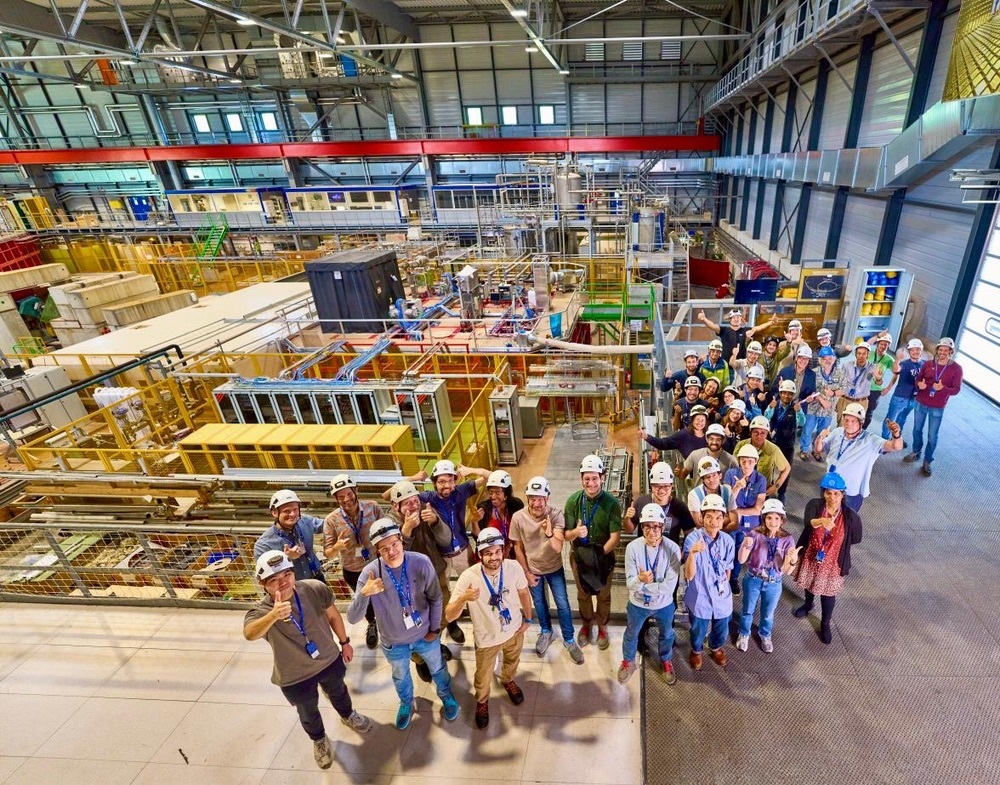
At CERN’s neutrino platform in Europe, there are two 770-ton-scale prototype neutrino detectors called ProtoDUNEs. Each is playing a pivotal role in demonstrating the technologies planned for DUNE.
“The work at ProtoDUNE going into demonstrating the technology is heroic,” said Sowjanya Gollapinni, DUNE co-spokesperson and a senior scientist at Los Alamos National Laboratory. “Now we want to stress test it and see how it holds up over a long period of time.”
Beyond the neutrinos generated by Fermilab’s new particle accelerator, DUNE will also detect cosmic neutrinos — particles from space that pass effortlessly through the Earth. These cosmic signals will allow scientists to identify the earliest signs of a supernova. Because neutrinos escape a collapsing star before visible light does, they provide an early warning that gives astronomers time to ready their telescopes before the explosion’s glow reaches Earth.
“Neutrinos are key in our understanding of how the universe evolved to what it is today, and where it is headed,” Gollapinni said.
To capture these neutrinos, scientists are installing massive detectors, called liquid-argon time projection chambers, a mile underground at the Sanford Underground Research Facility in South Dakota.
“When a neutrino interacts with an argon atom, it generates a number of charged particles, and these charged particles leave tracks of ionization,” said Flavio Cavanna, a scientist at Fermilab.
The liberated electrons are then pulled by a strong electric field toward specialized components called readout planes inside the chamber. These readout planes record data from the ionized electrons, which scientists can use to reconstruct the direction and energy of the tracks. From this information, scientists can determine the position, energy and identity of the original neutrino.
“When a neutrino interacts with an argon atom, it generates a number of charged particles, and these charged particles leave tracks of ionization.”
Flavio Cavanna, Fermi National Accelerator Laboratory
Before building DUNE, scientists decided to test two different technologies at the CERN Neutrino Platform. One technique is based on a tried-and-true detector called an Anode Plane Assembly, or APA. This was developed in the 1980s and uses planes of loom-like wire detectors to collect current from the drifting electrons.
“We’ve already used this technique in other neutrino experiments,” Cavanna said. “We know it works.”
The other is a much newer technology that replaces the planes of wires with channels of copper printed onto circuit boards.
“If you ever open a computer or a keyboard, you will see a printed circuit board,” said Steve Kettell, a scientist at Brookhaven National Laboratory and one of DUNE’s technical coordinators. “It’s challenging to wrap wires 3,000 times around a frame. Printed circuit boards are available commercially, so it’s more efficient for the collaboration.”
Scientists successfully tested the APA technique at ProtoDUNE between 2018 and 2024. During this time, physicists and engineers were also testing, redesigning and perfecting the new printed circuit board design, which they nicknamed the “vertical drift,” based on the direction the charged particles move in the liquid argon.
In addition to replacing the APAs with printed circuit boards, the new vertical drift geometry doubles the distance the liberated electrons move, thus allowing scientists to capture and record more neutrinos with fewer components. But this also means that they need a much higher voltage to maintain the electric field that pushes the liberated electrons to the detectors before they disappear.
“A battery that you can hold in your hand has one and a half volts between the two ends,” Kettell said. “We are taking that same concept and scaling it up to 300,000 volts.”
“It’s like building a lightning storm inside of a detector, but we don’t actually want the physical lightning strikes.
Steve Kettell, Brookhaven National Laboratory
Last year, the collaboration started commissioning the new design of the ProtoDUNE Vertical Drift, and by June 2025 the detector was ready to be launched.
“It ran smoothly out of the box,” Gollapinni said. “The ProtoDUNE Vertical Drift has been a resounding success, and we are very thankful for the incredible support provided by the CERN neutrino platform.”
Now that they know it works, the team is ramping the voltage up to 300 kilovolts and seeing how long the detector can hold it.
“It’s like building a lightning storm inside of a detector, but we don’t actually want the physical lightning strikes,” Kettell said. “If we see sparks, it will allow us to study how all of the various components react.”
The stress test started on May 22, 2026, and the scientists plan to have it completed by the fall. According to Kettell, this extended stress test simulates the conditions scientists will ultimately use inside DUNE, but inside a much smaller prototype. “If all the components survive, that’s very encouraging,” Kettell said.
Fermi National Accelerator Laboratory is America’s national laboratory for particle physics and accelerator research. Fermi Forward Discovery Group manages Fermilab for the U.S. Department of Energy Office of Science. Visit Fermilab’s website at www.fnal.gov and follow us on social media.
Recommended reading

Nobel Prize in physics awarded to Francis Halzen for groundbreaking neutrino research
The Royal Swedish Academy of Sciences has awarded the 2026 Nobel Prize in physics to Francis Halzen of the University of Wisconsin–Madison.

Scientists travel to Fermilab to discuss future of high-energy physics
Fermilab recently hosted over 500 physicists for the American Physical Society’s biennial Division of Particles and Fields meeting. With presentations by Fermilab Director Norbert Holtkamp and CERN Director-General Mark Thomson, the meeting provided particle physicists the opportunity to come together and consider the future of high-energy physics research.

DUNE uses AI to transform the future of neutrino research
DUNE is pioneering the future of neutrino research by integrating artificial intelligence into its experiment, drawing on decades of machine learning work at Fermilab.