Leaders with the U.S. Department of Energy’s Fermi National Accelerator Laboratory and the University of Campinas in Brazil, known as UNICAMP, met at Fermilab in November to sign an addition to their Inter-Agency Cooperative Research and Development Agreement, strengthening collaboration on key technologies for the Long-Baseline Neutrino Facility far detector cryogenics for the Deep Underground Neutrino Experiment.
A new project called Annex C, added to the existing agreement, brought together Fermilab’s then-Interim Director Young-Kee Kim, UNICAMP Rector Paulo Cesar Montagner and UNICAMP Vice-Rector Fernando Antonio Santos for the signing ceremony, as researchers and engineers from both institutions gathered to watch the event.
Annex C marks the beginning of the next phase of the collaboration between Fermilab and UNICAMP. Building on earlier successes, this phase focuses on engineering design, manufacturing and testing of cryogenic subsystems for DUNE’s vertical and horizontal drift far detector modules. The systems will be installed a mile underground at the Sanford Underground Research Facility in Lead, South Dakota — the site where DUNE will detect neutrinos sent 800 miles through the Earth from the Fermilab Accelerator Complex in Batavia, Illinois.
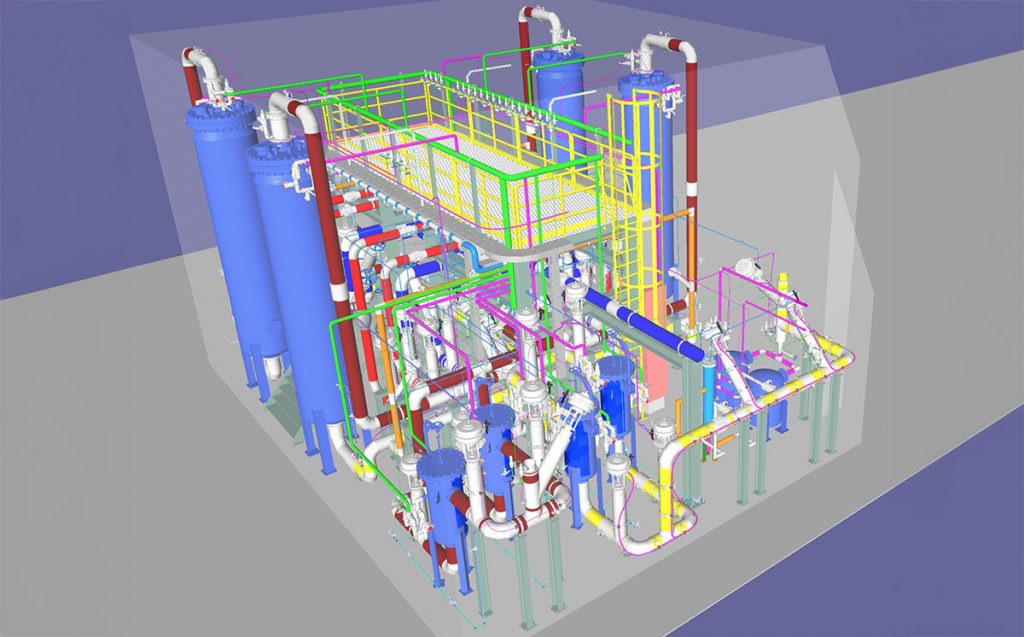
Phase one of the collaboration, signed in March 2020 in Brazil, focused on R&D for liquid-argon purification, a process critical for maintaining the extreme purity of the argon used in DUNE’s detectors.
Annex C now transitions that work into production. Under the agreement, UNICAMP’s industrial partner in Brazil will lead the construction of both liquid and gaseous argon purification and regeneration systems. Each separate system is referred to as a “skid,” and the gaseous purification skid will be used during initial filling of the massive detector modules.
UNICAMP plans to deliver the first purification system in spring 2027, with the final components completed a year later.
“This new phase of collaboration with Fermilab reflects Universidade Estadual de Campinas’ strong commitment to advancing global scientific discovery,” said UNICAMP Rector Paulo Cesar Montagner. “By contributing our expertise in liquid-argon purification and working closely with our international partners, we are proud to help build the technologies that will make the Deep Underground Neutrino Experiment a reality. This partnership strengthens Brazil’s role in neutrino research and propels our scientists and engineers toward reaching new heights of innovation.”
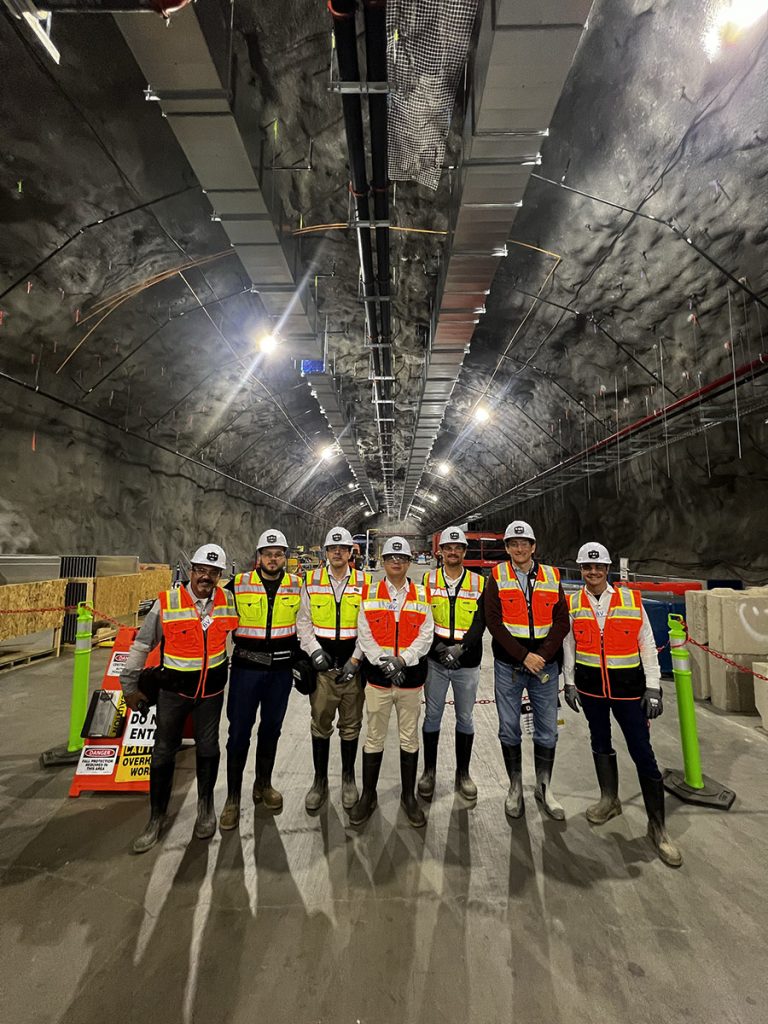
In October, a team from UNICAMP and its Brazilian industry partner visited SURF to survey the installation areas in the underground spaces, a crucial step in preparing for fabrication and delivery.
“The international LBNF/DUNE project is an engineering marvel which will enable experimental studies in previously unavailable regimes of high energy physics,” said LBNF/DUNE-US Project Director Jim Kerby. “Building on a strong foundation, the past year has seen continued development of the technical bond between not just our institutions but also associated industrial partners. I look forward to our continued partnership and ultimately the incorporation of these key contributions to the experiment.”
LBNF/DUNE represents a truly global scientific effort, with more than 200 institutions from over 35 countries contributing expertise and hardware. UNICAMP’s role includes both photon detection and cryogenic purification technology, making it a key partner in realizing DUNE’s ambitious goals.
“Our research partners at UNICAMP are highly valued and reliable, and they are great collaborators,” said Fermilab Senior Engineer Roza Doubnik. “Their work has provided precise calculations and excellent 3D modeling, and they are open to suggestions during the collaboration process. We value and appreciate their professionalism and their approach to providing high-quality deliverables that advance the project.”
The signing of Annex C continues a partnership rooted in scientific curiosity, technological excellence and international collaboration. Together, Fermilab and UNICAMP are making strides to advance the frontiers of particle physics by preparing infrastructure that can help us to understand why there is more matter than antimatter in our universe.
Fermi National Accelerator Laboratory is America’s premier national laboratory for particle physics and accelerator research. Fermi Forward Discovery Group manages Fermilab for the U.S. Department of Energy Office of Science. Visit Fermilab’s website at www.fnal.gov and follow us on social media.
Recommended reading

URA honors Fermilab researchers advancing laboratory’s top priorities
Tyler Barrett, Charis-Kleio Koraka, Kevin Kelly and Silvia Zorzetti are the recipients of the 2026 URA Honorary Awards. The awards are presented each year by Universities Research Association to recognize significant contributions to research at Fermilab.
Associate lab directors help shape future of Fermilab
Fermilab’s recent reorganization brings its accelerator, physics and technology programs under three unified directorates, each charged with advancing the laboratory’s most important scientific priorities. Together, these directorates form a coordinated leadership structure designed to deliver world class research and guide Fermilab’s future.
Scientists travel to Fermilab to discuss future of high-energy physics
Fermilab recently hosted over 500 physicists for the American Physical Society’s biennial Division of Particles and Fields meeting. With presentations by Fermilab Director Norbert Holtkamp and CERN Director-General Mark Thomson, the meeting provided particle physicists the opportunity to come together and consider the future of high-energy physics research.