Aleksandra Ćiprijanović, a Wilson Fellow and associate scientist at the U.S. Department of Energy’s Fermi National Accelerator Laboratory, is a recipient of a 2025 DOE Early Career Award. Her project, “Bridging the Gap Between Scientific Datasets with Artificial Intelligence,” was selected for funding by the Office of High Energy Physics as part of the new Computational Research in High Energy Physics program.
Ćiprijanović’s project aims to address a problem that she encountered almost a decade ago when she first started dabbling with AI in her research: the domain shift problem. The problem occurs when a machine learning model is trained on one dataset but is tested or deployed on data that comes from somewhere else; since the model only learned patterns from the training data, its performance often drops when the data changes.
The domain shift problem is persistent in high-energy physics research. Scientists often use simulations to train their AI models, but computational constraints, approximations and unknown physics create unavoidable differences between simulations and real data. This means simulation-trained AI models may perform poorly when they are applied to experimental data.
“Trying to solve this would help the high-energy physics community in general,” said Ćiprijanović.
So Ćiprijanović wants to create a universal AI analysis framework to bridge the gap between simulated and real data. “The main deliverable of this project is going to be a software package that is general and broad and easy to use for all communities,” she said. “You can just plug in your own dataset, easily choose the type of AI model that you want to train and a downstream task that you want to solve.”

While she plans to start with cosmological data — since that is her scientific home — Ćiprijanović also intends to test her project on collider and neutrino physics.
“I really do want to make a software framework that will be used across different high-energy physics frontiers,” she said.
The framework will have a modular structure and a number of data, model and task options to enable broad scientific use and solutions to any high-energy physics domain-shift problem.
Fermilab is uniquely positioned to support this project, said Ćiprijanović. The lab’s science and computing capabilities will enable the creation of a universal AI analysis framework that will work with a vast range of high-energy physics research needs and coding standards.
“We will need to find people to test out the code and give us inputs from cosmic and from neutrinos and from the collider world,” said Ćiprijanović. “Luckily, at Fermilab, we have experts from all these frontiers! Fermilab is the place to do this.”
Since 2010, the highly competitive DOE Office of Science Early Career Research Program has distributed funding annually to support outstanding early career scientists at universities, national laboratories and Office of Science user facilities.
Fermi National Accelerator Laboratory is America’s national laboratory for particle physics and accelerator research. Fermi Forward Discovery Group manages Fermilab for the U.S. Department of Energy Office of Science. Visit Fermilab’s website at www.fnal.gov and follow us on social media.
Recommended reading
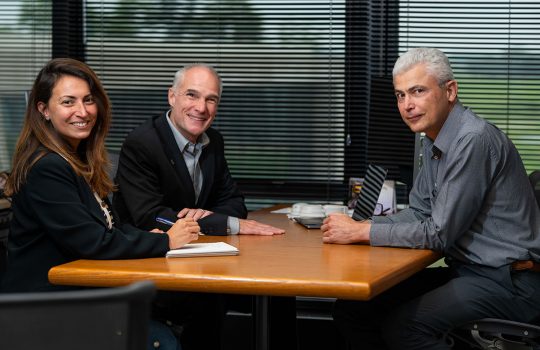
Associate lab directors help shape future of Fermilab
Fermilab’s recent reorganization brings its accelerator, physics and technology programs under three unified directorates, each charged with advancing the laboratory’s most important scientific priorities. Together, these directorates form a coordinated leadership structure designed to deliver world class research and guide Fermilab’s future.
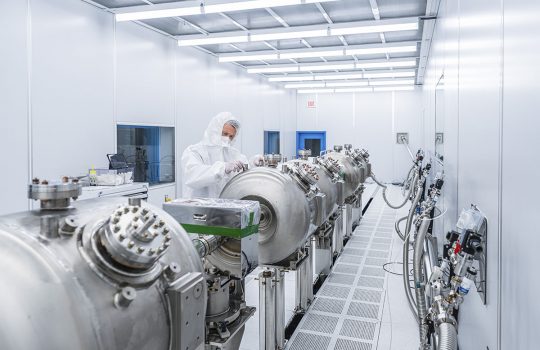
DOE selects Fermilab-led AI initiative to advance particle accelerator performance
In a project selected for funding by the Department of Energy’s Genesis Mission, Fermi National Accelerator Laboratory and partners from other national laboratories, universities and industry will apply artificial intelligence and machine learning to enable precise and adaptive resonance control in particle accelerators. Their work aims to lower operating costs by millions of dollars each year and improve accelerator performance, driving scientific discovery.
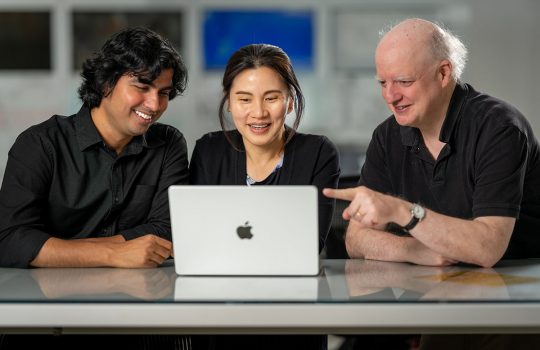
DUNE uses AI to transform the future of neutrino research
DUNE is pioneering the future of neutrino research by integrating artificial intelligence into its experiment, drawing on decades of machine learning work at Fermilab.