
The race to build functional, large quantum computers is not just about faster processing, it’s about solving complex problems to drive innovation and benefit society. To reach this bright future, researchers must develop the ability to precisely control many interconnected qubits, the basic units of information in quantum computing, to maximize their performance.
“We are excited to team up with Harmoniqs. As we scale QICK to control greater numbers of qubits, we’ll use Piccolo.jl to optimize our control pulses in a way that accounts for both qubit dynamics and the QICK hardware.”
Sho Uemura, Fermilab
Drawing on decades of experience creating microelectronics and software to run particle physics experiments, engineers at the U.S. Department of Energy’s Fermi National Accelerator Laboratory began developing a quantum research tool called QICK in 2020. Comprised of open-source software, radio-frequency electronics and commercial hardware, QICK is a customizable system that controls qubits and measures and reads out their quantum states. As such, it plays an important role in optimizing qubit performance. Its proven ability to precisely synchronize short bursts of energy called pulses to control qubits makes it a game changer for scaling up quantum computers.
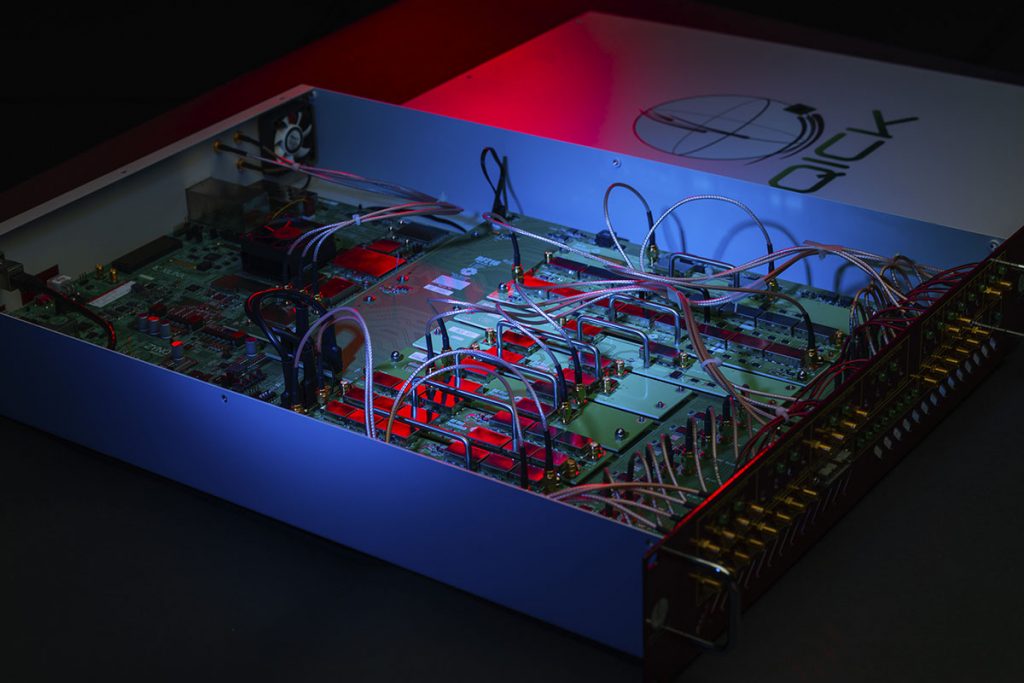
More than 500 scientists worldwide are now using QICK, and its developers continue to enhance and extend its capabilities through collaborations with DOE national labs, academia and industry.
Through one such collaboration, Fermilab is working with industry partner Harmoniqs to bring together the company’s open-source quantum optimization software, called Piccolo.jl, and QICK to enable precise qubit control at larger scales.
Integrating the two enables users of the Piccolo.jl software to test pulse optimizations — quantum computing techniques that precisely control the shape, frequency, amplitude and phase of the electromagnetic or microwave signals that control qubits and define their basic operations. This integration gives QICK users access to Piccolo’s algorithms without the manual setup otherwise required.
Piccolo.jl optimizes pulse shapes with finer granularity than standard optimization software, borrowing proven algorithms from robotics and aerospace to bring stability and rigor to quantum hardware control. It makes minute adjustments to determine the best pulse shape for a particular use case.
“We are excited to team up with Harmoniqs. As we scale QICK to control greater numbers of qubits, we’ll use Piccolo.jl to optimize our control pulses in a way that accounts for both qubit dynamics and the QICK hardware,” said Sho Uemura, lead software developer and a core member of the QICK development team at Fermilab. “Pairing the two can help you get to a better end result much faster, with fewer trial measurements, less effort testing different sets of parameters and a shorter time to results.”

Importantly, both systems are open-source, reflecting a collaboration ethos common in particle physics. They are available to the public, cost-effective and built to be customized and expanded by their users.
“Piccolo.jl gives researchers an open path into advanced pulse optimization. When integrated with QICK, it demonstrates what’s possible when open-source foundations meet purpose-built commercial software,” said Jack Champagne, chief technology officer at Harmoniqs. “QICK gives its users the hardware to deliver pulses. Piccolo.jl gives them the tools to design those pulses with hardware-aware precision. We’re looking forward to bringing that full capability to every platform that relies on QICK.”
“Piccolo.jl gives researchers an open path into advanced pulse optimization. When integrated with QICK, it demonstrates what’s possible when open-source foundations meet purpose-built commercial software.”
Jack Champagne, Harmoniqs
With tools like QICK and Piccolo.jl working in concert, researchers are simplifying how precise quantum control strategies are developed and deployed. The partnership lowers barriers to experimentation and accelerates progress toward larger, more reliable quantum systems, bringing the promise of practical quantum computing closer to reality.
Fermi National Accelerator Laboratory is America’s national laboratory for particle physics and accelerator research. Fermi Forward Discovery Group manages Fermilab for the U.S. Department of Energy Office of Science. Visit Fermilab’s website at www.fnal.gov and follow us on social media.
The development of QICK at Fermilab was originally supported primarily through the lab’s key partnership in the Quantum Science Center, a DOE National Quantum Initiative Science Research Center headquartered at Oak Ridge National Laboratory.
Recommended reading
SQMS Center uncovers material origins of variations in qubit performance through landmark study
A first-of-its-kind blinded materials characterization study spanning 22 superconducting quantum devices, seven characterization techniques and six leading institutions helps build the scientific foundations of scalable quantum computing.

DOE releases national quantum computing roadmap following field-wide effort led by SCAC subcommittee
Quantum computing is becoming a revolutionary tool for scientific discovery.
Fermilab and Microsoft partner to provide new quantum tools and expand quantum research
Fermilab is among the initial partners in Microsoft Quantum’s newly established quantum research center. Opening in the Discovery District, Maryland, the center will feature a quantum hardware makerspace, where researchers can develop new approaches to hands-on quantum training. As part of this effort, Fermilab will expand the capabilities of its Quantum Instrumentation Control Kit, or QICK, an open-source quantum control and readout system, providing flexible new tools to the quantum community.