
The U.S. Department of Energy’s Fermi National Accelerator Laboratory (Fermilab) recently achieved an important milestone by safely positioning the first major piece of equipment for the new Proton Improvement Plan (PIP-II) linear accelerator.
The radio-frequency quadrupole, or RFQ, will serve as the heart of the front end of the PIP-II’s state-of-the-art superconducting radio-frequency linear accelerator, or linac. It will power a high-energy particle beam for the Deep Underground Neutrino Experiment at the Long-Baseline Neutrino Facility, Fermilab’s flagship international experiment. Neutrinos in the beam will travel 800 miles through Earth from Batavia, Illinois, to Lead, South Dakota, where DUNE’s massive underground detectors will study the behavior of these elusive particles. DUNE is a world-leading neutrino experiment driving new technologies and capable of pushing the boundaries of scientific discovery.

During the delicate move, the RFQ was placed on a purpose-made transport fixture and driven to the PIP-II site at a careful speed of 5 miles per hour. Once the RFQ reached the newly completed High Bay Building, it was craned down 30 feet to the tunnel level and wheeled into place.
“2026 marks a significant milestone for the PIP-II project. As we accelerate cryomodule production across the United States, U.K. and France, our team is beginning installation of the warm front end in the newly completed facility,” said PIP-II Project Director Cristian Boffo. “The RFQ is the first essential component placed in the pit, marking the beginning of the PIP-II installation phase.”
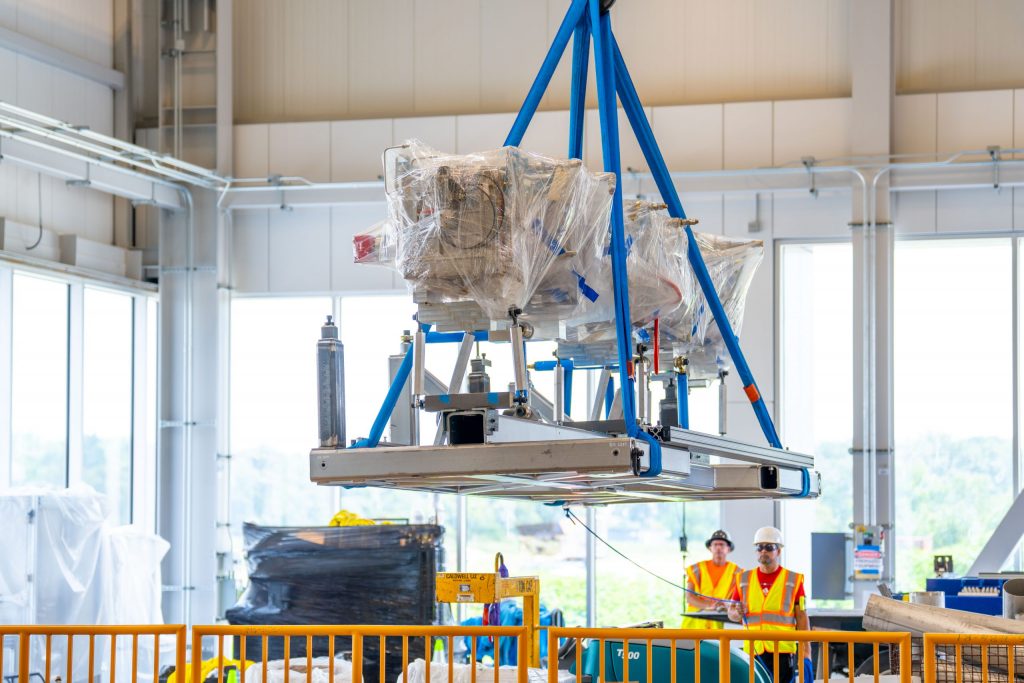
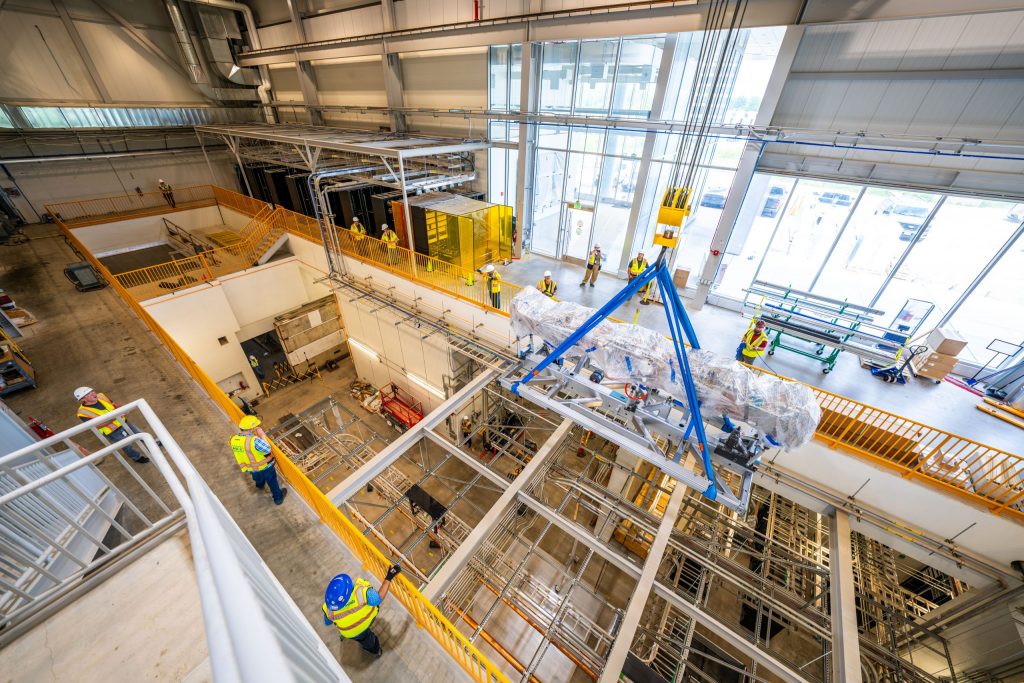
Because the RFQ is the largest single beamline component in PIP-II’s warm front end, it must be installed first. This allows for maximum space and flexibility.
The PIP-II linac will consist of 23 accelerating devices called cryomodules that gradually power a beam of H-minus ions to 800 million electron volts, or MeV, over its 215-meter length.
“The RFQ handles one of the trickiest regimes, where the beam’s energy is low and the velocity is changing a lot,” said Curt Baffes, linac installation manager for PIP-II. “Seeing this machine come to life is extremely rewarding.”
The 4-meter-long RFQ is made of copper and — unlike the rest of the linac — operates at room temperature.
Next, teams will interface the RFQ with the water-cooling, high-power radio-frequency and vacuum systems, a process expected to take the rest of 2026. In 2027, they will start to apply power to the RFQ to prepare for the first parts of beam commissioning, a slow and steady process that involves turning on one part of the system at a time.
“The last time we built a linac was in the 1960s, and it served the lab for all of this time. What we’re building now will set Fermilab up for the next 50 to 60 years.”
Steve Dixon, PIP-II conventional facilities manager
“The last time we built a linac was in the 1960s, and it served the lab for all of this time,” said Steve Dixon, PIP-II conventional facilities manager. “What we’re building now will set Fermilab up for the next 50 to 60 years.”
Other pieces of the PIP-II complex are also progressing. The coldbox and its compressors, key parts of the accelerator’s cryogenic system, arrived at the PIP-II site in January 2025 and were installed and interconnected with piping and electrical wiring. In recent weeks, the team received operational readiness clearance for the cryoplant and compressor room, another major milestone for PIP-II. Soon, they will begin commissioning the coldbox, a process that will take about six months.
Notably, the PIP-II linac is the first particle accelerator in the United States built with significant contributions from international partners, demonstrating the nation’s ability to host and lead major global scientific infrastructure projects. Institutions in France, India, Italy, Poland and the United Kingdom are contributing technologies, instrumentation and expertise to build the accelerator.
Over the next 50 years, the PIP-II linear accelerator will drive a broad physics research program beyond DUNE — and may even lead to benefits beyond physics.
Fermi National Accelerator Laboratory is America’s national laboratory for particle physics and accelerator research. Fermi Forward Discovery Group manages Fermilab for the U.S. Department of Energy Office of Science. Visit Fermilab’s website at www.fnal.gov and follow us on social media.
Recommended reading

Nobel Prize in physics awarded to Francis Halzen for groundbreaking neutrino research
The Royal Swedish Academy of Sciences has awarded the 2026 Nobel Prize in physics to Francis Halzen of the University of Wisconsin–Madison.

URA honors Fermilab researchers advancing laboratory’s top priorities
Tyler Barrett, Charis-Kleio Koraka, Kevin Kelly and Silvia Zorzetti are the recipients of the 2026 URA Honorary Awards. The awards are presented each year by Universities Research Association to recognize significant contributions to research at Fermilab.
Associate lab directors help shape future of Fermilab
Fermilab’s recent reorganization brings its accelerator, physics and technology programs under three unified directorates, each charged with advancing the laboratory’s most important scientific priorities. Together, these directorates form a coordinated leadership structure designed to deliver world class research and guide Fermilab’s future.