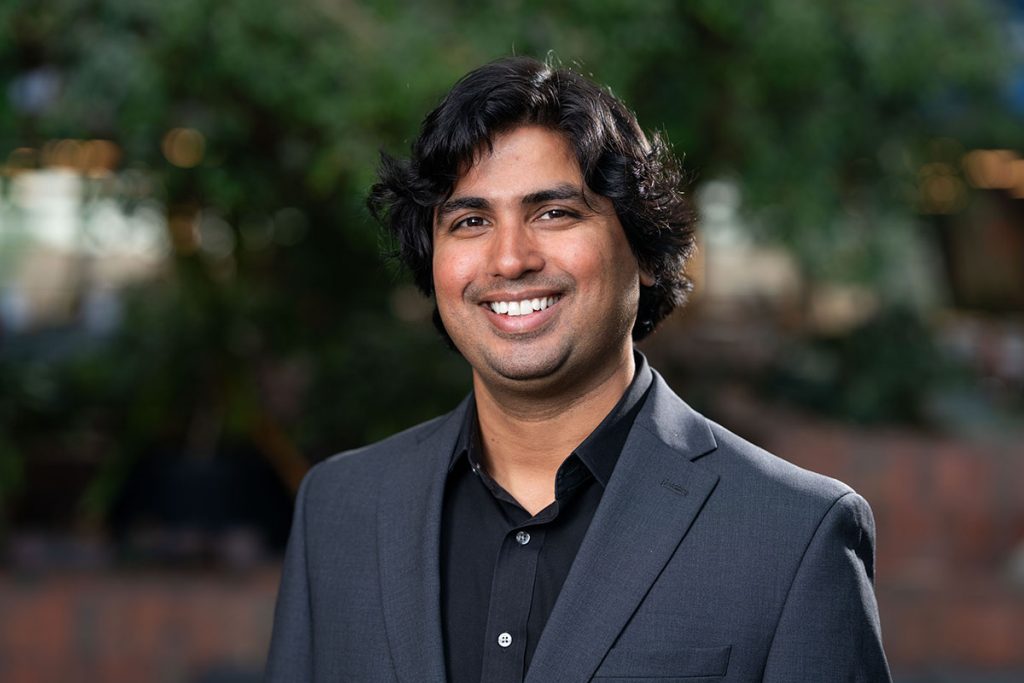
Fermilab associate scientist and Wilson Fellow Vishvas Pandey was recently elected to help lead the Neutrino Scattering Theory Experiment Collaboration, or NuSTEC, as their newest co-spokesperson.
Founded in 2014, NuSTEC is an international initiative dedicated to fostering cross-disciplinary teamwork between experimentalists and theorists working primarily around particle accelerator-based neutrino research programs. Ultimately, NuSTEC’s goal is to drive higher precision in neutrino-interaction physics across a wide range of experiments, including the upcoming Deep Underground Neutrino Experiment — hosted by the U.S. Department of Energy’s Fermi National Accelerator Laboratory.
“NuSTEC has played an important role in my professional and scientific development, and it is a genuine privilege for me to help continue supporting and strengthening our community and our mission in this role as co-spokesperson,” Pandey said.
With its international Short-Baseline Neutrino Program and leadership in developing the Long-Baseline Neutrino Facility for DUNE, Fermilab has become a center for neutrino research, and its scientists have been integral in the growth and success of NuSTEC.
“From founding co-spokesperson Jorge Morfin to outgoing co-spokesperson Jonathan Paley, Fermilab scientists have played a central role in shaping NuSTEC into the strong international collaboration it is today,” Pandey added.
Pandey, who started at Fermilab through a prestigious Wilson Fellowship in 2022, said his academic and professional career have been shaped by working at the intersection of experiment and theory.
For the past 16 years, Pandey’s work has focused on neutrino–nucleus cross-section physics, and he has worked in several areas of the NuSTEC ecosystem.
“In this way, my career has naturally evolved at the intersection of theory and experiment — the same intersection that NuSTEC was created to support,” Pandey said. “My scientific identity has been shaped by the core mission of NuSTEC.”
“From founding co-spokesperson Jorge Morfin to outgoing co-spokesperson Jonathan Paley, Fermilab scientists have played a central role in shaping NuSTEC into the strong international collaboration it is today.”
Vishvas Pandey, NuSTEC co-spokesperson
Neutrinos are among the most abundant yet elusive particles in the universe, capable of passing through entire planets almost without interacting. To study them, scientists observe the rare occasions when a neutrino collides with the nucleus of an atom, a process known as neutrino-nucleus scattering.
“In our experiments, these interactions occur inside large detectors and produce tiny flashes and particle tracks that allow researchers to infer the neutrino’s properties,” Pandey explained. “Understanding these interactions is essential because the nucleus is not a simple target; complex nuclear effects can alter the visible signals in the detector and affect how accurately scientists reconstruct the neutrino’s energy and infer neutrino properties.”
Precise knowledge of neutrino-nucleus scattering therefore plays an important role in current and next-generation accelerator-based neutrino experiments that aim to study neutrino oscillations, investigate why matter dominates over antimatter in the universe, and search for new physics beyond the Standard Model. The same physics also connects to astrophysics, including the study of supernova explosions and the behavior of matter under extreme conditions.
Current NuSTEC co-spokesperson Natalie Jachowicz of Ghent University in Belgium is excited to welcome Pandey to his role. “Vishvas has been active at the intersection of theory and experiment in neutrino interactions for many years and has a thorough understanding of the needs of the field, Jachowicz said. “I am very much looking forward to working with him on the role NuSTEC will play for the neutrino physics community in the exciting times ahead.”
“I would like to thank Jonathan Paley for his work as co-spokesperson over the past six years. Thanks to his dedication, NuSTEC has grown into the broad and active community it is today,” Jachowicz added.
“New tools, including AI and machine learning, are beginning to play an important role in neutrino interaction studies.”
Vishvas Pandey, NuSTEC co-spokesperson
Pandey noted that the chief goal for his tenure is to maintain a strong focus on the next generation of experiments. “During my term, our next-generation experiments, DUNE and Hyper-Kamiokande in Japan, will begin approaching operation,” Pandey said. “Now is the time to move the focus to that next generation and concentrate on how we can enable these experiments to achieve discovery-level precision.”
Pandey also hopes to explore the potential for artificial intelligence to assist with the goals of NuSTEC by creating a new working group focused on AI. Leveraging the power of AI could potentially strengthen the collaboration’s ability to answer some of the challenging questions it is pursuing.
“New tools, including AI and machine learning, are beginning to play an important role in neutrino interaction studies,” Pandey said. “NuSTEC could provide a natural platform for coordinating these efforts across experimental collaborations and theory groups, and I would support the creation of a working group focused on this area.”
Later this year at Fermilab, the collaboration will hold the NuSTEC School to train both graduate students and postdoctoral researchers and further cooperative work between neutrino theorists and experimentalists. “There is a clear need for this across the community, and this school will help bring together the next generation of scientists to Fermilab to train them in model development, data sharing and the broader theoretical and experimental landscape of neutrino interaction physics,” Pandey said.
Fermi National Accelerator Laboratory is America’s national laboratory for particle physics and accelerator research. Fermi Forward Discovery Group manages Fermilab for the U.S. Department of Energy Office of Science. Visit Fermilab’s website at www.fnal.gov and follow us on social media.
Recommended reading

Nobel Prize in physics awarded to Francis Halzen for groundbreaking neutrino research
The Royal Swedish Academy of Sciences has awarded the 2026 Nobel Prize in physics to Francis Halzen of the University of Wisconsin–Madison.
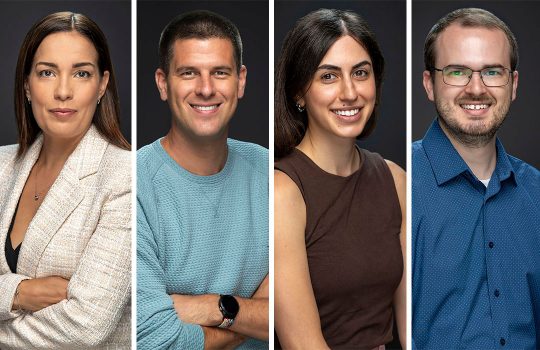
URA honors Fermilab researchers advancing laboratory’s top priorities
Tyler Barrett, Charis-Kleio Koraka, Kevin Kelly and Silvia Zorzetti are the recipients of the 2026 URA Honorary Awards. The awards are presented each year by Universities Research Association to recognize significant contributions to research at Fermilab.
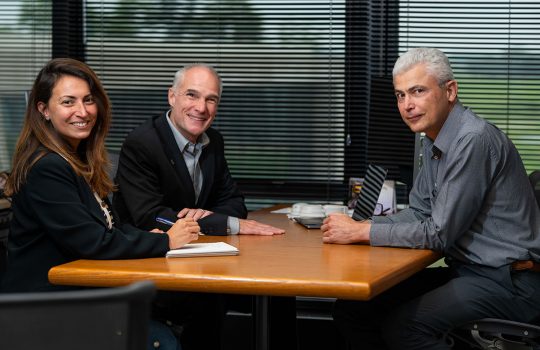
Associate lab directors help shape future of Fermilab
Fermilab’s recent reorganization brings its accelerator, physics and technology programs under three unified directorates, each charged with advancing the laboratory’s most important scientific priorities. Together, these directorates form a coordinated leadership structure designed to deliver world class research and guide Fermilab’s future.