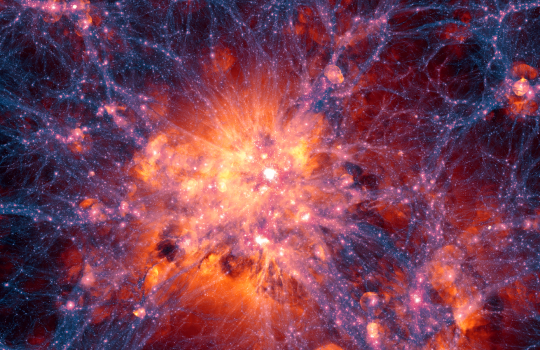
Creating the universe in a computer
Computer simulations help cosmologists unlock the mystery of how the universe evolved.

1461 - 1470 of 1785 results
Computer simulations help cosmologists unlock the mystery of how the universe evolved.
From The New York Times, Oct. 4, 2016: Fermilab congratulates scientists David J. Thouless, F. Duncan M. Haldane and J. Michael Kosterlitz for winning the Nobel Prize for their discoveries in condensed-matter physics.
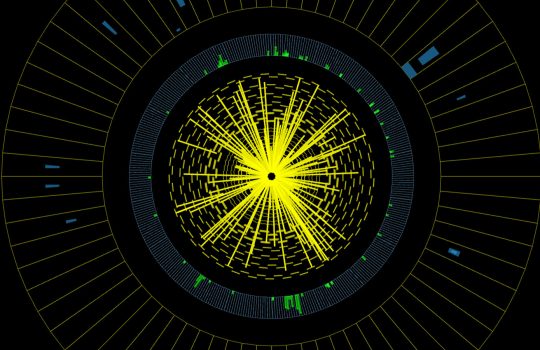
The Large Hadron Collider is now producing about a billion proton-proton collisions per second.
From Nature, Sept. 22, 2016: Cronin, scientist at the University of Chicago and who held leadership position at Fermilab, won the Nobel Prize for the discovery of violations of fundamental symmetry principles in the decay of neutral K mesons.
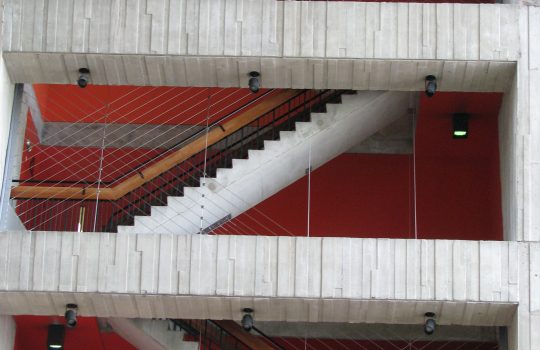
A story of the fate of some walnut trees on the laboratory site in 1979 takes us inside the Wilson Hall stairways.
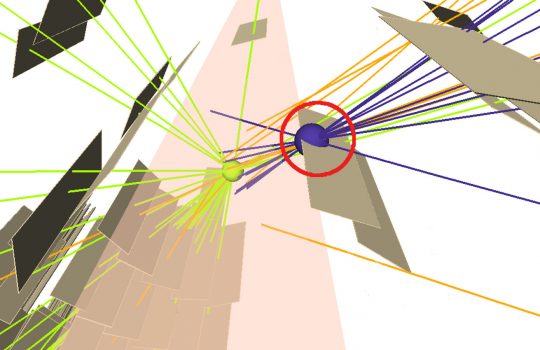
A theoretical species of particle might answer nearly every question about our cosmos—if scientists can find it.
From The Washington Post, Sept. 8, 2016: When it comes to cyclotrons, former Fermilab scientist Timothy Koeth, now at the University of Maryland, is a mixture of promoter, preacher and sorcerer. Fermilab physicist Todd Johnson contributes to the Post article.
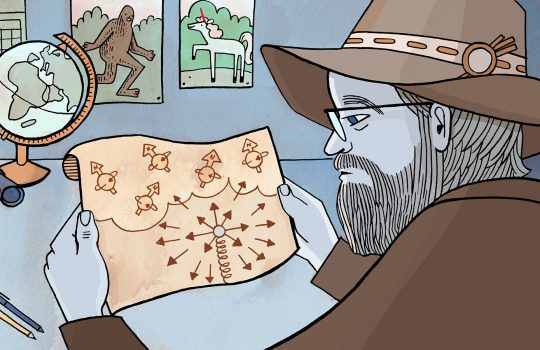
Many theories predict the existence of magnetic monopoles, but experiments have yet to see them.
From CIO Review, Sept. 7, 2016: Fermilab Chief Information Officer Rob Roser gives a summary of computing at Fermilab for CIO Review magazine.