Physicists finally calculated where the proton’s mass comes from
From Science News, Nov. 26, 2018: Fermilab’s Andreas Kronfeld comments on a new study on the source of a proton’s mass.
1621 - 1630 of 2263 results
From Science News, Nov. 26, 2018: Fermilab’s Andreas Kronfeld comments on a new study on the source of a proton’s mass.
From Physics World, Nov. 23, 2018: Fans of Fermilab, the Monkees and vintage American pickup trucks will love this film, shot in 1970 by Monkees drummer Mickey Dolenz and shows construction of the National Accelerator Laboratory (now Fermilab).
From Seeker, Nov. 26, 2018: This 5-minute video discusses DUNE along with other neutrino experiments.
From CNN, Nov. 26, 2018: Fermilab scientist Don Lincoln details the planned landing sequence of NASA’s InSight spacecraft on Mars.
From Inside Science, Nov. 20, 2018: Fermilab scientist Charles Thangaraj appears in this fun article on the use of accelerators to cross-link materials, including the plastic that wraps around your Thanksgiving turkey.
From CNN, Nov. 20, 2018: Fermilab scientist Don Lincoln talks about a stellar stream called S1, which consists of nearly 100 stars of similar age and composition, orbiting the Milky Way in a direction exactly opposite that of normal stars.
From 9 to 5 Google, Nov. 15, 2018: The LHC’s massive physics experiments will require computing capacity that is an estimated 50-100 times higher than today. Google finds the challenge exciting and has already been working with Fermilab and Brookhaven National Laboratory to store and analyze data from the LHC using the Google Computer Engine.
From Suburban Chronicle, Nov. 16, 2018: Funding has been finalized, design work is under way and construction is now set to start next summer. Construction is likely be completed by the end of 2021.
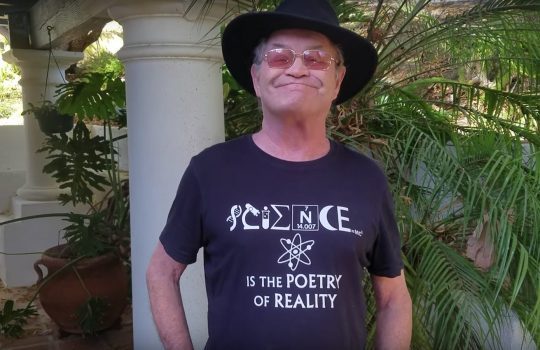
1970s video footage recorded by musician Micky Dolenz when he visited the then-nascent Fermilab is now available on YouTube.
From The Chicago Maroon, Nov. 12, 2018: Fermilab Chief Research Officer Joe Lykken appears in this overview of the Nov. 8-9 Chicago Quantum Summit.