Below is a press release issued by Lawrence Berkeley National Laboratory on the LUX-ZEPLIN project. A Fermilab group led by Eric Dahl, a joint appointee and associate professor at Northwestern University, is responsible for implementing key parts of the critical systems that handle the xenon in the LUX-ZEPLIN detector. These include the heat exchange system that allows the entire 10-ton xenon target to be purified every 2.3 days, as well as the controls system that safeguards the greater than $10 million xenon payload in emergency scenarios. View the original Berkeley Lab press release on their news site.
Q: How do you get a 5,000-pound, 9-foot-tall particle detector, designed to hunt for dark matter, nearly a mile underground?
A: Very carefully.
Last week, crews at the Sanford Underground Research Facility (SURF) in South Dakota strapped the central component of LUX-ZEPLIN (LZ) – the largest direct-detection dark matter experiment in the U.S. – below an elevator and s-l-o-w-l-y lowered it 4,850 feet down a shaft formerly used in gold-mining operations.
This final journey of LZ’s central detector on Oct. 21 to its resting place in a custom-built research cavern required extensive planning and involved two test moves of a “dummy” detector to ensure its safe delivery.
Jake Davis, a SURF mechanical engineer who worked on the cryostat move, said, “Between the size of the device, the confines of the space, and the multiple groups involved in the move, the entire process required rigorous attention to both the design and the scheduling. Prior to rigging the detector under the cage, we did testing with other cranes to see how it would react when suspended. We also completed analysis and testing to ensure it would remain nice and straight in the shaft.”
He added, “The ride was slow, right around 100 feet per minute. The ride to the 4,850-foot level typically takes 13-15 minutes. Today, it took close to 45 minutes. I rode in the cage, watching it through an inspection port in the floor. There was a huge sigh of relief after the move, but there’s still a lot of work ahead to finish LZ.”

The LUX-ZEPLIN central detector makes its way to Yates Shaft at Sanford Underground Research Facility, which can be seen in the background, for its nearly mile-long descent down an elevator shaft. The move was successfully completed last week. Photo: Nick Hubbard/Sanford Underground Research Facility
Theresa Fruth, a postdoctoral research fellow at University College London who works on LZ’s central detector, said that keeping LZ well-sealed from any contaminants during its journey was a high priority – even the slightest traces of dust and dirt could ultimately affect its measurements.
“From a science perspective, we wanted the detector to come down exactly as it was on the surface,” she said. “The structural integrity is incredibly important, but so is the cleanliness, because we’ve been building this detector for 10 months in a cleanroom. Before the move, the detector was bagged twice, then inserted in the transporter structure. Then, the transporter was wrapped with another layer of strong plastic. We also need to move all our equipment underground so we can do the rest of the installation work underground.”
The central detector, known as the LZ cryostat and time projection chamber, will ultimately be filled with 10 tons of liquid xenon that will be chilled to minus 148 degrees Fahrenheit. Scientists hope to see telltale signals that are produced when dark matter particles interact with the heavy xenon atoms in this cryostat.
The liquid form of xenon, a very rare element, is so dense that a chunk of granite can float atop its surface. It is this density, owing to the heavy atomic weight of xenon, that makes it a good candidate for capturing particle interactions.
The cryostat is a large tank, assembled from ultrapure titanium, is about five-and-a-half feet in diameter. It contains systems with a total of 625 photomultiplier tubes that are positioned at its top and bottom (see a related article). These tubes are designed to capture flashes of light produced in particle interactions.
Pawel Majewski of the Rutherford Appleton Laboratory in the UK, who led the design, fabrication, cleaning and delivery of LZ’s inner cryostat vessel for the U.K. Science and Technology Facilities Council, said, “Now it is extremely gratifying to see it … holding the heart of the experiment and resting in its final place in the Davis Campus, one mile underground.”
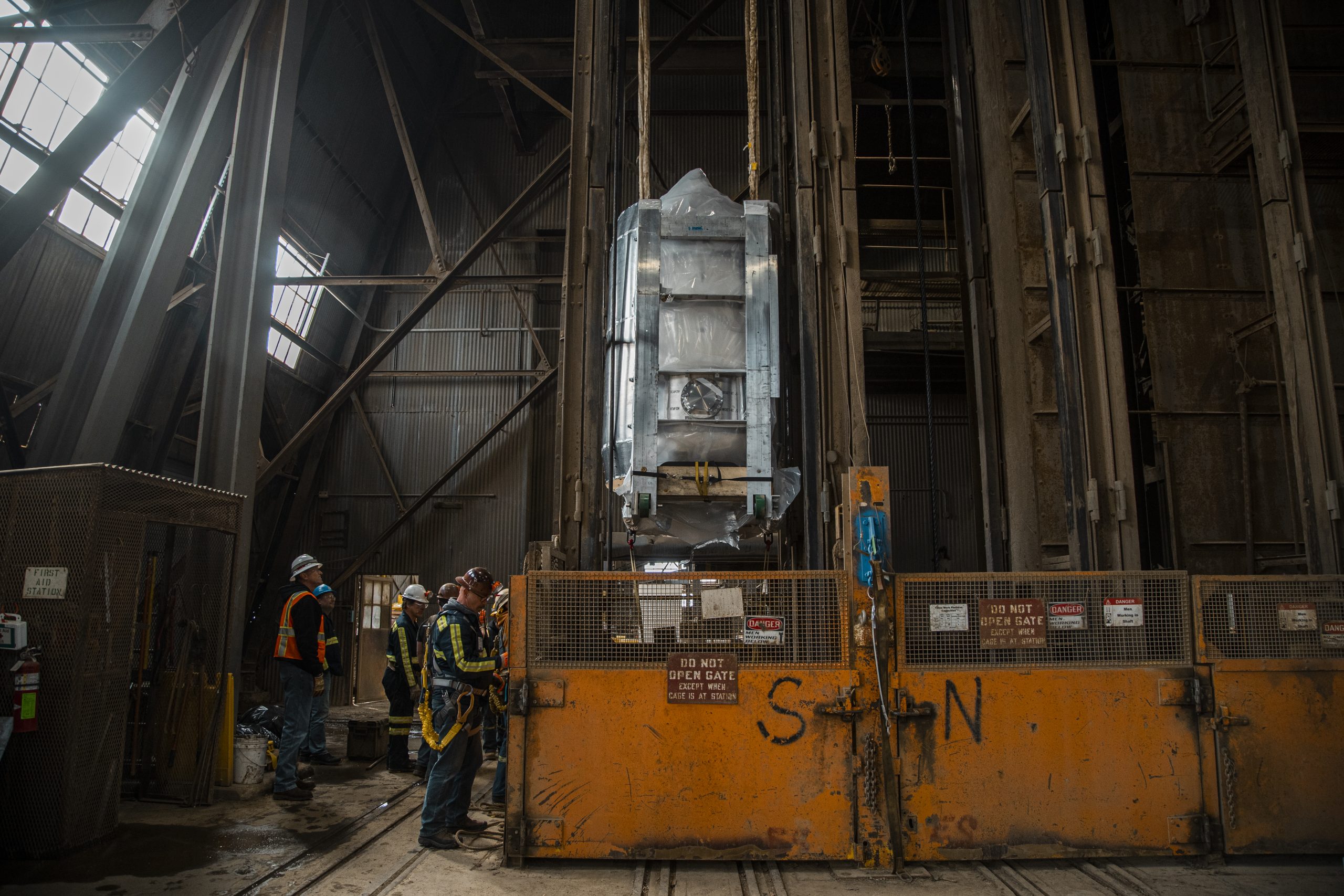
Crews at the Sanford Underground Research Laboratory in Lead, South Dakota, begin to lower the LUX-ZEPLIN central detector. Its nearly mile-long descent down an elevator shaft, and its delivery to a research cavern where it will hunt for dark matter, were successfully carried out last week. Photo: Nick Hubbard/Sanford Underground Research Facility
LZ is designed to hunt for theorized dark matter particles called WIMPs, or weakly interacting massive particles. Dark matter makes up about 27 percent of the universe, though we don’t yet know what it’s made of and have only detected it through its gravitational effects on normal matter.
LZ is 100 times more sensitive than its predecessor experiment, called LUX, which operated in the same underground space. Placing LZ deep underground serves to shield it from much of the steady bombardment of particles that are present at Earth’s surface.
LZ’s cryostat will be surrounded by a tank filled with a liquid known as a scintillator that will also be outfitted with an array of photomultiplier tubes and is designed to help weed out false signals of unwanted particle “noise.” And the cryostat and scintillator tank will be embedded within a large water tank that provides a further buffer layer from unwanted particle signals.
While LUX’s main detector was small enough to fit in the SURF elevator, LZ’s cryostat narrowly fit in the elevator shaft.
It was first moved outside of a cleanroom at the surface level, picked up with a forklift and carried into position below the elevator cage. It was then attached to the underside of the cage with slings and straps, where it was slowly moved down to the level of the Davis Cavern, its final resting place.
Once detached from the elevator cage, it was moved using air skates on a temporarily assembled surface – akin to how an air hockey puck moves across the table’s surface. Because of the cryostat’s size, crews had to first temporarily remove underground duct work to allow the move.
Jeff Cherwinka, the LZ chief engineer from the University of Wisconsin, led the planning effort for the move along with SURF engineers and other support.
“This was the most challenging move of a detector system that I have ever done in decades of working on experiments,” Cherwinka said.
Murdock “Gil” Gilchriese, LZ project director and a physicist at Lawrence Berkeley National Laboratory (Berkeley Lab), said, “Next, the cryostat will be wrapped with multiple layers of insulation, and a few other exterior components will be installed.”
Berkeley Lab is the lead institution for the LZ project.
“Then it will get lowered into the outer cryostat vessel,” he added. “It will take months to hook up and check out all of the cables and make everything vacuum-tight.”
Most of the LZ work is now concentrated underground, he said, with multiple work shifts scheduled to complete LZ assembly and installation.
There are plans to begin testing the process of liquefying xenon gas for LZ in November using a mock cryostat, and to fill the actual cryostat with xenon in spring 2020. Project completion could come as soon as July 2020, Gilchriese said.
Erin Broberg of the Sanford Underground Research Facility contributed to this press release.
# # #
Founded in 1931 on the belief that the biggest scientific challenges are best addressed by teams, Lawrence Berkeley National Laboratory and its scientists have been recognized with 13 Nobel Prizes. Today, Berkeley Lab researchers develop sustainable energy and environmental solutions, create useful new materials, advance the frontiers of computing, and probe the mysteries of life, matter, and the universe. Scientists from around the world rely on the Lab’s facilities for their own discovery science. Berkeley Lab is a multiprogram national laboratory, managed by the University of California for the U.S. Department of Energy’s Office of Science.
DOE’s Office of Science is the single largest supporter of basic research in the physical sciences in the United States, and is working to address some of the most pressing challenges of our time. For more information, please visit energy.gov/science.
The Sanford Underground Research Facility’s mission is to enable compelling underground, interdisciplinary research in a safe work environment and to inspire our next generation through science, technology, engineering, and math education. For more information, please visit the Sanford Lab website at http://www.sanfordlab.org.
If you have seen a photograph of Fermilab in the past three decades, odds are good that Reidar Hahn was behind the lens. You name it, and he’s probably taken a picture of it: a neutrino detector the size of a hockey rink, the experiments that co-discovered the top quark, a 570-megapixel camera peering into space. He’s captured underground groundbreakings, orchestrated photo shoots with one-of-a-kind magnets, delivered images of baby bison. Hahn has documented the birth and conclusion of experiments across the lab – and in the process, perhaps explored more of Fermilab’s nooks and crannies than anyone else.
Fermilab’s staff photographer of 32 years will retire this December. As he leaves, his work will be on display in Fermilab’s art gallery. Hahn’s show, “Collections,” runs from Nov. 6, 2019, through Jan. 3, 2020, with a free artist’s reception on Nov. 8 from 5-7 p.m.

Hahn’s photos of science at Fermilab are omnipresent at the laboratory. They populate the Fermilab photo archive, grace brochures and webpages and even hang as enormous banners in Wilson Hall’s soaring atrium – appropriately enough, right above the art gallery. But rather than displaying more of the same, “Collections” features photographs from Hahn’s life beyond the lab.
“I’m looking forward to showing some of my personal work instead of the science photos that people know me by,” he said.
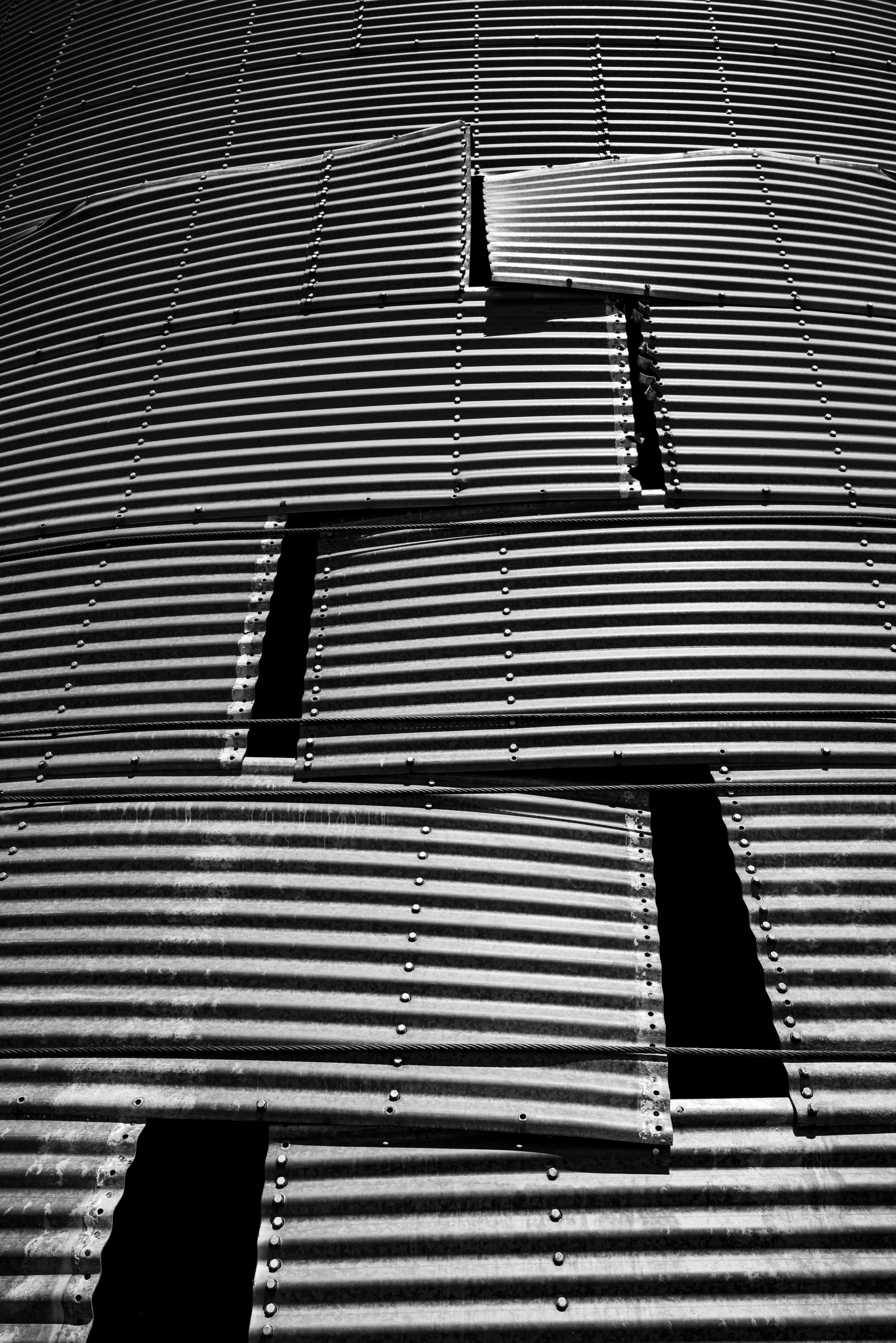
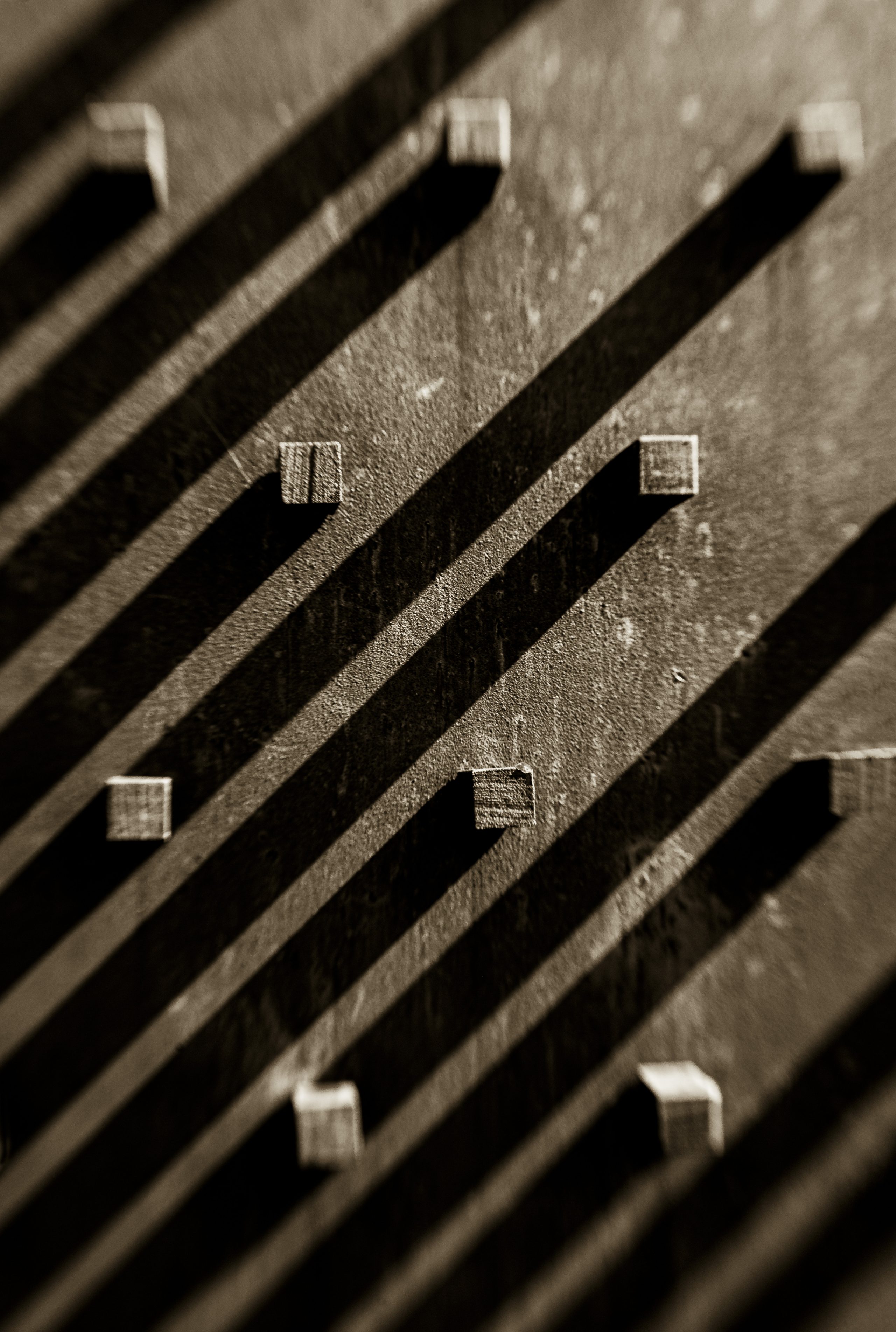
An avid outdoorsman (with a forestry degree to boot), Hahn has spent much of his free time camping, canoeing and hiking his way through all 50 states and photographing both the people and the nature therein. “Collections” will group some of his favorite photos by themes, including winter, flowers, trees, water, and farming communities.
“He’s a true artist,” said Georgia Schwender, Fermilab’s art gallery curator. “I think it’s an honor to be able to see his photographs in this setting – and that people will be able to see another side of Reidar’s photography that is more his personal vision of the world.”
Schwender wanted to highlight the artistry that few people get to see, but she also organized the exhibit as a way to say farewell and recognize Hahn for his profound impact on the lab.
“There are 2,000 people at this place, and I’ve never met anybody on site that didn’t know Reidar,” said Marty Murphy, an accelerator operations specialist at Fermilab who turned to Hahn for photography advice two decades ago. “He’s one of the most kind and generous people I’ve met, and one of the most talented and capable people I’ve ever met. There are a lot of talented people at Fermilab, but none of them are really like Reidar.”

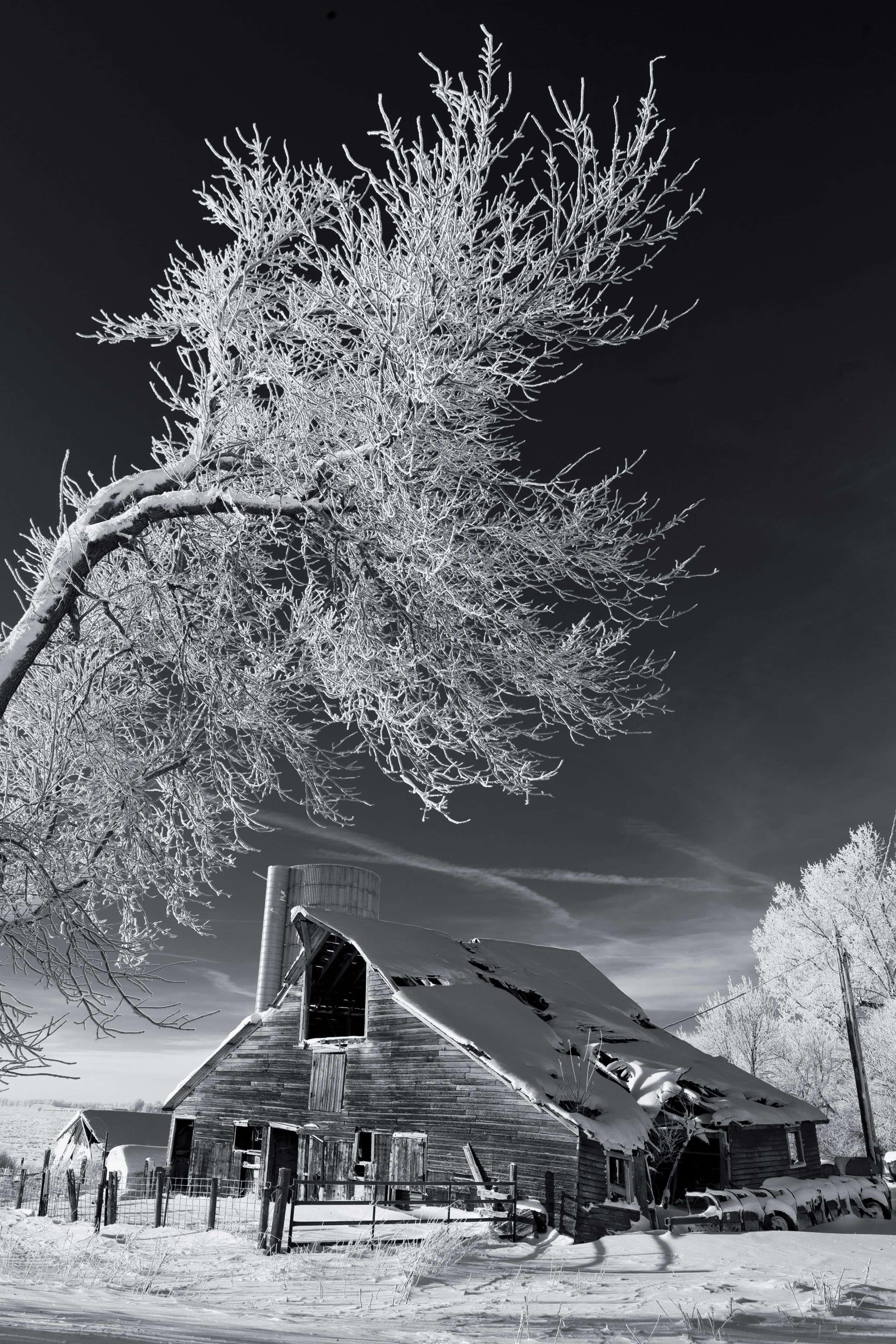

After stints as a hot-tar roofer and seven years as a newspaper photographer, Hahn joined Fermilab as a photographer in 1987. He has since worked for five of Fermilab’s six directors and knew and photographed the sixth – founding director, Robert Wilson.
“Mrs. Wilson once told me that I had captured the best picture of Bob that anyone had ever taken – and that was when Wilson was in his eighties,” Hahn said. “That was nice of her. She didn’t have to say that to me.”
Since then, Hahn has seen a lot of changes at the lab, including the growth of Fermilab’s computing sector, the lifespan of the Tevatron and the discovery of new particles, and the move from collider physics to a focus on neutrinos. Experiments moved from film in bubble chambers to the now common digital readouts, paralleling the biggest change in Hahn’s photographic career: the switch from film to digital cameras.
“Reidar’s photos have been an absolutely essential record of the lab’s activities for the last 32 years and capture important elements of the lab’s history that aren’t preserved in any other type of record,” said Valerie Higgins, Fermilab’s archivist. “His images make the wonder that many of the lab’s scientists see in the experiments they perform or the questions they explore accessible to a wider audience.”
For Hahn, who also has a degree in technical communication, it’s been a 32-year education in physics and engineering – one that he’s shared through photography but also in conversations with visitors to the lab.
“It’s really impressive how well he grasps the science of what we do,” Murphy said. “He has a great understanding of it and he explains it well – and he’s a very easy-going person. He’d be equally comfortable talking with Leon Lederman or talking with an intern.”
Hahn says he’d often couldn’t help asking questions about the research whenever he showed up to take a photo.
“People have been great to share what they’re working on with me, and I have a much greater understanding of how the universe works, and a real appreciation for all the tough, hard work people do at a frontier-science laboratory,” Hahn says. “I learned all kinds of things that I wouldn’t have if they hadn’t shared that with me.”
Hahn plans to expand his photography collections in retirement from his new home base in Idaho. After providing 32 years of consistent visual style as well as guidance and a helping hand, he’ll undoubtedly be missed at his second home.
“Reidar Hahn is one-of-a-kind,” said Fermilab Director Nigel Lockyer. “He’s smart, skilled, always working to get things done, always helping people from all across the lab. He embodies the best of the Fermilab spirit, and the lab has been lucky to have him.”
The Dark Energy Spectroscopic Instrument seeks to further our cosmic understanding by creating the largest 3-D map of galaxies to date. Below is a press release issued by Lawrence Berkeley National Laboratory announcing first light for this extraordinary instrument. The U.S. Department of Energy’s Fermi National Accelerator Laboratory is a key player in the construction of this instrument, drawing on more than 25 years of experience with the Sloan Digital Sky Survey and the Dark Energy Survey.
Fermilab contributed key elements to DESI, including the corrector barrel, hexapod and cage. The corrector barrel – designed, built and initially tested at Fermilab – aligns DESI’s six large lenses to within the accuracy of the width of a human hair. This precision is essential to ensure that the images DESI collects are sharp and clear. The hexapod, designed and built with partners in Italy, moves and focuses the lenses. Both the barrel and hexapod are housed in the cage, which was also designed and built by Fermilab. Additionally, Fermilab carried out the testing and packaging of the charge-coupled devices, or CCDs. The CCDs convert the light passing through these lenses from distant galaxies into digital information that can then be analyzed by the collaboration.
Fermilab also provided other components to the project, including the online databases used for data acquisition and the software that will ensure that each of the 5,000 robotic positioners are precisely pointing to their celestial targets.
“It’s been a long journey to first light, but it’s immensely gratifying to see this next-generation instrument come alive,” said Gaston Gutierrez, Fermilab scientist and manager of the DESI collector barrel construction. “I look forward to the new discoveries and new insights about our cosmos this instrument will provide.”

Members of the Fermilab team stand with the lens-holding barrel for the Dark Energy Spectroscopic Instrument. From left: Jorge Montes, Mike Roman, David Butler, Gaston Gutierrez, Giuseppe Gallo and Otto Alvarez. Photo: Reidar Hahn
A new instrument mounted atop a telescope in Arizona aimed its robotic array of 5,000 fiber-optic “eyes” at the night sky on Oct. 22 to capture the first images showing its unique view of galaxy light.
It was the first test of the Dark Energy Spectroscopic Instrument, known as DESI, with its nearly complete complement of components. The long-awaited instrument is designed to explore the mystery of dark energy, which makes up about 68 percent of the universe and is speeding up its expansion.
DESI’s components are designed to automatically point at preselected sets of galaxies, gather their light, and then split that light into narrow bands of color to precisely map their distance from Earth and gauge how much the universe expanded as this light traveled to Earth. In ideal conditions DESI can cycle through a new set of 5,000 galaxies every 20 minutes.
The latest milestone marks the opening of DESI’s final testing toward the formal start of observations in early 2020.
Like a powerful time machine, DESI will peer deeply into the universe’s infancy and early development – up to about 11 billion years ago – to create the most detailed 3-D map of the universe.
By repeatedly mapping the distance to 35 million galaxies and 2.4 million quasars across one-third of the area of the sky over its five-year run, DESI will teach us more about dark energy. Quasars, among the brightest objects in the universe, allow DESI to look deeply into the universe’s past.
DESI will provide very precise measurements of the universe’s expansion rate. Gravity had slowed this rate of expansion in the early universe, though dark energy has since been responsible for speeding up its expansion.
“After a decade in planning and R&D, installation and assembly, we are delighted that DESI can soon begin its quest to unravel the mystery of dark energy,” said DESI Director Michael Levi of the Department of Energy’s Lawrence Berkeley National Laboratory, the lead institution for DESI’s construction and operations.
“Most of the universe’s matter and energy are dark and unknown, and next-generation experiments like DESI are our best bet for unraveling these mysteries,” Levi added. “I am thrilled to see this new experiment come to life.”
The DESI collaboration has participation from nearly 500 researchers at 75 institutions in 13 countries.
Installation of DESI began in February 2018 at the Nicholas U. Mayall Telescope at Kitt Peak National Observatory near Tucson, Arizona.
“With DESI we are combining a modern instrument with a venerable old telescope to make a state-of-the-art survey machine,” said Lori Allen, director of Kitt Peak National Observatory at the National Science Foundation’s National Optical-Infrared Astronomy Research Laboratory.
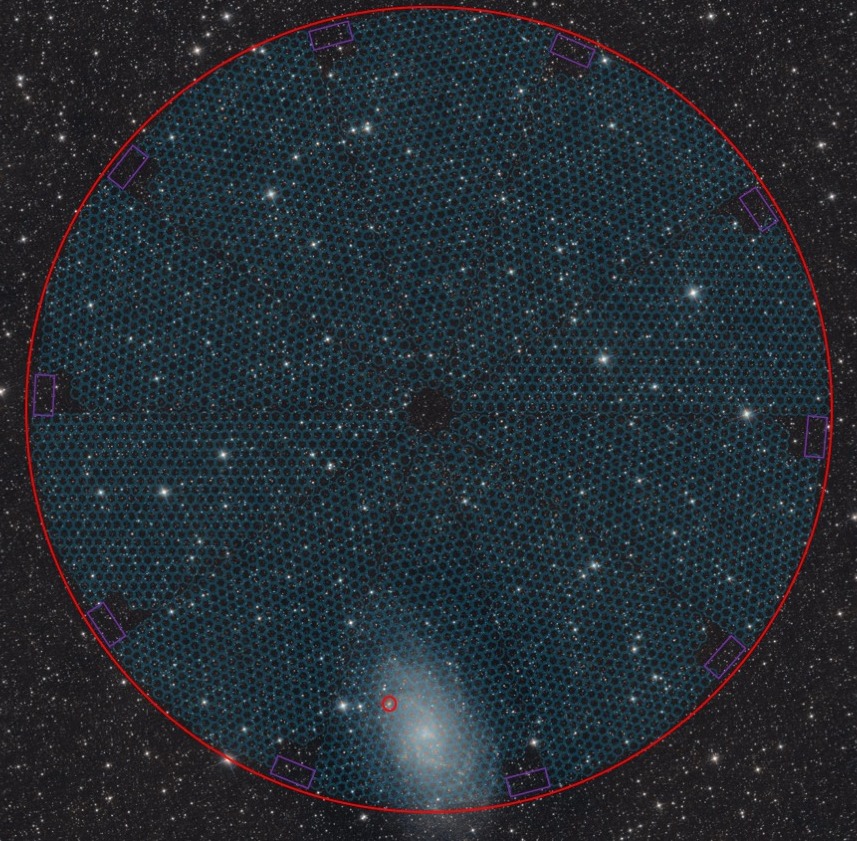
DESI’s 5000 spectroscopic “eyes” can cover an area of sky about 38 times larger than that of the full moon, as seen in this overlay of DESI’s focal plane on the night sky (top). Each one of these robotically controlled eyes can fix a fiber-optic cable on a single object to gather its light. Photo: DESI collaboration
Over the past 18 months, a bevy of DESI components were shipped to the site from institutions around the globe and installed on the telescope.
Among the early arrivals was an assembly of lenses packaged in a large steel barrel, together weighing in at three tons. This corrector barrel sits over the 4-meter primary mirror of the Mayall Telescope and provides an expansive field of view. The lenses, each measuring about a meter across, were successfully tested in April.
DESI’s focal plane, which carries 5,000 robotic positioners that swivel in a choreographed “dance” to individually focus on galaxies, is at the top of the telescope.
These little robots – which each hold a light-gathering fiber-optic cable that is about the average width of a human hair – serve as DESI’s eyes. It takes about 10 seconds for the positioners to swivel to a new sequence of targeted galaxies. With its unprecedented surveying speed, DESI will map over 20 times more objects than any predecessor experiment.
The focal plane, which comprises a half-million individual parts, is arranged in a series of 10 wedge-shaped petals that each contain 500 positioners and a little camera to help the telescope point and focus.
The focal plane, corrector barrel, and other DESI components weigh 11 tons, and the Mayall telescope’s movable arm that DESI is installed on weighs 250 tons and rises 90 feet above the floor in the Mayall’s 14-story dome.
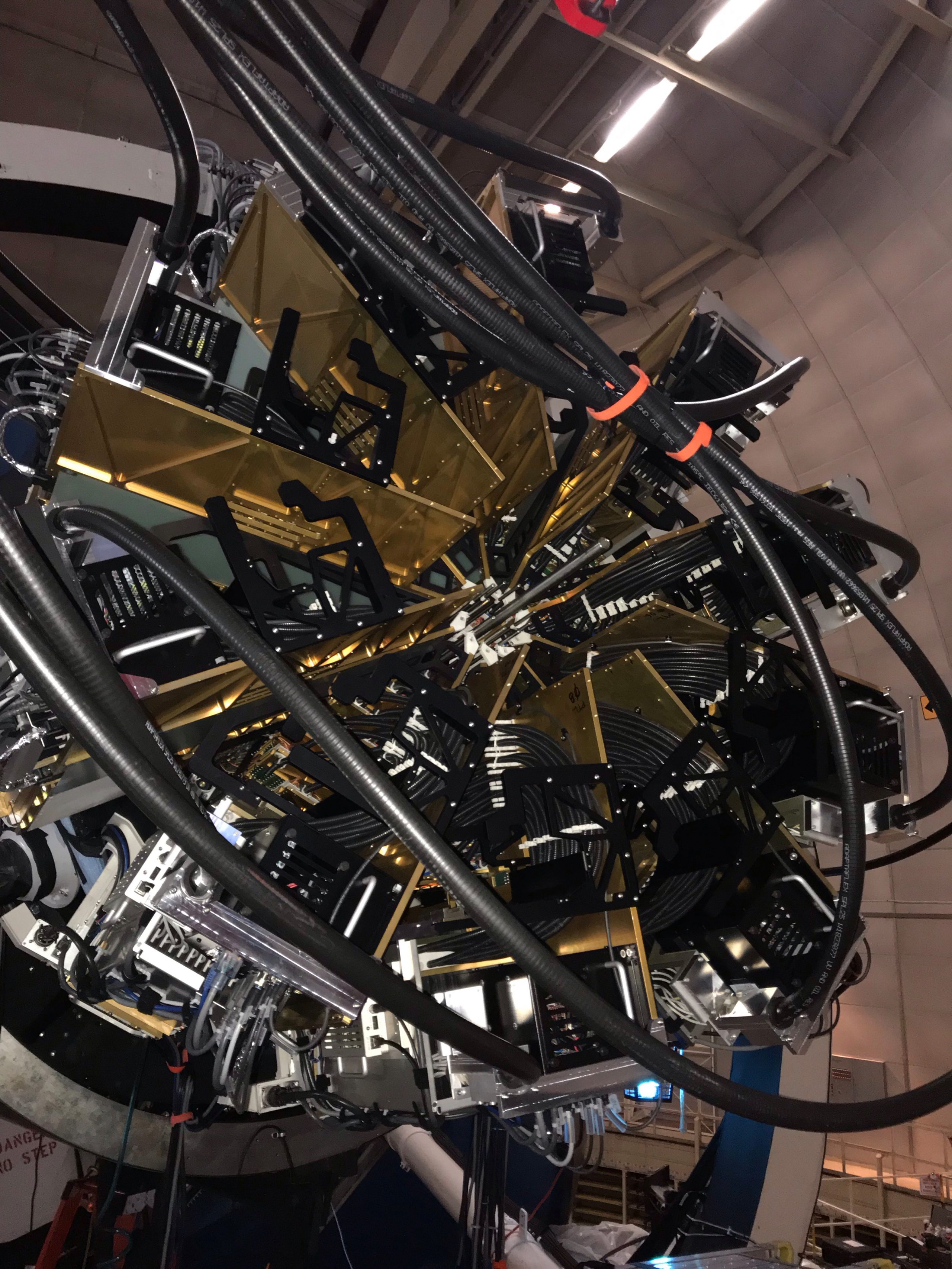
Crews use a special machine to install an individual wedge-shaped petal in DESI’s focal plane, which is installed atop the Mayall Telescope at Kitt Peak National Observatory near Tucson, Arizona. The roundish focal plane is made up of 10 petals, and each petal holds 500 robotic positioners that individually target galaxies to collect their light via thin fiber-optic cables. Photo: Christian Soto, National Optical-Infrared Astronomy Research Laboratory/AURA/NSF
Among the more recent arrivals at Kitt Peak is the collection of spectrographs that are designed to split up the gathered light into three separate color bands to allow precise distance measurements of the observed galaxies across a broad range of colors.
These spectrographs, which allow DESI’s robotic eyes to “see” even faint, distant galaxies, are designed to measure redshift, which is a shift in the color of objects to longer, redder wavelengths due to the objects’ movement away from us. Redshift is analogous to how the sound of a fire engine’s siren shifts to lower tones as it moves away from us.
There are now eight spectrographs installed, with the final two arriving before year-end. To connect the focal plane with the spectrographs, which are located beneath the telescope, DESI is equipped with about 150 miles of fiber-optic cabling.
“This is a very exciting moment,” said Nathalie Palanque-Delabrouille, a DESI spokesperson and an astrophysics researcher at France’s Atomic Energy Commission who has participated in the selection process to determine which galaxies and other objects DESI will observe.
“The instrument is all there. It has been very exciting to be a part of this from the start,” she said. “This is a very significant advance compared to previous experiments. By looking at objects very far away from us, we can actually map the history of the universe and see what the universe is composed of by looking at very different objects from different eras.”
Palanque-Delabrouille’s institution, CEA, contributed a specialized cooling system to optimize the performance of the light sensors (known as CCDs or charge-coupled devices) that enable DESI’s broad color-sampling range.
Gregory Tarlé, a physics professor at the University of Michigan who led the student teams that assembled the robotic positioners for DESI and related components, said it’s gratifying to reach a stage in the project where all of DESI’s complex components are functioning together.
The University of Michigan delivered a total of 7,300 robotic positioners, including spares. During the production peak, the teams were churning out about 50 positioners a day.
“It was quite a process,” Tarlé said. “We were at the limits of precision for these production parts.”
The positioners were installed in the focal plane petals at Berkeley Lab, and after assembly and testing the completed petals were shipped to Kitt Peak and installed one at a time on the Mayall Telescope.
Now that the hard work of building DESI is largely done, Tarlé said he looks forward to DESI discoveries.
“I want to find out what the nature of dark energy is,” he said. “We finally have a shot at really trying to understand the nature of this stuff that dominates the universe.”
###
DESI is supported by the U.S. Department of Energy’s Office of Science; the U.S. National Science Foundation, Division of Astronomical Sciences under contract to the NSF’s National Optical-Infrared Astronomy Research Laboratory; the Science and Technologies Facilities Council of the United Kingdom; the Gordon and Betty Moore Foundation; the Heising-Simons Foundation; the French Alternative Energies and Atomic Energy Commission (CEA); the National Council of Science and Technology of Mexico; the Ministry of Economy of Spain; and DESI member institutions. The DESI scientists are honored to be permitted to conduct astronomical research on Iolkam Du’ag (Kitt Peak), a mountain with particular significance to the Tohono O’odham Nation. View the full list of DESI collaborating institutions, and learn more about DESI here: desi.lbl.gov.
Founded in 1931 on the belief that the biggest scientific challenges are best addressed by teams, Lawrence Berkeley National Laboratory and its scientists have been recognized with 13 Nobel Prizes. Today, Berkeley Lab researchers develop sustainable energy and environmental solutions, create useful new materials, advance the frontiers of computing, and probe the mysteries of life, matter, and the universe. Scientists from around the world rely on the Lab’s facilities for their own discovery science. Berkeley Lab is a multiprogram national laboratory, managed by the University of California for the U.S. Department of Energy’s Office of Science.
DOE’s Office of Science is the single largest supporter of basic research in the physical sciences in the United States, and is working to address some of the most pressing challenges of our time. For more information, please visit science.energy.gov.
The National Science Foundation’s National Optical-Infrared Astronomy Research Laboratory, the U.S. center for ground-based optical-infrared astronomy, operates multiple research facilities including Kitt Peak National Observatory (KPNO). The laboratory is operated by the Association of Universities for Research in Astronomy (AURA) under a cooperative agreement with NSF’s Division of Astronomical Sciences.
The National Science Foundation (NSF) is an independent federal agency created by Congress in 1950 to promote the progress of science. NSF supports basic research and people to create knowledge that transforms the future.
The Heising-Simons Foundation is a family foundation based in Los Altos, California. The Foundation works with its many partners to advance sustainable solutions in climate and clean energy, enable groundbreaking research in science, enhance the education of our youngest learners, and support human rights for all people.
The Gordon and Betty Moore Foundation, established in 2000, seeks to advance environmental conservation, patient care and scientific research. The Foundation’s Science Program aims to make a significant impact on the development of provocative, transformative scientific research, and increase knowledge in emerging fields.
The Science and Technology Facilities Council (STFC) of the United Kingdom coordinates research on some of the most significant challenges facing society, such as future energy needs, monitoring and understanding climate change, and global security. It offers grants and support in particle physics, astronomy and nuclear physics; visit www.stfc.ac.uk.
Established in 1958 and aiming at the forefront of astronomical science, the National Astronomical Observatories of the Chinese Academy of Sciences (NAOC) conducts cutting-edge astronomical studies, operates major national facilities and develops state-of the-art technological innovations.