muons

81 - 90 of 103 results

MICE cold: Collaboration demonstrates muon ionization cooling

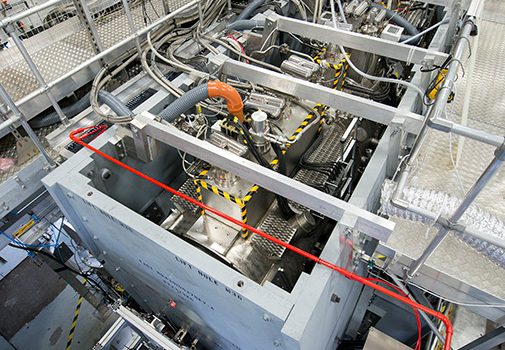
    From Scientific American, Feb. 5, 2020: The best-laid plans of MICE and muons did not go awry: Physicists at the International Muon Ionization Cooling Experiment, or MICE, collaboration have achieved their years-long goal of quickly sapping energy from muons. The results are the first demonstration of ionization cooling, a technique which could allow researchers to control muons for future collider applications — an epochal achievement, according to Fermilab physicist Vladimir Shiltsev.
    This locked cabinet holds the answer to one of the biggest questions in particle physics

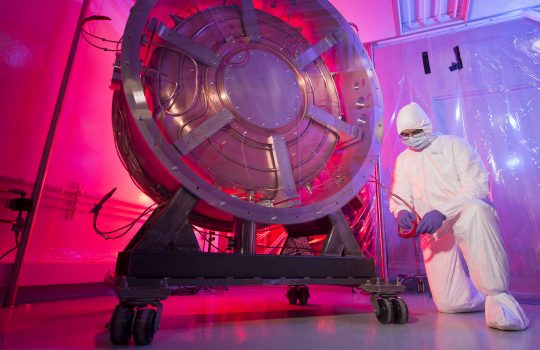
      From Gizmodo, Jan. 25, 2020: Physicists have found all of the particles and forces that the Standard Model describes, but there are still countless mysteries in the universe that the theory fails to explain. Various experiments are now probing the Standard Model for cracks, and this year, scientists hope to unveil a measurement from one of them, the Muon g-2 experiment, a measurement that might break from the theory.

      The science events to watch for in 2020

        From Nature, Dec. 20, 2019: Fermilab should unveil long-awaited results from Muon g–2, a high-precision measurement of how muons — more-massive siblings of electrons — behave in a magnetic field. Physicists hope that slight anomalies could reveal previously unknown elementary particles.

        U.Va. physicists explore subatomic questions in multimillion-dollar, international experiments

          The Cavalier Daily, Nov. 20, 2019: University physicists are beginning to make their mark on two multimillion dollar experiments in particle physics by contributing their research analyses to experiments at Fermilab for short: the Mu2e muon experiment and the NOvA neutrino experiment. NOvA is under way, and Mu2e is scheduled to begin in 2023.

          Physicists are out to unlock the muon’s secret

            From Back Reaction, June 13, 2019: The so-called muon g-2 anomaly is a tension between experimental measurement and theoretical prediction. The most recent experimental data comes from a 2006 experiment at Brookhaven National Lab. A new experiment is now following up on the 2006 result: The Muon g-2 experiment at Fermilab.

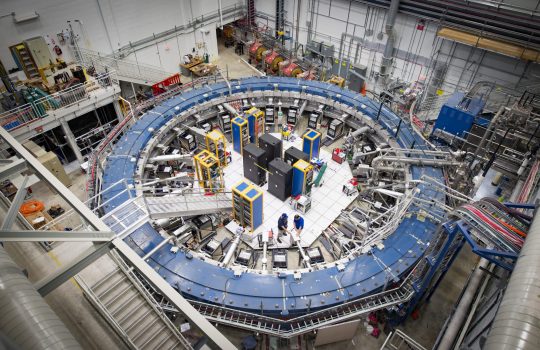
            The Muon g-2 experiment recently started its second run. Scientists use this particle storage, a 50-foot-diameter magnet, to look for hidden particles and forces. Photo: Reidar Hahn

            Muon g-2 begins second run

            Muon g-2 has begun its second run to search for hidden particles and forces. Muon g-2 collaborators have performed upgrades to improve the experiment’s precision and increase the amount of data it generates. As the experiment starts up again, scientists expect to make the world’s most precise measurement of the muon’s anomalous magnetic moment, which could tell us whether additional, undiscovered particles exist in the universe.