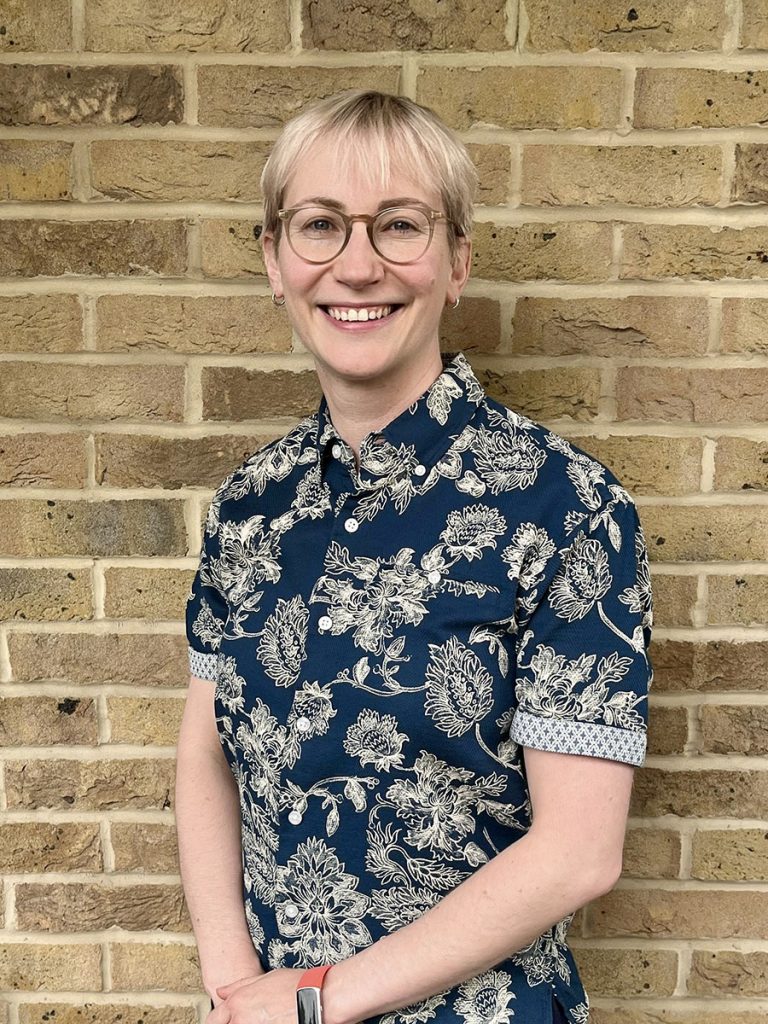
Linda Cremonesi stumbled upon neutrinos somewhat by accident. Or maybe it was fate.
As an exchange student from the University of Milan, Cremonesi needed to choose a topic for her final project at Queen Mary University of London. “All the other students that were enrolled had already chosen their projects, so there wasn’t a lot left,” she said.
One of the few remaining topics was neutrinos: tiny, elusive fundamental particles that permeate the universe. “I didn’t know what they were, so I ended up googling things on my phone on the way to meet up with my supervisor,” she recalled.
Since that serendipitous introduction, Cremonesi has never parted from neutrinos. She would go on to work on Japanese neutrino experiments T2K and Hyper-Kamiokande while earning her doctorate. Today, Cremonesi is an associate professor in particle physics and UKRI Future Leaders Fellow at Imperial College London. And as of April 1, she is the new co-spokesperson of the international NOvA collaboration.
With NOvA co-spokesperson Fermilab scientist Alex Himmel, Cremonesi will help set research priorities, keep the experiment running smoothly and represent the teams to the outside world.
NOvA — short for NuMI Off-axis νe Appearance — is a long-baseline neutrino experiment managed by the U.S. Department of Energy’s Fermi National Accelerator Laboratory. It consists of a neutrino detector at Fermilab in Batavia, Illinois, and a larger detector 500 miles away in Ash River, Minnesota. Physicists generate a powerful neutrino beam at Fermilab, send it through both detectors, and then study how the neutrinos change over time and space. The collaboration can then make insights into neutrino properties, types and phenomena to learn more about the elusive particles that permeate — and could even explain some of the mysteries of — our universe.
“Neutrinos do not give up their secrets easily,” said Himmel. “Even after 10 years of operating NOvA, there is still so much for us to learn.”
“Even after 10 years of operating NOvA, there is still so much for us to learn.”
Alex Himmel, NOvA co-spokesperson
The NOvA collaboration consists of 203 scientists and engineers from 52 institutions in eight countries, and the experiment began fully operating in October 2014. Shortly after, Cremonesi joined as a postdoctoral researcher at University College London. “What really drew me to NOvA was how welcoming it was and how valued I felt from the beginning,” she said. “This is something that I really like about this collaboration, and definitely something that I want to bring forward.”
In 2022, Cremonesi was appointed analysis coordinator, requiring her to oversee the entire physics program of NOvA. In this role, she shepherded the oscillation analysis of 10 years of NOvA data to publication, helped coordinate the first joint analysis with Japanese experiment T2K and enhanced the internal review processes to increase the experiment’s physics output twofold. Running for co-spokesperson was a natural next step.
“My goal is to lead NOvA into its final stage, where we can solidify our findings and cement our scientific legacy.”
Linda Cremonesi, NOvA co-spokesperson
“NOvA is in an exciting transition phase,” she said. “While it is already a mature experiment, we still have another few months of data collection ahead. My goal is to lead NOvA into its final stage, where we can solidify our findings and cement our scientific legacy.”
The experiment is a vital precursor for the Deep Underground Neutrino Experiment at the Long Baseline Neutrino Facility, one of Fermilab’s flagship projects. Once complete, DUNE at LBNF will shoot neutrinos through a near detector at Fermilab to a far detector many hundreds of miles away and observe their properties — just like NOvA. But DUNE’s detectors will be separated by 800 miles rather than NOvA’s 500.
Until DUNE is operational, NOvA is the only long-baseline neutrino experiment in the United States. And there is still work to do and results to uncover. By delivering some of the world’s most precise measurements of neutrino oscillations, NOvA has significantly narrowed down the mass constraints, mass hierarchy, and mixing angles of these elusive particles.
But maximizing this concluding dataset is only part of the vision. By laying the groundwork for ambitious joint analyses with other international experiments, the collaboration aims to push the boundaries of neutrino research long after the beam turns off.
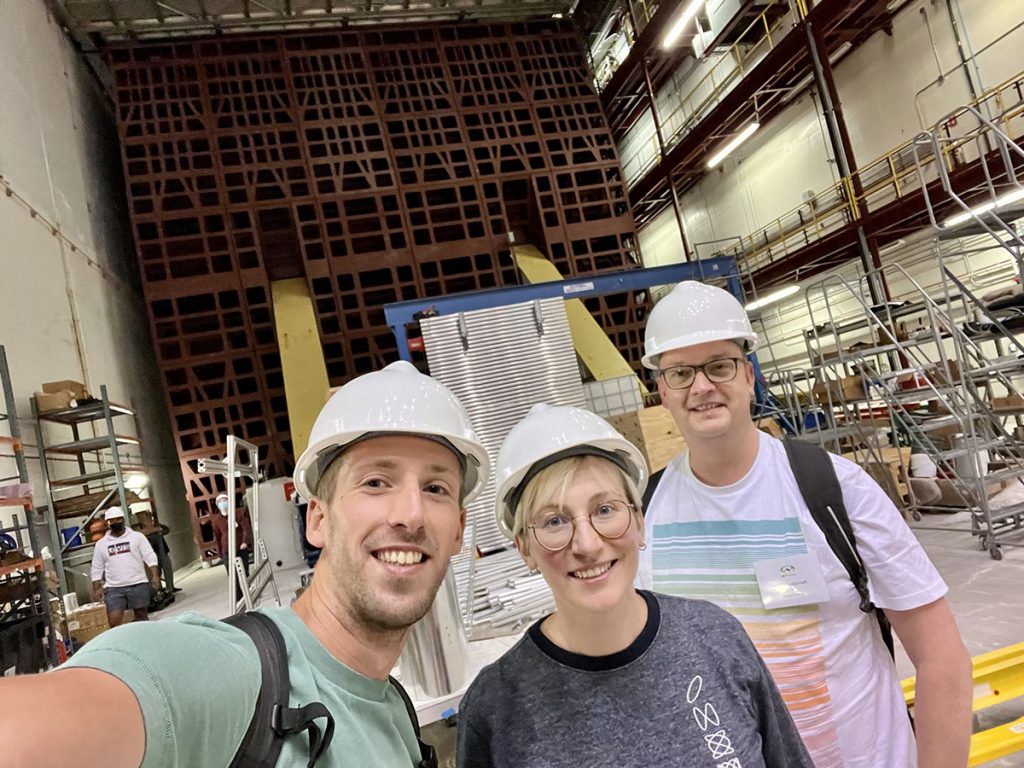
“We have a lot that we can give to the international neutrino community,” Cremonesi said. “And that legacy isn’t just in the data. It’s in ensuring we train the next generation of physicists in an environment that is as supportive and dynamic as the science itself.”
Fermi National Accelerator Laboratory is America’s national laboratory for particle physics and accelerator research. Fermi Forward Discovery Group manages Fermilab for the U.S. Department of Energy Office of Science. Visit Fermilab’s website at www.fnal.gov and follow us on social media.
Recommended reading

Nobel Prize in physics awarded to Francis Halzen for groundbreaking neutrino research
The Royal Swedish Academy of Sciences has awarded the 2026 Nobel Prize in physics to Francis Halzen of the University of Wisconsin–Madison.
DUNE uses AI to transform the future of neutrino research
DUNE is pioneering the future of neutrino research by integrating artificial intelligence into its experiment, drawing on decades of machine learning work at Fermilab.
New DUNE technology put to the ultimate stress test
A prototype for the world’s biggest neutrino experiment is running under extreme conditions to see how well the technology performs under pressure.