
Building a state-of-the-art superconducting radio-frequency particle accelerator is a study in precision. Every component must go together exactly right, because the smallest flaw in assembly can compromise how the machine performs for years to come.
An SRF accelerator is made up of a series of thermos-like vessels called cryomodules that insulate metal accelerating structures, called cavities. These cavities enable the technology’s super-efficient particle acceleration, but only if their interiors are pristine and their components are installed with exacting accuracy. Misalignment or contamination can degrade performance. In fact, the interiors of these cavities must be spotless, as the tiniest particulates can degrade accelerating efficiency or, worse, render a cavity unusable.
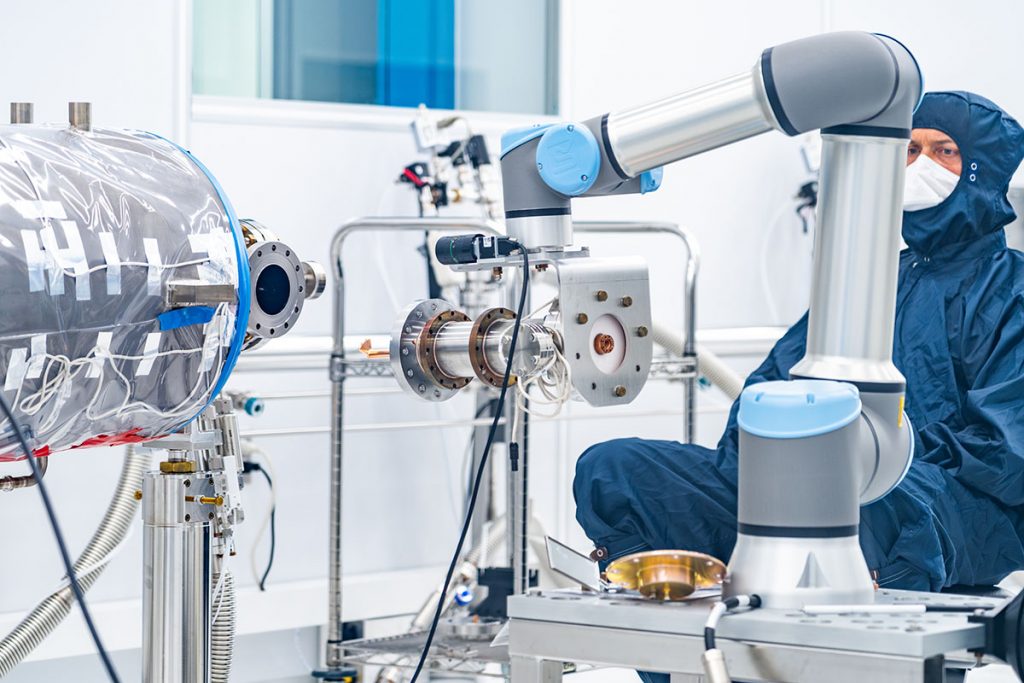
The technicians at the U.S. Department of Energy’s Fermi National Accelerator Laboratory are experts at this rigorous work. They assemble SRF cavities in a “clean room,” taking precautions by wearing protective gear that covers their head, clothing and shoes, along with a mask to filter their breath. But even with these measures, there is significant risk of contaminating the equipment and components.
So, the team behind the Proton Improvement Plan-II project at Fermilab decided to incorporate robots to assist humans assembling accelerator parts inside clean rooms. PIP-II is enhancing the Fermilab Accelerator Complex by building a 215-meter-long linear particle accelerator. The linac will produce high-power proton beams to support new physics experiments at Fermilab and will be used to generate the world’s most powerful neutrino beam for the Deep Underground Neutrino Experiment at the Long-Baseline Neutrino Facility, currently under construction in Lead, South Dakota, and at Fermilab.
“This breakthrough for the SRF community was only possible because of the team’s multidisciplinary composition and effective collaboration.”
Cristian Boffo, PIP-II project director
To enhance precision and maintain an ultra-clean environment during assembly of SRF cavities, the PIP-II team brought in a collaborative robot, known as a “cobot,” in 2023. Unlike a standard industrial robot, a cobot is designed to work safely alongside people and react to contact in its environment. Where an industrial robot is programmed to carry out its task to completion no matter what and is kept in a cage for safety, a cobot is equipped with sensors that allow it to stop or respond if it feels unexpected pressure from bumping into something or someone.
This summer, after three years of development, the PIP-II team reached a major milestone: a cobot autonomously aligned a coupler on an SRF cavity in a clean room. A prime example of Fermilab’s commitment to driving technological innovation, this key step forward in SRF cleanroom assembly allows the cobot to next be deployed on a production cavity for PIP-II.
“This breakthrough for the SRF community was only possible because of the team’s multidisciplinary composition and effective collaboration,” said Cristian Boffo, PIP-II project director.
Precision in a clean room
The PIP-II linac will be made of 23 accelerating units — called cryomodules, because they supply the required liquid helium bath and insulate the cavities from the too-warm outside world, much like a Thermos. PIP-II uses five different types of cryomodule, two of which are called single-spoke resonators: SSR1 and SSR2.
SSR cavities look like very squat soda cans as big as a car tire, and they have a flange on the side for connecting a component called the coupler. Typically, cavities are assembled with two people working inside the clean room, ideally standing at least six feet away from the cavity to limit contamination. In 2016 and 2017, PIP-II technicians tried manually aligning and installing the coupler using prototypes. However, the pieces were heavy and awkward to lift, the angle of connection was unwieldy, and the tooling was too complex.
That’s where the idea arose to utilize a cobot. The PIP-II team needed cobotic help to align and install the coupler with the 16 bolt holes on the flange while minimizing the possibility of human contamination. This task requires submillimeter and subdegree precision — all before the coupler touches the sealing surface. As soon as the cavity is closed, the risk of contamination is gone, and human technicians can re-enter the process.
“We want to bring the technicians as far away from the cavity as possible while the cavity is open — not to replace human technicians,” said Mattia Parise, Fermilab senior engineer and the level-3 manager for the SSR cryomodules for PIP-II.
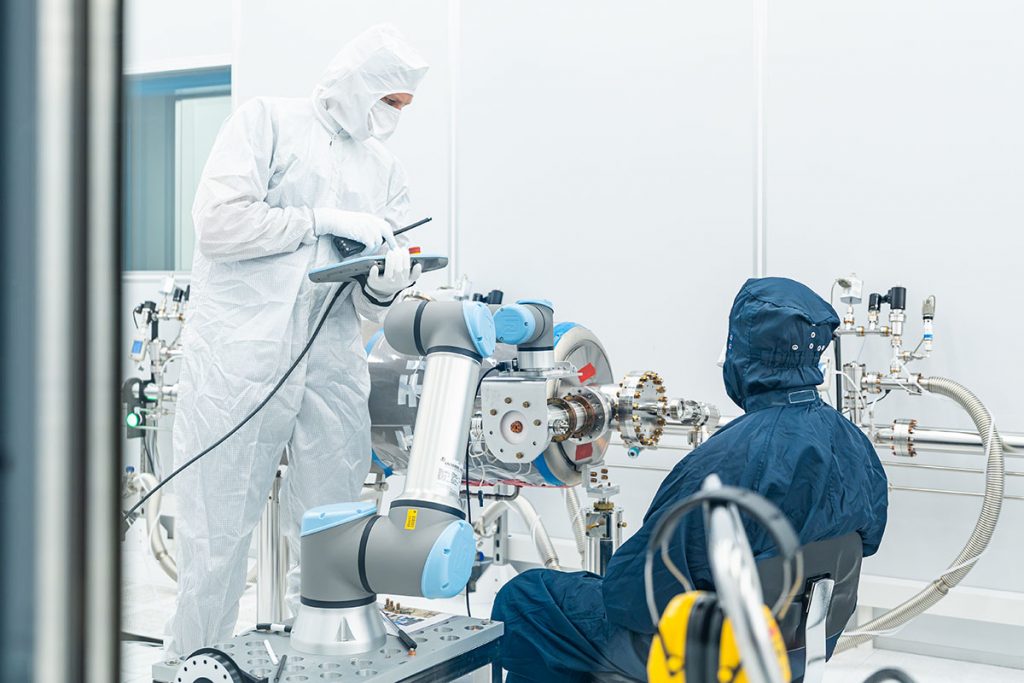
In December 2023, the PIP-II team acquired a cobotic arm with three joints — shoulder, elbow and wrist — that could be controlled by a human outside a clean room. Soon, they had successfully performed their first cobotic installation of a coupler on an SSR2 cavity. PIP-II then procured two additional cobots to boost research and development; over the following three years, they worked with several students from the University of Pisa in Italy and Northern Illinois University in the United States to develop alignment and assembly techniques.
The other piece of the puzzle was to automate the installation. “The goal was always to have this specific part of the process fully automated,” said Parise. “If it’s still semi-automatic and requires the operator to push buttons, you can still make mistakes because you rely on your senses and you’re trying to do alignment with submillimeter precision.”
To automate the coupling process, the PIP-II team added a camera to the cobotic arm. Once calibrated, the camera allowed the cobot to detect the flange’s central hole, align the coupler with the boreholes and connect them together.
In July 2026, they successfully performed the entire process automatically, achieving their three-year-old goal and paving the way for more automated assembly for PIP-II soon.
“Achieving autonomous coupler alignment was a critical first step,” said Tommaso Aiazzi, staff engineer and level-4 and subproject manager for the couplers for PIP-II.
Cobots in the future
All around the world, laboratories are developing robotic or cobotic applications to assemble accelerators or automate clean room processes. “What we are doing differently from everybody else is that we are not relying on plug-and-play solutions,” said Parise.
The problem with off-the-shelf products is that the software usually isn’t scalable or has other limitations because it was developed with a specific application in mind. “Here, we are developing everything from scratch,” said Parise. “We own our process, so we can easily change it because we developed this processing code with our needs in mind.”
This means they have complete adaptability for specialized accelerator applications that can also be tailored to any other existing process that would benefit from automation in a clean room — like the nanofabrication of microchips.
“Whatever application would benefit from automation, we are ready.”
Mattia Parise, senior engineer
The cobot is already speeding up other aspects of assembly, cutting some two- to three-hour cleaning and parts swapping steps down to about an hour. The team is now working to automate a swapping mechanism that currently takes 30 minutes down to as little as 5 seconds.
“There are many ways to improve things with cobotic automation,” said Colin Narug, a staff engineer at Fermilab who has led R&D on the cobotic activities since 2023. “This can cut away some of the more stressful points to make the clean room technicians’ lives easier — and produce better cavity results.”
In 2025, the team connected multiple SSR2 cavities together in a “string” — mostly using cobots. “It was not fully automatic, but we still benefited from this technology and this process,” said Parise.
The team is excited to implement automated cobotic alignment for an SSR1 string assembly this fall. “Whatever application would benefit from automation, we are ready,” said Parise. “Let’s go.”
Fermi National Accelerator Laboratory is America’s national laboratory for particle physics and accelerator research. Fermi Forward Discovery Group manages Fermilab for the U.S. Department of Energy Office of Science. Visit Fermilab’s website at www.fnal.gov and follow us on social media.
Recommended reading
Fermilab installs first beamline component for new state-of-the-art accelerator
Fermilab crews have successfully placed the first beamline component in the tunnel that will house the powerful new PIP-II linear accelerator, marking a major milestone for the lab’s future neutrino research program.
A minute with Jacopo Bernardini
After joining Fermilab in 2020, Jacopo Bernardini was recently appointed level-3 manager for the 650-MHz cryomodules for the Proton Improvement Plan-II project. PIP-II is building a new, powerful linear accelerator that will create the world’s most intense beam of neutrinos for the Deep Underground Neutrino Experiment. An amateur triathlete outside of work, Bernardini enjoys working with collaborators around the world as well as watching a design become reality.
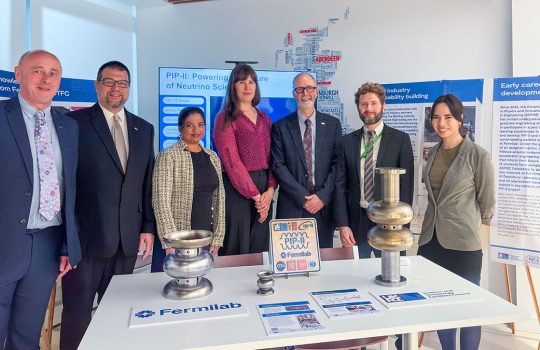
Fermilab’s PIP-II accelerator project recognized at UK-US research showcase
During an event at the British Embassy in Washington, D.C., officials honored the successful collaboration between the United States and United Kingdom for building the PIP-II particle accelerator at Fermilab. The powerful new accelerator will be used to send a beam of neutrinos through the Earth for the Deep Underground Neutrino Experiment.