Sam Zeller, a distinguished scientist at the U.S. Department of Energy’s Fermi National Accelerator Laboratory, has been awarded the prestigious W.K.H. Panofsky Prize by the American Physical Society.
Each year, APS awards the Panofsky Prize to recognize outstanding achievements in experimental particle physics from a pool of nominees worldwide. The 2026 prize honors both Zeller and University of Chicago physicist Bonnie Fleming for their co-leadership of the MicroBooNE neutrino experiment at Fermilab.
“I am humbled and honored to be receiving this award with Bonnie Fleming in recognition of our leadership of MicroBooNE, which was the first large-scale detector of this kind in the United States and the longest-running liquid-argon neutrino detector to date,” Zeller said. “But most of all, I am proud of the MicroBooNE team for what we have accomplished and what this all means for DUNE.”
“I want to congratulate Sam and Bonnie for this honor and for their accomplishments,” Fermilab Director Norbert Holtkamp said. “Thanks to their leadership, the MicroBooNE experiment has had a significant impact on neutrino research and on Fermilab. We are excited to continue advancing and building upon their work.”
Neutrinos are known to come in three types, but for over 20 years, physicists theorized that there could be a fourth type called the sterile neutrino. In 2021, after six years of collecting data, the MicroBooNE collaboration reported results showing no evidence of the sterile neutrino with 95% certainty. The finding was an important milestone in neutrino research. It was part of a large body of work by MicroBooNE on neutrino interactions, new particle searches and advances in liquid-argon technology.

“MicroBooNE proved unequivocally that the technology works and works exceedingly well for precision neutrino physics,” Zeller said.
MicroBooNE also laid the groundwork for the upcoming Deep Underground Neutrino Experiment at the Long-Baseline Neutrino Facility. This experiment is an international collaboration hosted by Fermilab. Zeller is now the LBNF/DUNE-U.S. deputy project director for the experiment’s near detector.
“It was not too long ago that people were worried that we were taking too large a leap of faith with the choice of the liquid-argon technology for DUNE,” Zeller said. “Sure, such detectors produce beautiful images, but can they deliver on the science? None of this is in question anymore after MicroBooNE.”
MicroBooNE broke new ground on several fronts. The experiment pioneered fully automated neutrino event reconstruction and showed what precision signal processing could achieve. It also proved that this type of detector could operate reliably over long periods, and it paved the way for physics analyses using large-statistics neutrino samples in liquid argon.
“Before MicroBooNE, the necessary tools didn’t exist,” Zeller said. “We don’t bring on new detector technologies very often in neutrino physics, so this is all incredibly exciting for the future of neutrino physics.”
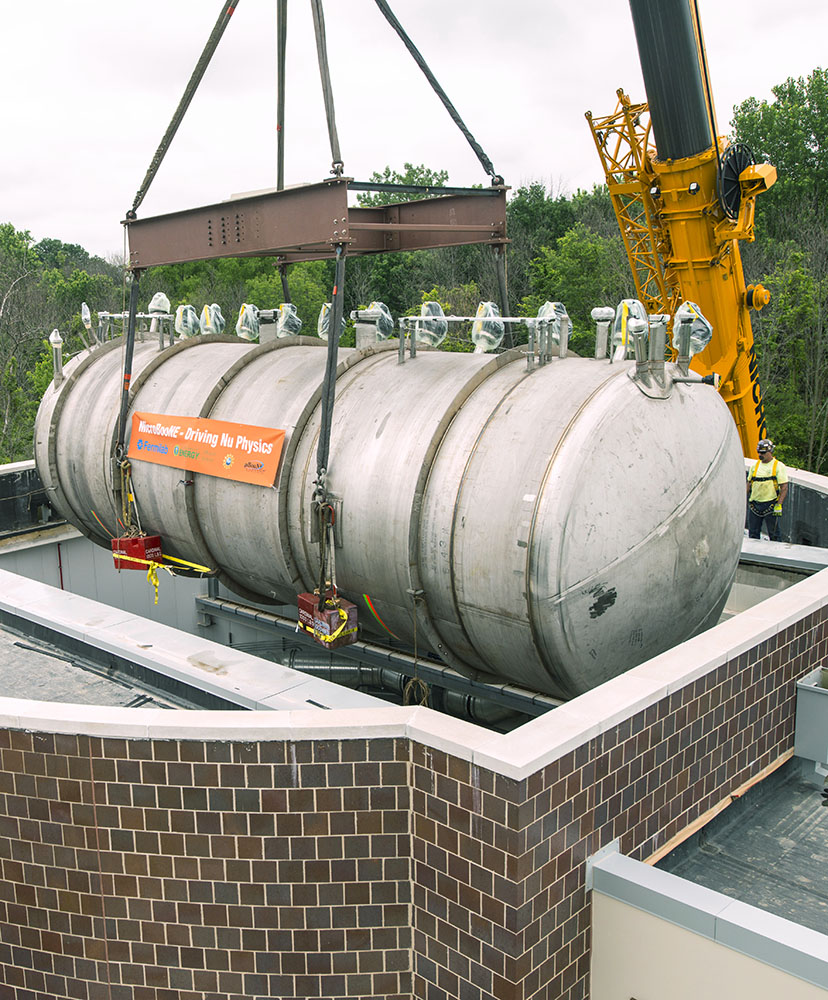
MicroBooNE has produced more output than any other Fermilab neutrino experiment. Over the past decade, the collaboration has produced more than 92 publications, and more than 70 Ph.D. students have completed their degrees through work on the experiment. The experiment continues to further the understanding of neutrino physics, and MicroBooNE students and postdocs have had front-row seats in shaping the future.
Fermi National Accelerator Laboratory is America’s national laboratory for particle physics and accelerator research. Fermi Forward Discovery Group manages Fermilab for the U.S. Department of Energy Office of Science. Visit Fermilab’s website at www.fnal.gov and follow us on social media.
Recommended reading

FemtoMind advances Genesis Mission at the proton scale
A multi-laboratory effort, FemtoMind will leverage super intelligence to advance our understanding of subatomic particles, improving the science potential of experiments like the Deep Underground Neutrino Experiment. FemtoMind will streamline workflows, lower the barrier to entry for computational physics and transform the questions scientists will seek to answer.
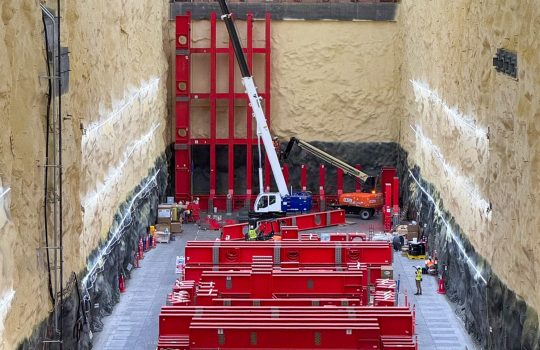
Construction begins on massive underground neutrino experiment designed to unlock the secrets of the universe
Nearly a mile underground in South Dakota, scientists are building a world-leading experiment to study neutrinos and investigate some of the universe’s greatest mysteries, including how the universe took shape after the Big Bang and if neutrinos are the reason our world is predominantly made of matter. Currently, crews from Fermilab, CERN and SURF are assembling large steel beams to form the outer structure of the neutrino experiment’s massive detector modules.
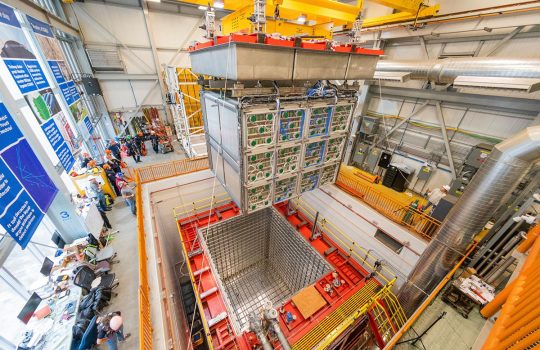
The SBND collaboration releases first neutrino results
Following years of preparation, the new result from the Short-Baseline Near Detector improves neutrino interaction modeling, paving the way for the Deep Underground Neutrino Experiment.