
Neutrinos are among the most elusive particles in the universe and understanding them may be the key to solving some of the biggest cosmic mysteries. For decades, scientists have been building massive detectors and using intense neutrino sources to capture these ghostly particles.
The Short-Baseline Near Detector is the newest liquid-argon neutrino detector at the U.S. Department of Energy’s Fermi National Accelerator Laboratory. The SBND collaboration published their first results on Oct. 30 in arXiv and submitted to Physical Review Letters for review and publication, marking a critical demonstration of the powerful tool scientists now have at their disposal.
This result focuses on understanding how neutrinos interact with argon atoms and lays critical groundwork needed to prepare for the Fermilab-hosted Deep Underground Neutrino Experiment at the Long-Baseline Neutrino Facility.
“This is a huge milestone for the collaboration.”
Afroditi Papadopoulou, Georgia Institute of Technology
“This is a huge milestone for the collaboration,” said Afroditi Papadopoulou, a physicist at Georgia Institute of Technology and member of the SBND collaboration. “This result is going to be a stepping stone for all the analyses that will follow from this point on.”
When it comes to finding new physics, researchers rely on comparing real results to simulations of how the universe is supposed to work. One of the trickiest aspects of these detectors is modeling all the different ways a neutrino can interact with the argon atoms. This measurement also serves to shed more light on a specific subset of interactions and improve our understanding of the modeling of these processes. Future measurements will complement the picture.
“Nobody has as many statistics as we do on neutrino interactions.”
Anne Schukraft, Fermilab
“Nobody has as many statistics as we do on neutrino interactions,” said Anne Schukraft, Fermilab scientist and former SBND physics co-coordinator. “So, we’re able to measure these processes in more dimensions than other experiments because we have so much data.”
Whereas in the past, uncertainties in the detector itself meant it was unclear whether a model was correct or not, SBND will be able to concretely indicate which models work and which do not. Such precision is critical for determining whether neutrinos may hold the key to answering some of the biggest questions about our cosmos, like why we live in a matter-dominated universe.
DUNE at LBNF, a next-generation liquid-argon neutrino experiment, will be the most comprehensive neutrino experiment in the world, promising to revolutionize our understanding of neutrinos. And delivering an intense beam of neutrinos to the experiment by 2031 is Fermilab’s top institutional priority. SBND is key to developing the strong foundation of neutrino-argon interactions DUNE scientists will rely on to reduce uncertainties to deliver results.
Preparing a new detector
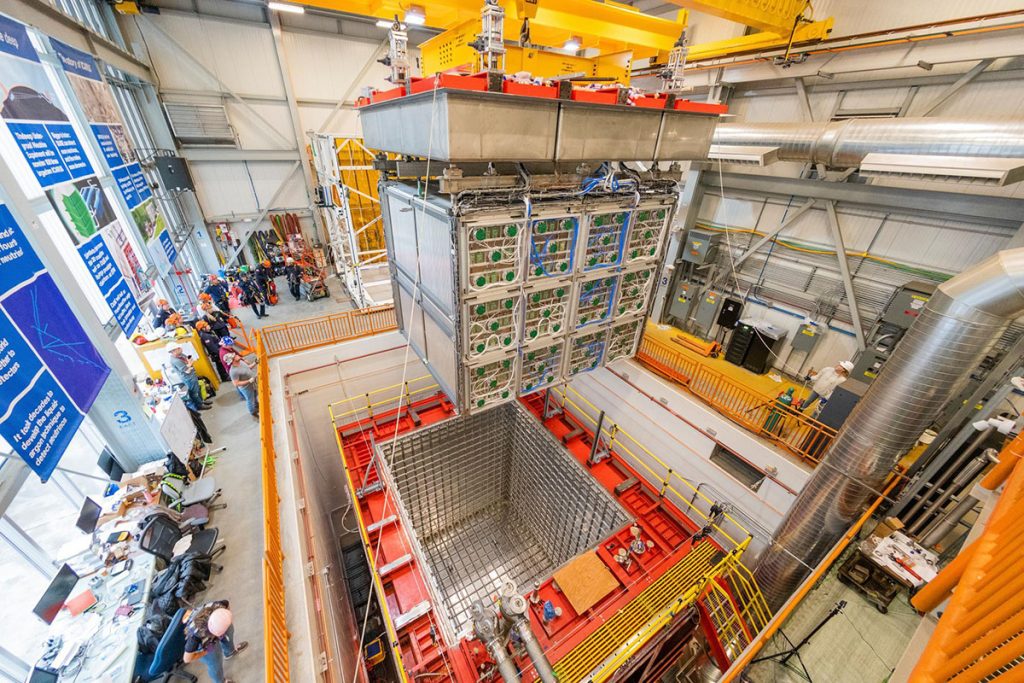
To achieve this first measurement, the SBND collaboration first had to meticulously prepare their new detector.
The collaboration detected their first neutrinos with SBND in 2024. That moment marked the beginning of a new era for the SBND collaboration. Following a dedicated campaign to calibrate all the components in the detector, SBND moved on to testing the programs needed to simulate and reconstruct neutrino interactions using real experimental data.
“A lot of our tools are based on what we have done in other experiments before us, so we are standing on the shoulders of giants,” said Schukraft. That said, “everything still has to be customized for SBND and used it in our detector for the first time.”
Once the detector was calibrated and the tools were in place, the team could finally turn their attention to how they were going to analyze the data.
Because each detector is a new machine and therefore slightly unique, the researchers had to determine how to select from the thousands of events occurring each day within the detector.
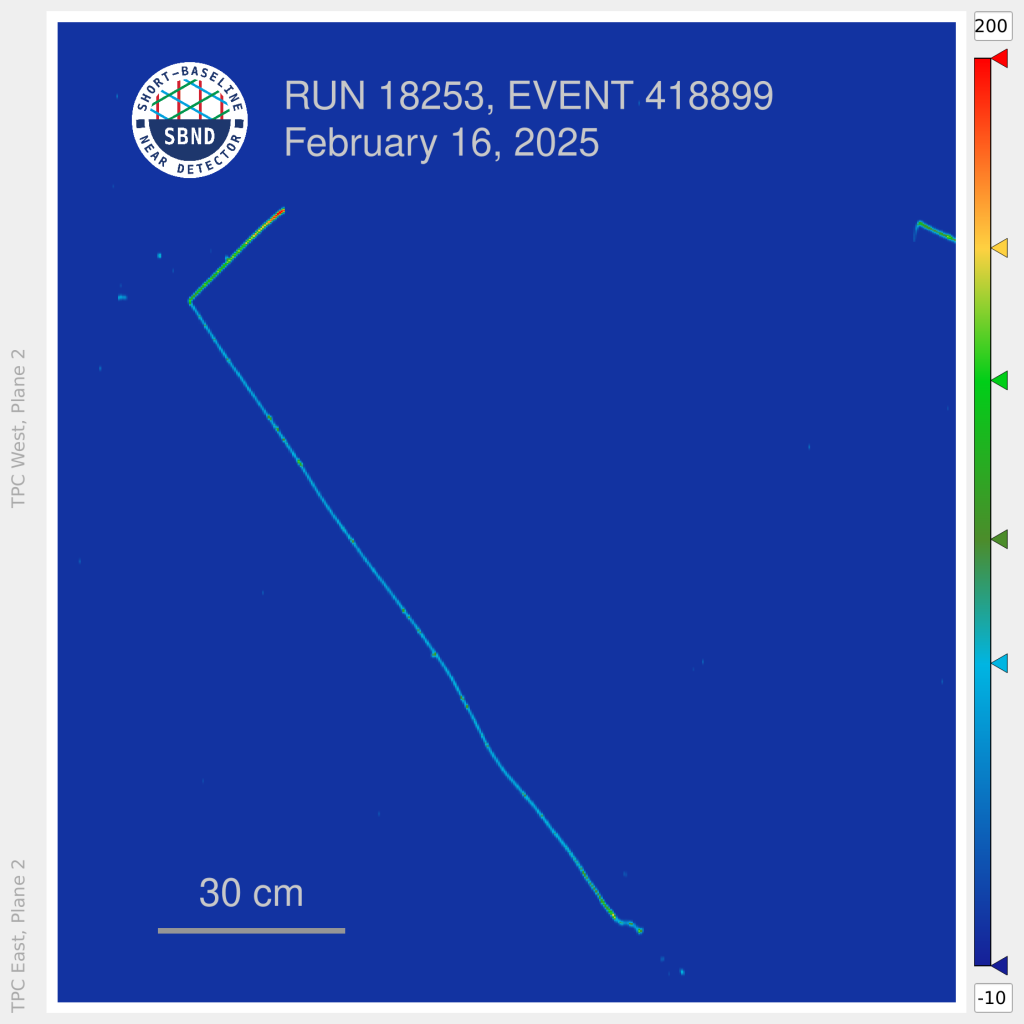
Neutrinos are like ghosts entering the detector invisibly. It’s only when they interact, producing a spray of particles the detector can see, that scientists know a neutrino was ever there. Researchers work backward from those secondary particle tracks to trace back to where the neutrino interaction took place, piecing together the type of neutrino, energy and direction. This makes neutrino research a bit like detective work.
Fermilab’s Short-Baseline Neutrino Program detectors are all liquid-argon time projection chambers. Liquid-argon TPCs are fantastic at capturing neutrino interactions, essentially taking a 3D snapshot of the event.
For this very first measurement, the SBND team narrowed in on event signatures with two tracks, one coming from a muon and the other from a proton. These tracks are both common and simple to identify, ensuring a strong foundation for the collaboration to build upon with future analyses.
“Because of the proximity of the detector to the neutrino source, we have fairly high statistics,” said Papadopoulou. “We can leverage that to choose the best of the best events in our detector.”
Even after narrowing down to the best interactions, SBND could isolate 12,000 initial events with a 91% selection purity. This is a significant increase from the selection purity and efficiency of previous experiments.
This high purity gives the SBND collaboration an extremely high level of confidence in their results. “I think that really provides a clear path forward on the next generation measurements,” said Mun Jung, who was the main analyzer for this result while a graduate student at University of Chicago.
“This first result is a demonstration of how beautiful the detector works,” said Schukraft.
An unsolved mystery
Beyond taking neutrino-argon interaction measurements, SBND will also play a critical role as the near detector in the Short-Baseline Neutrino Program at Fermilab. Along with MicroBooNE and the SBN Program’s far detector ICARUS, SBND is looking to shed light on whether additional types of neutrinos exist.
Neutrinos come in three known flavors: electron, muon and tau. One of the strangest facets of neutrinos is that they oscillate between the different types. Scientists understand how many of each type of neutrino should be present at different distances from a neutrino source very well. Yet a few decades ago, two different experiments recorded unexpected ratios, suggesting that neutrinos might be oscillating into yet-to-be-discovered types.
MicroBooNE recently placed strong limits on a leading explanation for these unusual observations, but the mystery still remains.
To solve it, the SBND and ICARUS detectors were installed at the ideal location — 110 meters and 600 meters, respectively, from the neutrino beam to see any new neutrino oscillation phenomena.
Although SBND is not publishing results about this mystery quite yet, this measurement marks a critical demonstration of the full power of the near detector as the SBN Program prepares for its first joint measurement.
SBND is building upon a 70-year legacy of neutrino research and is poised to bring scientists one step closer to unraveling some of the mysteries surrounding these elusive particles.
“We’re really demonstrating the iterative advancements of these measurements,” said Jung. “We have spent years building and carefully planning for analysis on SBND. It’s exciting to see the start of a very rich physics program for our collaboration.”
Fermi National Accelerator Laboratory is America’s national laboratory for particle physics and accelerator research. Fermi Forward Discovery Group manages Fermilab for the U.S. Department of Energy Office of Science. Visit Fermilab’s website at www.fnal.gov and follow us on social media.
Recommended reading
Momentum builds for world-leading neutrino experiment hosted by Fermilab
Construction of the Long-Baseline Neutrino Facility is entering its next phase, marking a major step forward for the international Deep Underground Neutrino Experiment hosted by Fermilab. With the arrival of critical components and growing momentum across partner institutions, DUNE is moving closer to unlocking long standing mysteries in particle physics and the origins of the universe.

Nobel Prize in physics awarded to Francis Halzen for groundbreaking neutrino research
The Royal Swedish Academy of Sciences has awarded the 2026 Nobel Prize in physics to Francis Halzen of the University of Wisconsin–Madison.

DUNE uses AI to transform the future of neutrino research
DUNE is pioneering the future of neutrino research by integrating artificial intelligence into its experiment, drawing on decades of machine learning work at Fermilab.