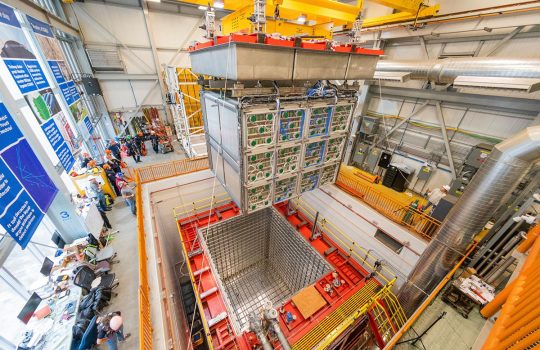
The SBND collaboration releases first neutrino results
Following years of preparation, the new result from the Short-Baseline Near Detector improves neutrino interaction modeling, paving the way for the Deep Underground Neutrino Experiment.

1 - 10 of 30 results
Following years of preparation, the new result from the Short-Baseline Near Detector improves neutrino interaction modeling, paving the way for the Deep Underground Neutrino Experiment.
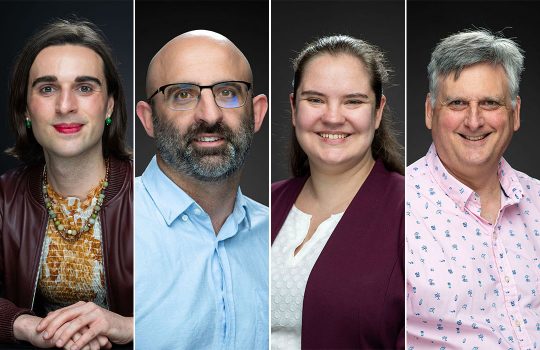
Gray Putnam, James Mott, Lauren Yates and Chris Jensen are this year’s recipients of the URA Honorary Awards. The awards are presented each year to recognize significant contributions to research at Fermilab.

The Short-Baseline Near Detector has logged the largest sample of neutrino interactions in liquid argon in the world. Newly elected, Andrzej Szelc will co-lead SBND during the next phase of the experiment.
Syracuse University News, October 14, 2024
Faculty and students in the Experimental Neutrino Physics group at Syracuse University are working on DUNE detector construction, operation and analysis. This includes collaboration work on the the 2×2 prototype, a new prototype “pixel” Liquid Argon Time Projection Chamber detector and the Short-Baseline Near Detector.
Interesting Engineering, Sept. 11, 2024
The Short-Baseline Near Detector’s wealth of data will enable researchers to study neutrino interactions with a level of precision never before achieved.

After years of preparation, the first neutrinos have been observed by the Short-Baseline Near Detector collaboration. The data SBND collects will expand our knowledge of how neutrinos interact with matter and will be used to search for evidence of new physics.

The Short-Baseline Near Detector collaboration at Fermilab has started filling their detector with liquid argon. It’s one of the last steps before the detector sees its first particle tracks.
Innovation News Network Feb. 9, 2024
Neutrino oscillations, discovered 25 years ago, break the Standard Model of particle physics and have been the subject of much investigation.To further study neutrino oscillation, Fermilab’s Short Baseline Neutrino (SBN) program has three detectors in the beam, placed at three very different distances to research if neutrinos are changing as a function of distance.
From Scientific American, Dec. 26, 2023
To determine whether sterile neutrinos exist, researchers at Fermilab have constructed two new detectors as part of the Short-Baseline Neutrino (SBN) Program that they hope will resolve the situation once and for all.

The award recognizes Marco Del Tutto for his work that enhances the capabilities of the Short Baseline Near Detector, the first stage of data collection along the Short-Baseline Neutrino experiment.