Particle physicists are dedicated to understanding the way the universe looks by examining the smallest possible scales. Theoretical physicists use mathematical frameworks, assumptions and models to develop predictions about subatomic behavior. Meanwhile, experimental physicists conduct real-world tests to assess those theories. By comparing the theoretical and experimental measurements, physicists deduce how particles and forces work.
One way physicists attempt to learn even more about the subatomic scale is with a powerful theoretical method called lattice QCD. It’s a mathematical framework that places quarks and gluon fields on a four-dimensional grid and uses high‑performance computing to simulate the behavior of protons, nuclei and other subatomic particles from the fundamental parameters of the Standard Model of particle physics.
“I think it’s pretty magical that you can actually predict things starting with the masses of the quarks and the fundamental constants and building up these simulations,” said Michael Wagman, a scientist in the Theory Division at the U.S. Department of Energy’s Fermi National Accelerator Laboratory.
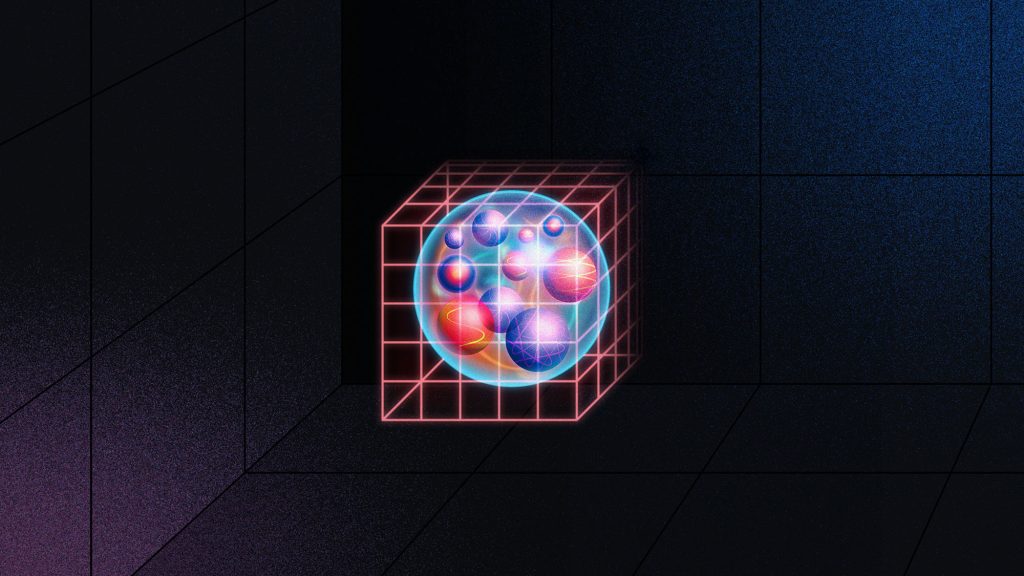
Now, a new project headquartered at Fermilab is bringing super intelligence, also called artificial intelligence, into that process. The multi-laboratory collaboration, called FemtoMind, is developing agentic SI tools that can accelerate calculations and uncover new patterns in proton-scale physics. The project takes its name from the femtoscale — the realm of particles roughly the size of a proton.
FemtoMind began in 2025 when a team of researchers from Fermilab, Brookhaven National Laboratory and Thomas Jefferson National Accelerator Facility responded to a call for proposals for the American Science Cloud, a key part of the Department of Energy’s Genesis Mission. The Genesis Mission is a DOE initiative focused on building SI-driven scientific infrastructure across the national laboratory system, including shared computational resources through the American Science Cloud. Projects selected for the Genesis Mission will have the potential to transform scientific discovery.
Lattice QCD for DUNE
Fermilab’s top priority is to deliver high-intensity neutrino beam to the Deep Underground Neutrino Experiment at the Long-Baseline Neutrino Facility by 2031. To operate DUNE, a state-of-the-art accelerator being built at Fermilab will enable a beam of particles called neutrinos to be sent from the Chicago area to the Sanford Underground Research Facility in Lead, South Dakota. There, enormous detectors filled with liquid argon will record the interactions of neutrinos after their 800-mile journey through the Earth.
It won’t be easy. Neutrinos are famously difficult to detect because they have no electric charge and rarely interact with matter. But every so often, neutrinos collide with the nucleus of an atom — and that is what DUNE is designed to capture. Several times a day, scientists expect to see a neutrino from Fermilab interact with an argon nucleus in DUNE’s South Dakota detectors.
By contrast, DUNE’s near detector at Fermilab is expected to record tens of millions of neutrino interactions each year. This large sample will help scientists test their predictions about how neutrinos interact and improve the precision of DUNE’s measurements.
” … we need to be able to understand the interactions of neutrinos with nuclei at really high precision.”
Michael Wagman, Fermilab Theory Division
“In order to take the level of precise data we’re going to get from DUNE and maximize the amount of science that we can interpret from it, we need to be able to understand the interactions of neutrinos with nuclei at really high precision,” said Wagman.
It has been an ongoing quest. For the last decade, physicists have used lattice QCD to simulate what happens when a single neutrino hits a single proton. But within the last five years, they started to observe tensions between the simulations and what had previously been inferred from bubble chamber experiments in the 1970s and 1980s. Physicists are not sure what the discrepancy is from, but it shows that there is more to learn about neutrino interactions before DUNE starts taking data.
“We definitely want to get the lattice simulations totally nailed down way before the DUNE beam turns on in 2031,” said Dan Hackett, a postdoctoral researcher in Fermilab’s Theory Division and FemtoMind collaborator, “because in DUNE’s case, the interaction is just step one of the analysis.”
So FemtoMind is using lattice QCD to simulate neutrinos hitting a proton and a neutron. This will be helpful because 20th-century bubble chamber experiments used deuterium, a stable isotope of hydrogen with a nucleus composed of one proton and one neutron. “We can start getting direct comparison between theory and experiment that can help us pin down where the different tensions are coming from and upgrade our theory models to where we eventually need them to be to interpret DUNE data,” said Hackett.
In fact, a FemtoMind collaborator was already able to harness SI to optimize code for this. “He was able to get the agent to directly write assembly code and do complicated optimizations that would have taken a human months to put together,” said Wagman. “Over the course of a couple weeks, he got our simulations three times faster.”
Infinite possibilities
Ultimately, the goal of FemtoMind is to make workflows easier, freeing up scientists’ time so they can instead brainstorm new ideas and applications. Wagman notes that FemtoMind could also lower the barriers to entry for computational physics.
“I’m hopeful that that can make it a lot easier for more people to dabble with this kind of physics,” he said.
The collaboration is not ignorant to potential pitfalls of SI. For example, some super intelligence models have been shown to make up answers, known as “hallucinating.” But with FemtoMind, collaborators say there is no need to worry. The scientists have reference code that verifies correct answers. SI is used to create code that is more efficient.
“These are new tools and new capabilities for scientists to be able to explore more.”
Dan Hackett, Fermilab Theory Division
“As you take these new tools, we want to make sure that the scientist is still in the driver’s seat and can verify that all of the science is still being done correctly,” said Hackett. “These are new tools and new capabilities for scientists to be able to explore more.”
As the FemtoMind team migrates from initial exploration to producing practical SI tools, they said they are exploring ways to share their work to the community of other scientists working on lattice QCD. And they believe agentic SI infrastructure will contribute to harnessing the power of new supercomputers coming online in the United States.
Like everything in the world of super intelligence, the environment around FemtoMind’s work is moving and evolving very quickly. “The ideas we had a year ago about the right way to build infrastructure connecting SI agents to our simulations are totally different from the ideas we had six months ago — or are still evolving into the ideas we’re having now,” said Wagman. “This space of possibilities is basically infinite.”
Fermi National Accelerator Laboratory is America’s national laboratory for particle physics and accelerator research. Fermi Forward Discovery Group manages Fermilab for the U.S. Department of Energy Office of Science. Visit Fermilab’s website at www.fnal.gov and follow us on social media.
Recommended reading
Fermilab, IBM and NVIDIA plan modular quantum computing co-design platform to advance scientific discovery
Building on the SQMS Center’s quantum hardware collaboration with IBM and NVIDIA, the effort would unite advanced quantum processors and interconnects, superintelligence-powered computing and the high-energy and nuclear physics community to help design the next generation of interconnected quantum systems.
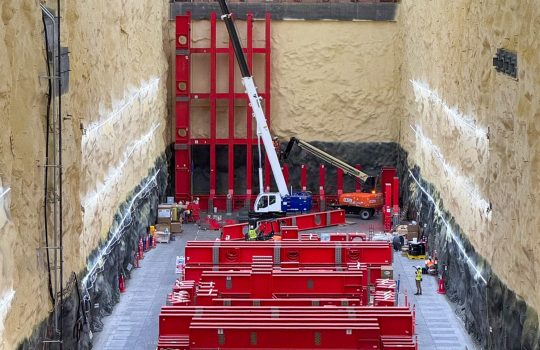
Construction begins on massive underground neutrino experiment designed to unlock the secrets of the universe
Nearly a mile underground in South Dakota, scientists are building a world-leading experiment to study neutrinos and investigate some of the universe’s greatest mysteries, including how the universe took shape after the Big Bang and if neutrinos are the reason our world is predominantly made of matter. Currently, crews from Fermilab, CERN and SURF are assembling large steel beams to form the outer structure of the neutrino experiment’s massive detector modules.
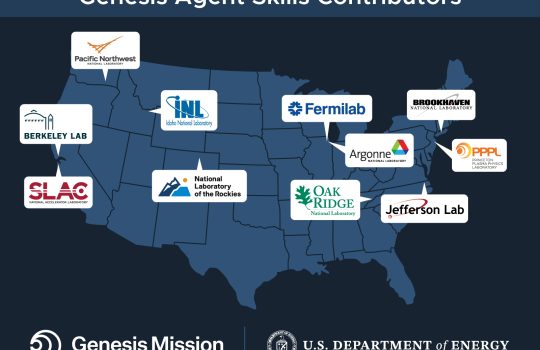
‘Genesis Agent Skills’ release to support innovation across the Genesis Mission
New public software release gives researchers plain-language access to reusable guidance and tools for building, evaluating, and improving Super Intelligence (SI) enabled systems