
Inside the particle accelerators that power modern high-energy physics research, timing is everything. A fraction of a second off, and the delicate rhythm that keeps subatomic particles racing through an accelerator can slip out of tune. Now a Fermilab-led team will leverage artificial intelligence to protect that rhythm. Their project, selected for the Department of Energy’s Genesis Mission, is poised to reshape how accelerators are controlled, optimized and operated.
The most powerful modern particle accelerators use superconducting radio-frequency, or SRF, cavities to transfer energy to particle beams. By creating strong electromagnetic fields and leveraging a phenomenon called resonance, they give gentle nudges at exactly the right times to charged subatomic particles — much like a playground swing given repeated, well-timed pushes to send it higher.
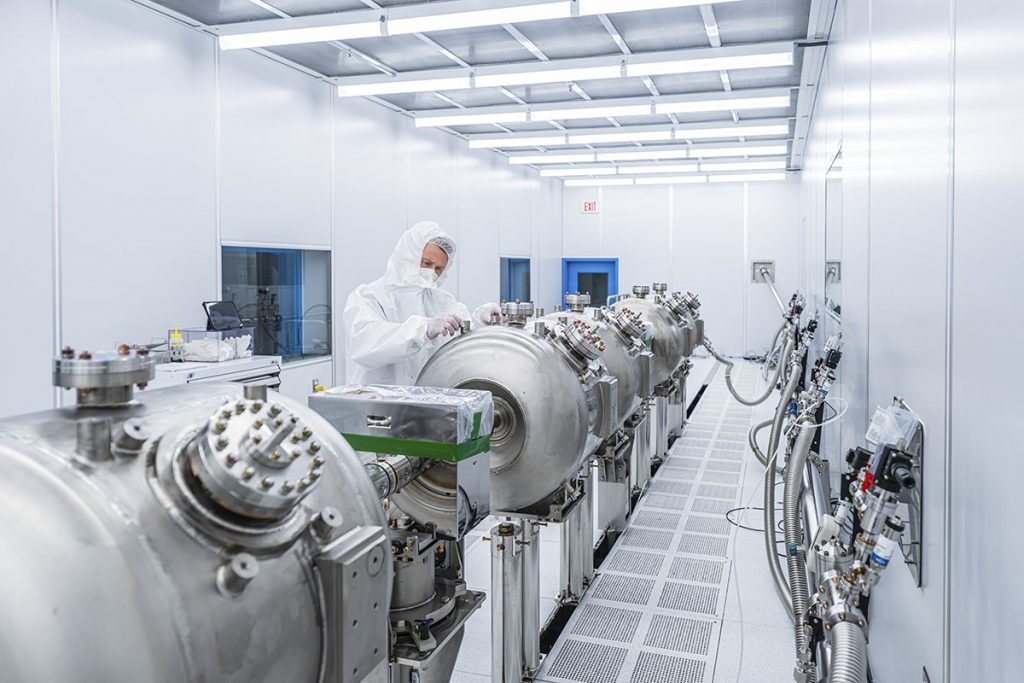
As the effects of these nudges accumulate, the particles in an accelerator are pushed faster and faster — close to the speed of light — until they collide with other particles traveling in the opposite direction or with a fixed target. The data from these collisions enables scientists to investigate and understand the underlying principles governing our universe.
“Controlling resonance is a critical area of development for particle accelerator facilities, potentially saving millions of dollars a year on operating costs, optimizing power consumption and improving beam stability for accurate scientific results and increasing equipment lifetimes.”
Matthias Liepe, Cornell University
While SRF cavities are extremely efficient resonators, several factors can stand in the way of perfect performance. They can be knocked off frequency by pressure variations in the liquid helium that cools them, changes in their electromagnetic fields, or vibrations from other nearby equipment. These disturbances interfere with resonance, wasting power and potentially tripping off the particle beam. Precise resonance control increases available power, resulting in higher particle beam performance and new discoveries.
“Controlling resonance is a critical area of development for particle accelerator facilities, potentially saving millions of dollars a year on operating costs, optimizing power consumption and improving beam stability for accurate scientific results and increasing equipment lifetimes,” said Matthias Liepe, a professor at Cornell University who is collaborating on this research. “Applying AI and machine learning to automate control processes will make this easier.”
Led by Fermi National Accelerator Laboratory, the resonance control project aims to develop artificial intelligence and machine learning algorithms to substantially improve particle accelerator performance, driving scientific discovery while saving significant amounts of money in operating costs. Several partner institutions, including other national labs, universities and industry, are also contributing to the project.
“For decades, Fermilab has been a global leader in superconducting radio-frequency technology — building, designing and operating among the most sophisticated accelerators and making transformative technological breakthroughs,” said Sam Posen, a senior scientist at Fermilab and project principal investigator.
“Today, the lab is at the forefront of an exciting new era to use AI and machine learning to extend our scientific reach even further by improving resonance control in next-generation accelerators and accelerating the time to discovery. We’re excited to take this next step,” Posen added.
Staying in tune
To make energy transfer to the beam as efficient as possible, each cavity is tuned to a specific frequency called a resonant frequency. Matching the cavity’s resonant frequency to the delivery of radio-frequency energy allows a relatively small amount of input power to build up large amplitude fields.
“While SRF cavities are incredibly efficient at speeding up particles using low power, shifts away from their correct frequencies consume power that could be better spent pushing the particle beam harder and furthering the discovery potential,” said Liepe.
“Today, the lab is at the forefront of an exciting new era to use AI and machine learning to extend our scientific reach even further by improving resonance control in next-generation accelerators and accelerating the time to discovery.”
Sam Posen, Fermilab
Scientists use a fast-moving tuner attached to the cavity to squeeze it back to its resonant frequency. Applying AI and machine learning has the potential to significantly improve tuning precision, and the algorithms and models learn over time how to minimize disturbances and adapt as conditions change. AI can also tailor this learning and adaptation to each of the 100-plus cavities that a large accelerator contains. This can allow researchers to push the operation of particle accelerators, increasing maximum energy or letting them turn down the power between beam pulses.
Current and future SRF-based particle accelerators, like Fermilab’s Proton Improvement Plan-II linear accelerator, SLAC National Accelerator Laboratory’s Linac Coherent Light Source-SC, Brookhaven National Laboratory’s Electron-Ion Collider, Michigan State University’s Facility for Rare Isotope Beams and Argonne National Laboratory’s Argonne Tandem Linac Accelerator System, or ATLAS, use SRF cavities to harness electromagnetic energy fed in from an outside source.
Increasing precision
One beneficiary of this research is the PIP-II accelerator, which will provide the world’s most intense neutrino beam for the Deep Underground Neutrino Experiment at the Long-Baseline Neutrino Facility, an international collaboration hosted by Fermilab.
During its initial operation, PIP-II’s particle beam will be sent as pulses, but the cavities are designed to operate at full electromagnetic field strength between pulses. Reducing the field between pulses would significantly reduce average power, cooling costs and equipment wear, but it would also make resonance control harder because of the frequency shifts as the cavity field is turned up and down.
A key objective of this research is to test whether introducing AI to PIP-II’s existing control equipment will provide enough precision to operate in pulsed mode — handling the cavity’s frequency shifts, using less power and avoiding unplanned shutdowns known as trips.
Creating a common framework
In addition to cost savings and increased performance and reliability, this research aims to achieve other important objectives. One of these is to establish a common framework for resonance control data that can be shared across DOE laboratories and facilities and their partners.
Enabling data sharing from different SRF-based accelerators can benefit the broader Genesis Mission research community. Today, every facility measures detuning in its own way, so the data can’t be pooled, and a controller built for one machine may not work on the next.
“That is what we want to show the Genesis Mission community: better and lower-cost operation of SRF cavities, but also how AI can close fast control loops on real hardware.”
Dan Wang, Berkeley Lab
“The open-source low-level radio-frequency control system Berkeley Lab developed is the baseline for PIP-II and runs the cavities at the SLAC Accelerator Center’s LCLS-II, said scientist Dan Wang, the project institutional lead from Lawrence Berkeley National Laboratory who also leads a related hardware-aware AI project. “The control system is used more widely still on conventional accelerators that do not rely on superconducting materials, such as the Argonne Wakefield Accelerator and our own Advanced Light Source.”
“An AI layer built on that platform benefits every facility running it,” added Wang. “That is what we want to show the Genesis Mission community: better and lower-cost operation of SRF cavities, but also how AI can close fast control loops on real hardware. It is the right demonstration, and with all the labs working on it together, the right moment.”
Benefiting society
Another objective is to build a workforce pipeline at the intersection of AI/machine learning and low-level radio-frequency engineering. This will help train the scientists, engineers and technicians to design and operate the precise control electronics used in particle accelerators — a highly specialized field that is currently facing a talent shortage.
By collaborating with industry partners, innovations can be applied in ways that directly benefit society and the U.S. economy. For example, industry partner xLight has developed a free-electron laser system, using particle accelerator technology pioneered at DOE national laboratories, to transform semiconductor manufacturing.
“This research exemplifies the Genesis Mission goal to use AI to dramatically improve our scientific tools so that we can innovate better, faster and more efficiently.”
Anna Grassellino, Fermilab
“This research exemplifies the Genesis Mission goal to use AI to dramatically improve our scientific tools so that we can innovate better, faster and more efficiently,” said Anna Grassellino, chief technology officer and associate laboratory director for the Technology Directorate at Fermilab. “By collaborating with other national labs, universities and industry, we are fostering innovation and developing a skilled workforce at the intersection of AI and science and engineering. This research will cement the role of the United States as a world leader in particle accelerator technology as we build more powerful, more sophisticated, more reliable and more autonomous accelerators.”
Along with Fermilab, partnering institutions on this project include Lawrence Berkeley National Laboratory, SLAC National Accelerator Laboratory, Argonne National Laboratory, Cornell University, Michigan State University, Toyota Technological Institute at Chicago, University of Michigan, the High Energy Accelerator Research Organization in Japan and xLight Inc.
Fermi National Accelerator Laboratory is America’s national laboratory for particle physics and accelerator research. Fermi Forward Discovery Group manages Fermilab for the U.S. Department of Energy Office of Science. Visit Fermilab’s website at www.fnal.gov and follow us on social media.
Recommended reading

DUNE uses AI to transform the future of neutrino research
DUNE is pioneering the future of neutrino research by integrating artificial intelligence into its experiment, drawing on decades of machine learning work at Fermilab.
U.S. Department of Energy invests in Fermilab projects to accelerate AI-enabled scientific discovery
The awards will support Fermilab projects by leveraging AI to boost innovation and technology development, advance DOE’s Genesis Mission and accelerate scientific discovery.
Fermilab storage infrastructure enables AI-driven scientific and research discovery for DOE’s Genesis Mission
The U.S. Department of Energy’s Genesis Mission is building a new era of AI-driven scientific discovery — and it requires far more than powerful supercomputers to succeed. To support this national effort, Fermilab’s Fermi Data Platform is providing secure, large-scale data infrastructure needed to make advanced AI research possible across the American Science Cloud.