Nearly three decades after beginning his research on the muon’s mysterious magnetic properties as a graduate student, Fermilab senior scientist Charles “Chris” Polly has received one of the U.S. Department of Energy’s highest scientific honors: the Ernest Orlando Lawrence Award.
The award recognizes Polly’s contributions to precision particle physics, particularly his leadership of the Muon g-2 experiment, which achieved the world’s most precise measurement of the muon’s anomalous magnetic moment.
“This year’s Lawrence Award recipients exemplify the ingenuity and determination that drive America’s leadership in science and technology.”
Chris Wright, U.S. secretary of energy
“This year’s Lawrence Award recipients exemplify the ingenuity and determination that drive America’s leadership in science and technology,” said U.S. Secretary of Energy Chris Wright. “From achieving fusion ignition to advancing critical materials and high-performance computing, these scientists and engineers are tackling some of our nation’s most complex challenges and translating groundbreaking research into real-world capabilities. Their work strengthens our nation’s energy security, drives American innovation and ensures the United States remains at the forefront of scientific discovery.”
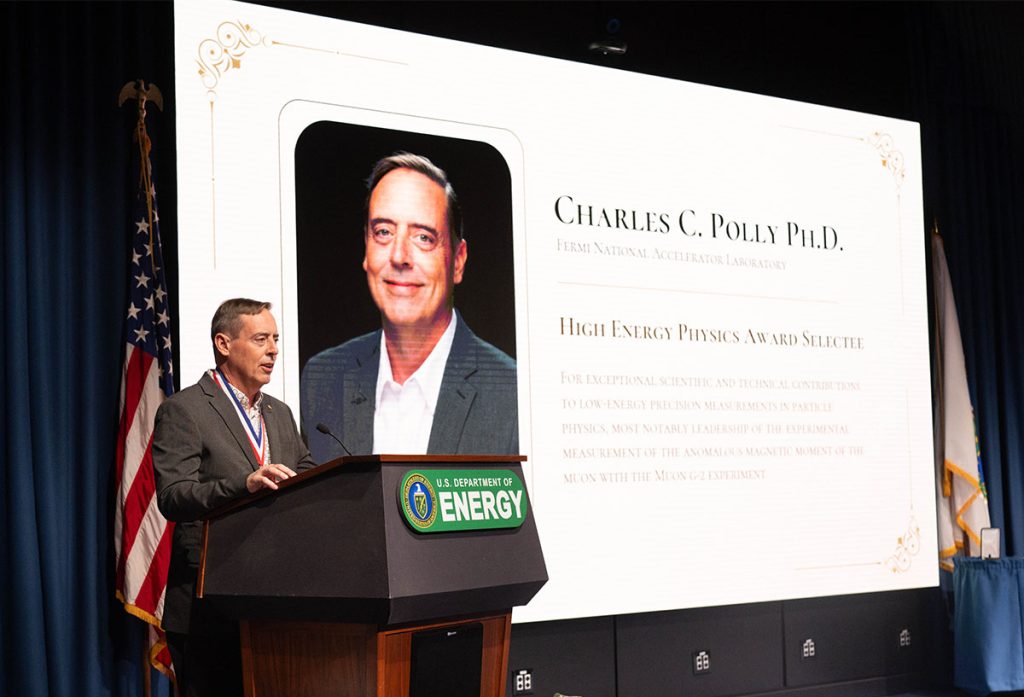
Polly joins a distinguished group of Lawrence Award recipients that includes Fermilab pioneer Helen Edwards, honored in 1986 for her leadership in constructing and commissioning the Tevatron particle collider.
“Helen Edwards was one of the giants of Fermilab’s history. To receive the same award for helping build the laboratory’s next generation of muon experiments is a tremendous honor,” Polly said.
Polly’s connection to Muon g-2 began in the early 2000s as a graduate student at Brookhaven National Laboratory, where he helped carry out the experiment that revealed an intriguing discrepancy between measurements of the muon’s magnetic properties and theoretical predictions. Years later, he would return to the same scientific challenge, this time leading the construction of a more powerful experiment at Fermilab.
Following the shutdown of Fermilab’s Tevatron collider in 2011, Polly helped spearhead the development of the Muon Campus. The facility would provide world-class beams for precision experiments capable of probing physics beyond the Standard Model.
Muon g-2 became the first experiment to operate at the new facility. As project manager, Polly led the design and construction of the $46 million experiment, including the remarkable relocation of a 50-foot-diameter superconducting storage ring from Brookhaven National Laboratory to Fermilab. The project was completed ahead of schedule and under budget. And through Polly’s leadership the experiment went on to exceed every major performance goal.
“We set extraordinarily ambitious goals for Muon g-2, and the collaboration managed to exceed every one of them. That speaks to the talent, dedication, and ingenuity of the people who made this experiment possible.” Polly said.
In 2025, the Muon g-2 collaboration published its final result, measuring the muon’s anomalous magnetic moment with an unprecedented precision of 127 parts per billion. This extraordinary sensitivity allows physicists to probe potential contributions from unknown particles and forces, including effects an order of magnitude smaller than those associated with the weak interaction.
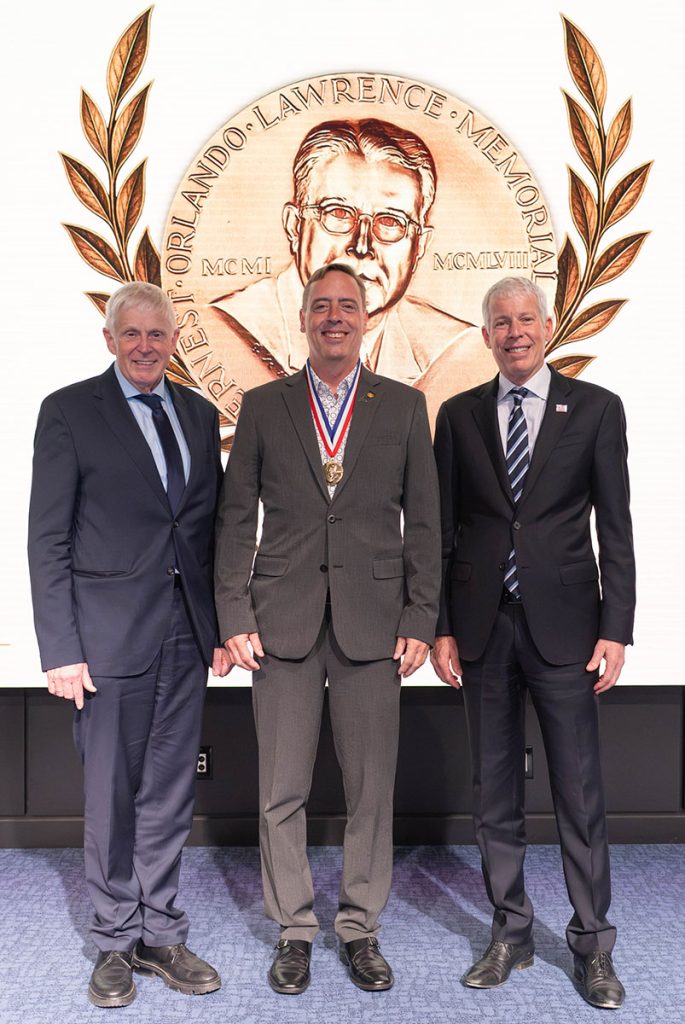
Polly served as scientific co-spokesperson during the experiment’s first published result, helping guide its transition from construction to scientific discovery. In recognition of their achievements, the Muon g-2 collaborations at Fermilab, Brookhaven and CERN received the 2026 Breakthrough Prize in Fundamental Physics.
“Chris Polly’s leadership of Muon g-2 exemplifies the collaborative spirit and determination that drive discovery at Fermilab.”
Norbert Holtkamp, director of Fermilab
“Congratulations to the entire Muon g‑2 collaboration on their outstanding achievements, said Director of Fermilab Norbert Holtkamp. “Chris Polly’s leadership of Muon g-2 exemplifies the collaborative spirit and determination that drive discovery at Fermilab. This well-deserved honor recognizes his extraordinary contributions to particle physics and his role in building a world-class scientific capability that will continue to advance our understanding of the universe.”
The Muon Campus continues its scientific mission with Mu2e, its next major experiment, for which Polly serves as project manager.
“One of the most rewarding parts of my career has been helping turn the idea of the Muon Campus into a reality. Seeing Muon g-2 succeed beyond our expectations, and now watching Mu2e take shape, makes all those years of effort worthwhile.” Polly said.
Fermi National Accelerator Laboratory is America’s national laboratory for particle physics and accelerator research. Fermi Forward Discovery Group manages Fermilab for the U.S. Department of Energy Office of Science. Visit Fermilab’s website at www.fnal.gov and follow us on social media.
Recommended reading

‘Genesis Agent Skills’ release to support innovation across the Genesis Mission
New public software release gives researchers plain-language access to reusable guidance and tools for building, evaluating, and improving Super Intelligence (SI) enabled systems
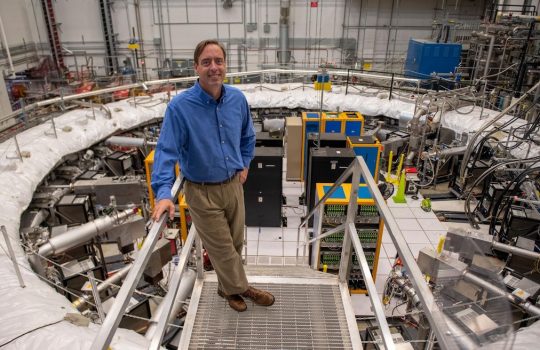
Energy Department announces 2026 Ernest Orlando Lawrence Award winners
U.S. Secretary of Energy Chris Wright announced that Fermilab’s Chris Polly was one of nine recipients of the prestigious Ernest Orlando Lawrence Award for exceptional contributions to research and development supporting the U.S. Department of Energy’s (DOE) missions in science, energy and national security.

URA honors Fermilab researchers advancing laboratory’s top priorities
Tyler Barrett, Charis-Kleio Koraka, Kevin Kelly and Silvia Zorzetti are the recipients of the 2026 URA Honorary Awards. The awards are presented each year by Universities Research Association to recognize significant contributions to research at Fermilab.