A tiny elementary particle called the muon has won a big prize, the Breakthrough Prize in Fundamental Physics. Fermilab researchers are among the winners of this year’s Breakthrough Prize, one of the world’s most notable and prestigious scientific awards that celebrates new scientific discoveries. Each prize is $3 million and is presented in the fields of Life Sciences, Fundamental Physics and Mathematics.
The 2026 award in Fundamental Physics recognized three generations of the Muon g-2 experiment, which provided the world’s most precise measurement to date of the muon, one of the fundamental subatomic particles. The experiment began at CERN in the 1970s, shifted to Brookhaven National Laboratory in the 1990s and concluded at Fermilab with final publication in 2025.
“I’m proud of the role Fermilab played in the Muon g-2 experiment, which is set to stand as the most accurate measurement of the muon for years to come,” said Fermilab Director Norbert Holtkamp. “Fermilab has a strong role as a collaborator and integrator, and this was demonstrated by our work with our colleagues at CERN, Brookhaven and institutions from around the world.”
The Breakthrough Prize, renowned as the “Oscars® of Science,” recognizes the world’s top scientists. The $3 million prize is being awarded to the hundreds of collaborators who contributed to publications reporting key results from CERN, Brookhaven and Fermilab.
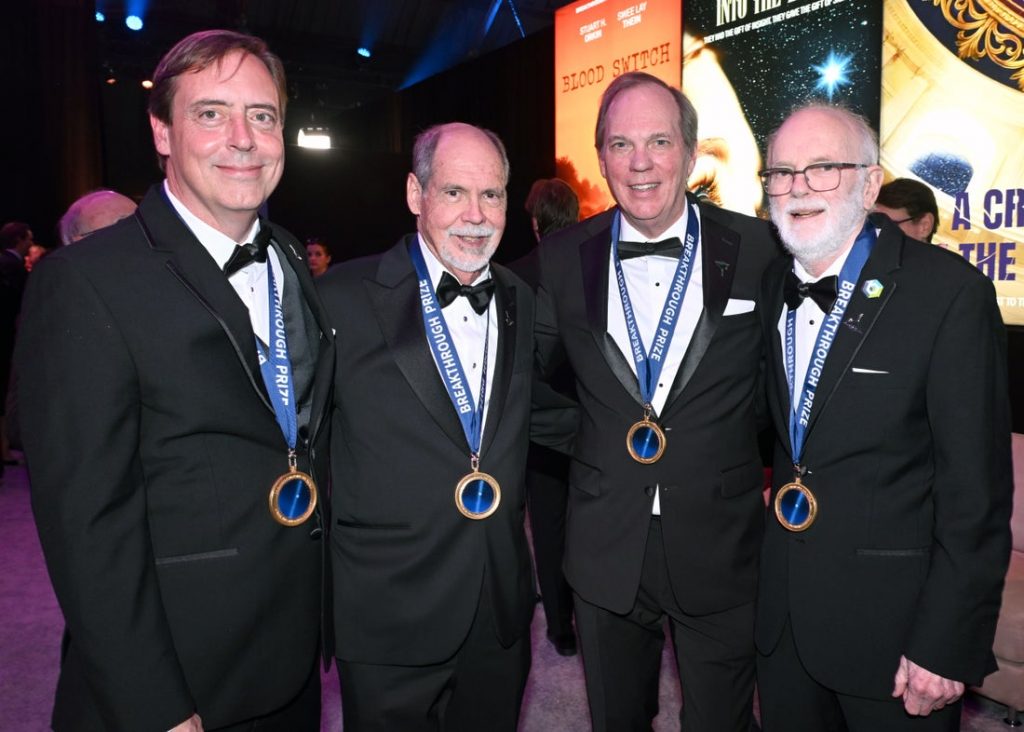
Fermilab scientist Chris Polly was among the four members of the scientific collaborations who accepted the prize. Others included: Bradley Lee Roberts of Boston University, William M. Morse of Brookhaven National Laboratory and David Hertzog of the University of Washington. The prize was presented at a ceremony at the Barker Hangar in Santa Monica, California, on Saturday, April 18, 2026.
The three generations of Muon g-2 experiments were designed to measure the magnetic moment of the muon with ever-increasing precision, exploring the quantum realm where particles briefly appear and vanish—and where even tiny deviations could point to entirely new laws of nature outside of the current Standard Model of Particle Physics.
The latest and most precise measurement of the muon’s magnetic moment was announced by Fermilab in 2025 and was important because it provided a sensitive test of the Standard Model of particle physics.
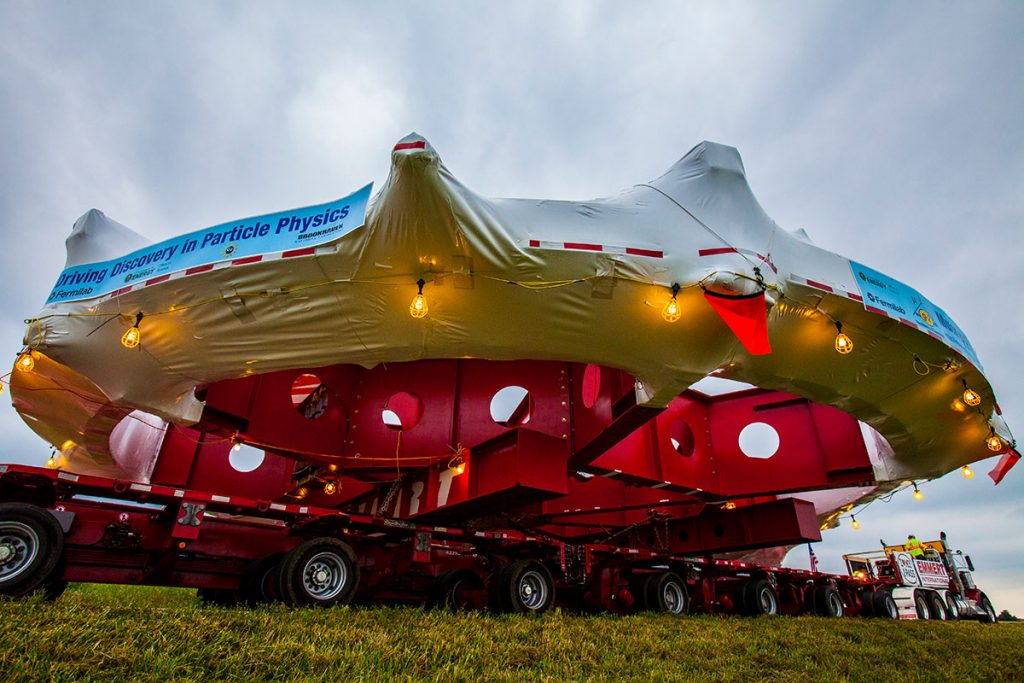
Fermilab led the most recent stage of the experiment that reused a 50-foot-diameter superconducting magnetic storage ring from the Brookhaven National Laboratory experiment when it was transported on a land-and-sea journey in 2013 from Long Island, New York to Fermilab in Illinois.
In 2021, the first result from the Muon g-2 experiment at Fermilab confirmed a two-decade-old measurement from Brookhaven, revealing a tantalizing tension with established theoretical predictions—while new calculations continue to refine what the Standard Model itself expects. The second run at Fermilab further improved the precision measurement. The third and final result in 2025 was in perfect agreement with the experiment’s previous results and proved to be the world’s most precise measurement of the muon magnetic anomaly.
The Breakthrough Prizes were founded by Sergey Brin, Priscilla Chan and Mark Zuckerberg, Julia and Yuri Milner, and Anne Wojcicki and have been sponsored by foundations established by them. Selection Committees composed of previous Breakthrough Prize laureates in each field choose the winners. Information on the Breakthrough Prize is available at breakthroughprize.org.
Fermi National Accelerator Laboratory is America’s premier national laboratory for particle physics and accelerator research. Fermi Forward Discovery Group manages Fermilab for the U.S. Department of Energy Office of Science. Visit Fermilab’s website at www.fnal.gov and follow us on social media.
Recommended reading
Energy Department announces 2026 Ernest Orlando Lawrence Award winners
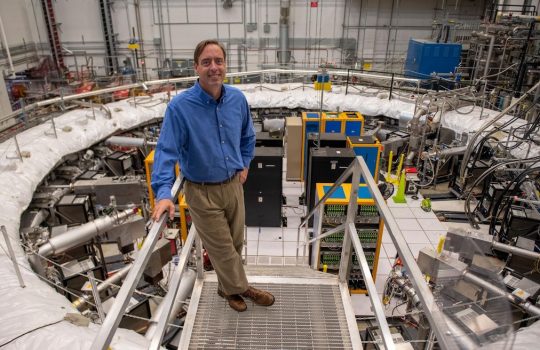
U.S. Secretary of Energy Chris Wright announced that Fermilab’s Chris Polly was one of nine recipients of the prestigious Ernest Orlando Lawrence Award for exceptional contributions to research and development supporting the U.S. Department of Energy’s (DOE) missions in science, energy and national security.
URA honors Fermilab researchers advancing laboratory’s top priorities
Tyler Barrett, Charis-Kleio Koraka, Kevin Kelly and Silvia Zorzetti are the recipients of the 2026 URA Honorary Awards. The awards are presented each year by Universities Research Association to recognize significant contributions to research at Fermilab.
Muon g-2 experiment places new constraints on a forbidden property of muons
The experiment, designed to measure the magnetic moment of the muon, is also sensitive to a particle property called the electric dipole moment.