HiLumi LHC: full-scale tests start
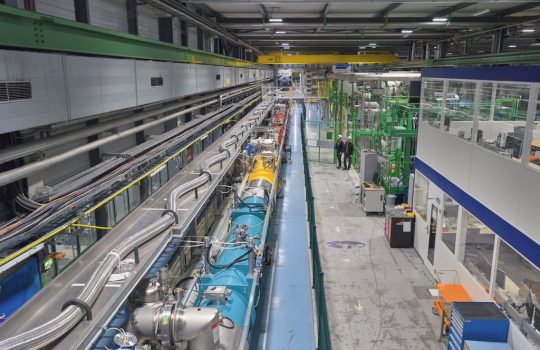
Scientists at CERN have triggered the complex cooldown of a 95-meter-long test stand that reproduces the underground configuration of innovative technologies for the Large Hadron Collider’s high-luminosity upgrade.
1 - 4 of 4 results
Scientists at CERN have triggered the complex cooldown of a 95-meter-long test stand that reproduces the underground configuration of innovative technologies for the Large Hadron Collider’s high-luminosity upgrade.
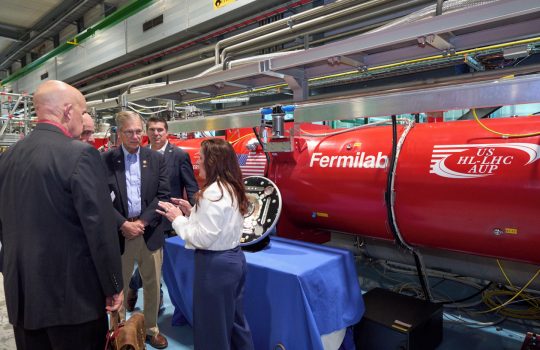
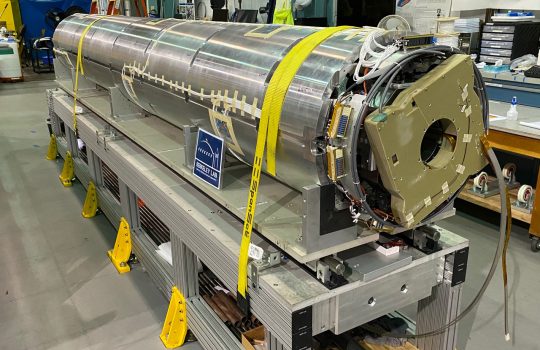
Several components developed, assembled and tested by the HL-LHC Accelerator Upgrade Project, a consortium of U.S. national laboratories and institutions, including Lawrence Berkeley National Laboratory, Brookhaven National Laboratory and Fermi National Accelerator Laboratory, take center stage as engineers at CERN build and test a section of the High-Luminosity Large Hadron Collider, a major upgrade to the world’s most powerful supercollider.
From CERN, March 24, 2021: A memorandum of understanding (MoU) between CERN and Fermilab, signed on 23 March, details Fermilab’s contributions to the High-Luminosity LHC project.
The U.S. Department of Energy has given the U.S. High-Luminosity Large Hadron Collider Accelerator Upgrade Project approval to move full-speed-ahead in building and delivering components for the HL-LHC, specifically, cutting-edge magnets and accelerator cavities that will enable more rapid-fire collisions at the collider. The collider upgrades will allow physicists to study particles such as the Higgs boson in greater detail and reveal rare new physics phenomena. The U.S. collaborators on the project may now move into production mode.