
Fermilab is a highly technical environment to work in. Can you explain the work you do at the lab?
I’m an engineer with the Cryogenics Division, and I help lead a small team that keeps our cryogenic facility running in Industrial Building 1. Our division is split between engineering and operations, and we maintain and operate systems that support testing superconducting magnets and cavities, which are essential for particle accelerators. As a cryogenic engineer, I supervise and participate in cryogenic operations, coordinating with a dedicated team of four full-time operators who work in two shifts to ensure 16-hour daily coverage. I review the operating procedures, prepare any engineering upgrades and update our documentation related to the facility. Our team is dedicated to keeping the system stable, monitoring alarms and maintaining a steady supply of liquid helium (chilled to below minus 450 degrees Fahrenheit) to the system.

Sounds like a very specialized focus! How did your career bring you to Fermilab?
I have been at Fermilab for three years. My background is in cryogenics across various applications — from small cryocooler systems for space-based superconducting magnets to working at CERN on liquid argon detectors. I came to Fermilab to focus on large-scale cryogenic systems, particularly industrial liquid helium systems.
These cryogenic systems seem very complex. What’s the most challenging part of your work?
At IB1, we operate two large cryogenic liquefiers that produce liquid helium 24 hours a day for testing superconducting magnets and cavities. IB1 is unique because we operate both an old, manual liquefier and a newer, automated one. Making these two systems work together is a constant challenge. We consume all the liquid helium we produce, so efficiency and leak prevention are critical. The helium cycle is complex: we compress gaseous helium, liquefy it, store it in dewars, distribute it for tests, and then recover the boiled-off gas to start the cycle again.
What do you find to be the most rewarding aspect of working at Fermilab?
There are very few places in the world like Fermilab. Being surrounded by experts from so many different fields is incredibly enriching. It’s a privilege to work in such a collaborative and technically advanced environment.
Besides working with large cryogenic systems, what else do you enjoy doing?
I love kayaking! Illinois is a great place for it, with access to beautiful rivers and Lake Michigan. It’s a seasonal activity, so I try to squeeze in time to kayak two times a week.
Fermi National Accelerator Laboratory is America’s premier national laboratory for particle physics and accelerator research. Fermi Forward Discovery Group manages Fermilab for the U.S. Department of Energy Office of Science. Visit Fermilab’s website at www.fnal.gov and follow us on social media.
Recommended reading
Fermilab drives progress for national AI Genesis Mission
- AI
- artificial intelligence
- astrophysics
- computing
- emerging technologies
- microelectronics
- particle accelerator
- particle physics
- theory
The Genesis Mission is leveraging the strength of the U.S. Department of Energy’s 17 national laboratories, including Fermilab, alongside American research universities and industry partners. The collaborative effort aims to supercharge innovation by integrating the transformative power of artificial intelligence across the national research landscape.
A chilling new search for dark matter will soon be underway
Fermilab has contributed vital components to the SuperCDMS experiment, located deep underground in a nickel mine outside of Sudbury, Canada.
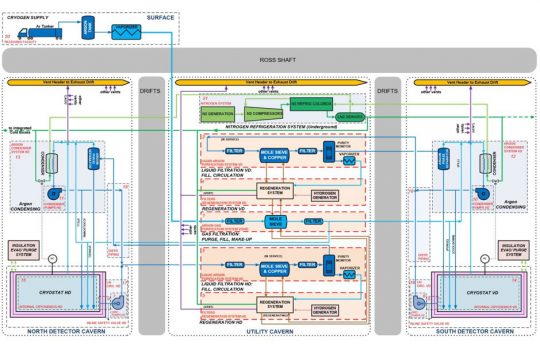
Keeping liquid argon chilled underground is one of DUNE’s coolest challenges
The Deep Underground Neutrino Experiment is building the largest underground cryogenic system ever attempted to support its massive liquid-argon detectors.