
A year after their final muon magnetic anomaly announcement, the Muon g-2 collaboration today announced a new measurement of a different property of the muon: its electric dipole moment. Based on an analysis of 25% of Fermilab’s experimental data, this is the most sensitive direct search for a muon EDM ever accomplished. It is the first direct search for the muon EDM done at the U.S. Department of Energy’s Fermi National Accelerator Laboratory and only the third search globally in the last 50 years.
Searches for EDMs play a vital role in particle physics; detecting an EDM could be key to better understanding the matter-antimatter asymmetry required to explain the universe we see around us. This new result shows that if a muon EDM exists, it must be smaller than what the Muon g-2 experiment can currently detect.
Fermilab has hosted the Muon g-2 experiment and collaboration since 2008. The experiment is made up of a 50-foot-diameter superconducting magnetic storage ring repurposed from an earlier version of the experiment at DOE’s Brookhaven National Laboratory, which concluded in 2001. The Fermilab experiment improves upon the Brookhaven version in numerous ways, enabling more precise measurements.
The Muon g-2 experiment sends a beam of muons — technically their antimatter counterparts, anti-muons or positive muons — into the storage ring, where they circulate hundreds of times at nearly the speed of light before they decay. Detectors lining the ring observe the decay products and allow scientists to determine how fast the muons are precessing, or wobbling, in the presence of a magnetic field. The precession speed is related to a property of the muon called the magnetic dipole moment, represented by the letter g. Theory predicts that g should be slightly larger than 2.
The electric dipole moment is a property that describes the separation of positive and negative charge within a system. The Muon g-2 collaboration can search for it almost for free since it uses the same data as the magnetic dipole moment analyses: while the g-2 measurement utilizes the muon’s horizontal wobble caused by the magnetic field, the muon EDM refers to a vertical component of the wobble caused by what the muon experiences as an electric field.
“If you set it all up and you tune all of the parameters of the experiment to measure the magnetic dipole moment as well as possible, there’s also, coincidentally, some sensitivity to the electric dipole moment,” said Joe Price, a co-lead of the EDM analysis from the University of Liverpool.
An indicator of new physics
The Muon g-2 experiment stores muons traveling at nearly the speed of light. They travel so fast that, due to Einstein’s theory of relativity, their typical lifetimes of 2.2 microseconds are boosted by a factor of nearly 30. This boost also enhances the electric field and, hence, the experiment’s sensitivity to the muon EDM, which allows scientists to look for new physics in a way for which the experiment wasn’t initially intended.
The Standard Model of particle physics predicts that fundamental particles, like muons, have an EDM so tiny that it could not be detected by an experiment. Therefore, measuring a non-zero muon EDM would indicate new physics.
Specifically, a non-zero EDM would violate fundamental symmetries in physics. Evidence of charge-parity violation could explain one of the biggest mysteries in the universe: why the universe is only made of matter and no antimatter is left today.
“The primary measurement of the g-2 experiment is sensitive to new physics unrelated to the matter-antimatter asymmetry,” said Gavin Hesketh, EDM analysis co-lead from University College London. “The electric dipole moment search gives us this sensitivity.”
The trackers: ‘an absolute necessity‘
The EDM analysis is possible thanks to two detectors called “trackers” inside the storage ring.
The trackers comprise 32 layers of aluminum-coated mylar straws that register the passages of charged particles. Like a connect-the-dots picture, the data from the trackers show locations of anti-muons and their decay products — positrons, the antimatter counterparts of electrons — in the ring. The muon EDM search requires knowing the difference between the numbers of positrons going up versus down, for which the trackers are indispensable.
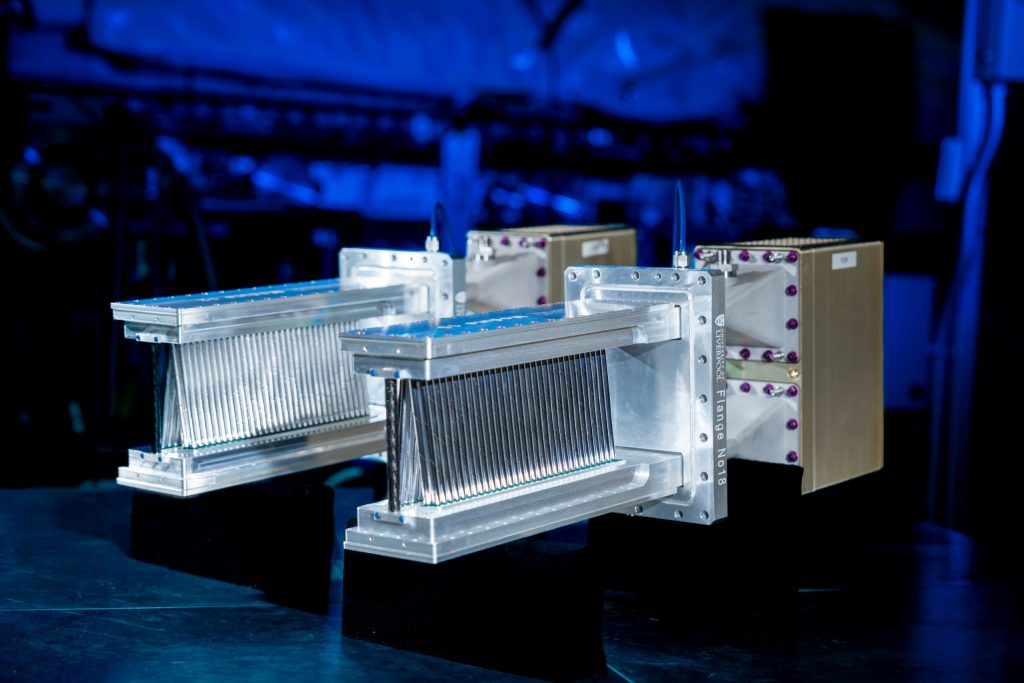
The tracker’s design and prototyping was funded by a DOE Early Career Research Award given to Fermilab scientist Brendan Casey in 2012. A grant from the U.K. Science and Technology Facilities Council funded their construction.
Casey and Fermilab collaborated on the trackers with U.S. and U.K. institutions, including Boston University, Northern Illinois University, the University of Liverpool and University College London. They even received help with prototyping and quality control from students at the Illinois Mathematics and Science Academy, a college prep school in Aurora.
The work on the trackers paid off. As soon as the collaboration turned on the experiment, they realized the beam didn’t meet specifications. The trackers turned out to be essential to locate the exact position of the beam and show how it was affecting the experiment.
“The trackers were essential in mapping the profile of the beam. Without them, we could not have extracted g-2 or the EDM from the data,” said Casey, now a senior scientist at Fermilab. “They really turned out to be an absolute necessity.”
Next steps
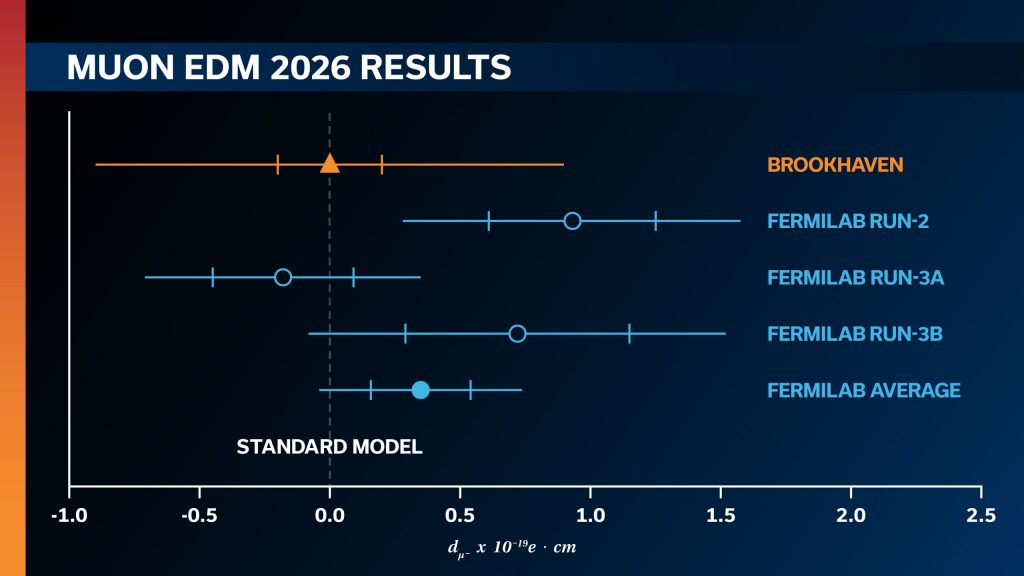
In the last 50 years, there have only been two direct measurements of the muon EDM: first from CERN in 1978, then from the Muon g-2 experiment at Brookhaven in 2009.
This latest result of dm = (-0.35 ± 0.39) ×10-19 e·cm is compatible with an EDM of zero, which means the collaboration could set an upper limit of |dm| < 1.1 × 10⁻¹⁹ e·cm at 95% confidence level, about 1.5 times more stringent than that set by the Brookhaven Muon g-2 experiment.
Physicists can calculate a bound on the muon EDM by scaling up the limit on the electron EDM. Electrons are essentially lighter, stable and more abundant cousins of muons, so there are more precise upper constraints of the electron EDM. But this method does not account for sources of new physics that may affect muons differently than electrons.
This first result from the Fermilab experiment only uses 25% of its data, but this is already vastly more data than Brookhaven collected. Because of this, Fermilab’s muon EDM measurement is the most stringent direct limit on muon EDM to date. It is also a crucial reference for the next generation of experiments now under construction in Japan and Switzerland, which are designed to reach higher precision.
Fermi National Accelerator Laboratory is America’s national laboratory for particle physics and accelerator research. Fermi Forward Discovery Group manages Fermilab for the U.S. Department of Energy Office of Science. Visit Fermilab’s website at www.fnal.gov and follow us on social media.
Recommended reading

URA honors Fermilab researchers advancing laboratory’s top priorities
Tyler Barrett, Charis-Kleio Koraka, Kevin Kelly and Silvia Zorzetti are the recipients of the 2026 URA Honorary Awards. The awards are presented each year by Universities Research Association to recognize significant contributions to research at Fermilab.

Fermilab experiment receives prestigious Breakthrough Prize in Fundamental Physics
The Muon g-2 experiment at Fermilab received the prestigious Breakthrough Prize in fundamental physics for its precision measurement of the muon.

Mu2e reaches major milestone with tracker move
Researchers at Fermilab moved the final subdetector for Mu2e into the experiment hall, marking a major step forward for the collaboration. Once completed, Mu2e will search for a rare muon conversion that may unlock evidence of physics beyond the Standard Model.