Governor general to undertake working visit to the United States of America
From Business Insider, April 24, 2018: In Chicago, Her Excellency visits Fermilab, America’s premier national laboratory for particle physics and accelerator research.
1861 - 1870 of 2266 results
From Business Insider, April 24, 2018: In Chicago, Her Excellency visits Fermilab, America’s premier national laboratory for particle physics and accelerator research.
From Indian Times Daily, April 16, 2018: U.S. Secretary of Energy Rick Perry and India’s Atomic Energy Secretary Sekhar Basu signed an agreement in New Delhi to expand the two countries’ collaboration on world-leading science and technology projects.
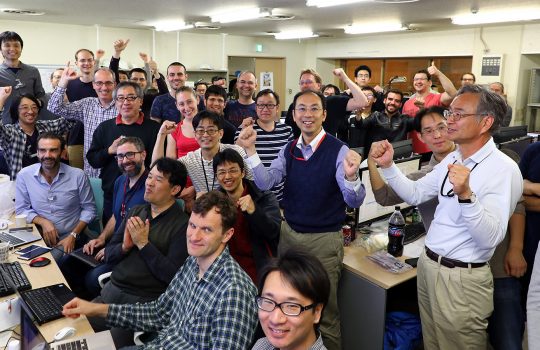
The Japan-based experiment is one step closer to answering mystifying questions about antimatter.
From World Nuclear News, April 17, 2018: Energy Secretary Rick Perry and India’s Atomic Energy Secretary Sekhar Basu signed an agreement in New Delhi that opens the way to jointly advancing cutting-edge neutrino science projects under way in both countries, LBNF/DUNE
From NEI Magazine, April 19, 2018: India and the United States have signed an agreement enabling their scientists to collaborate on the development and construction of different types of neutrino detectors, including for LBNF/DUNE.

Breakthroughs in physics sometimes require an assist from the field of mathematics — and vice versa.
From Argonne National Laboratory, April 19, 2018: Scientists from Argonne National Laboratory and Fermi National Accelerator Laboratory, along with collaborators from over 25 other institutions, are recreating a previous experiment with much higher precision.
From APS Physics, April 2018: Over the last five decades, Fermilab scientists have made some of the most fundamental discoveries in particle physics. But the facility may never have been built had a handful of physicists — chief among them the lab’s first director, Robert R. Wilson — not convinced the U.S. Congress of the project’s value.
From Astronomy Now, April 10, 2018: Researchers at the University of California at Berkeleysuccessfully adapted superconducting quantum interference devices, or SQUIDs, for use in the Axion Dark Matter Experiment at University of Washington. Fermilab is a collaborating institution on ADMX.
From APS’s Physics, April 9, 2018: Thanks to unprecedented detection sensitivity, ADMX, of which Fermilab is a collaborating member, has been able to probe, for the first time, the parameter space favored by both of the two most popular axion dark matter models.